In this page, we discuss a new object of study that appears in 3 dimensions, the plane. We can observe how these objects interact by looking at any room in our house. Think of a plane as one of the walls, the floor, or ceiling, extended infinitely.
We being by discussing a new operation between vectors called the cross product or vector product.
Cross/Vector Product
Definition (Cross Product in  ): The cross product, or vector product, maps two three-dimensional vectors to a new vector that points completely perpendicular to the plane containing the original two inputs.
![\[\vec{u} \times \vec{v} = \begin{pmatrix} u_y v_z - u_z v_y \\ u_z v_x - u_x v_z \\ u_x v_y - u_y v_x \end{pmatrix}\]](https://mathematics.lu/wp-content/ql-cache/quicklatex.com-1d39a4b83fc19bfb23a229952e100146_l3.png "Rendered by QuickLaTeX.com")
Example: Given the vectors  and
and  in , calculate their cross product
  .
.
 and
and  . Apply the component-wise cross product formula directly:
![\[\vec{u} \times \vec{v} = \begin{pmatrix} (3 \cdot 4) - (-2 \cdot -1) \\ (-2 \cdot 2) - (1 \cdot 4) \\ (1 \cdot -1) - (3 \cdot 2) \end{pmatrix}\]](https://mathematics.lu/wp-content/ql-cache/quicklatex.com-b49a4be737d2af379ec63dcd3d6e3ce1_l3.png "Rendered by QuickLaTeX.com")
![\[\vec{u} \times \vec{v} = \begin{pmatrix} 12 - 2 \\ -4 - 4 \\ -1 - 6 \end{pmatrix} = \begin{pmatrix} 10 \\ -8 \\ -7 \end{pmatrix}\]](https://mathematics.lu/wp-content/ql-cache/quicklatex.com-ad10006ce530c391a50a5ca9d46505bd_l3.png "Rendered by QuickLaTeX.com")
The vector product of  and
and  gives a new vector
  that is perpendicular to both and . This will be especially useful to define our next concept.
We will see towards the end that the cross product can also be used to determine the area of a triangle created by two vectors. Given two vectors and , the area of the rectangle created by them is:
![\[Area=\|\vec{v}\times\vec{u}\|\]](https://mathematics.lu/wp-content/ql-cache/quicklatex.com-271c1db42edec2741eb294eebead6cff_l3.png "Rendered by QuickLaTeX.com")
Similarly, the triangle created using the two vectors is simply half of the magnitude of the cross product.
Claim (Properties of the Vector Product): Let , , and be vectors in , and let  be a scalar constant.
![\[\vec{u} \times \vec{v} = -(\vec{v} \times \vec{u}) \quad \text{and} \quad \vec{u} \times \vec{v} = \vec{0} \iff \vec{u} \parallel \vec{v}\]](https://mathematics.lu/wp-content/ql-cache/quicklatex.com-84ba449da1ce44763a4f0490589a8c38_l3.png "Rendered by QuickLaTeX.com")
![\[\vec{u} \times \vec{v} = -(\vec{v} \times \vec{u})\]](https://mathematics.lu/wp-content/ql-cache/quicklatex.com-3345e708d6b55de69cc59f44f0c6adac_l3.png "Rendered by QuickLaTeX.com")
![\[\vec{u} \times (\vec{v} + \vec{w}) = (\vec{u} \times \vec{v}) + (\vec{u} \times \vec{w})\]](https://mathematics.lu/wp-content/ql-cache/quicklatex.com-2b4926949f9d9bdcb1a125fe8a02fc46_l3.png "Rendered by QuickLaTeX.com")
![\[(k\vec{u}) \times \vec{v} = \vec{u} \times (k\vec{v}) = k(\vec{u} \times \vec{v})\]](https://mathematics.lu/wp-content/ql-cache/quicklatex.com-7c0a99c117c65029c3429ca0e87a8c68_l3.png "Rendered by QuickLaTeX.com")
![\[\vec{u} \times \vec{u} = \vec{0} \quad \text{and} \quad \vec{u} \parallel \vec{v} \implies \vec{u} \times \vec{v} = \vec{0}\]](https://mathematics.lu/wp-content/ql-cache/quicklatex.com-73f91b6138f30733ea6b5d690a920469_l3.png "Rendered by QuickLaTeX.com")
![\[(\vec{u} \times \vec{v}) \cdot \vec{u} = 0 \quad \text{and} \quad (\vec{u} \times \vec{v}) \cdot \vec{v} = 0\]](https://mathematics.lu/wp-content/ql-cache/quicklatex.com-9687f254d4efe034239bda16574e8599_l3.png "Rendered by QuickLaTeX.com")
A New Object – The Plane
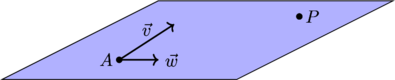
Much like a line is created with 2 points, a plane is created with 3 points that are not collinear. Another way to think of the plane is as two different directions (i.e.: not parallel) and a point. This should coincide with our idea of the walls/floor/ceiling in a room as planes. Hopefully, the ceiling and floor of the room you are in are “parallel” (i.e.: their two directions are the same). What sets them apart? How do we know they do not coincide, we have a point as a reference.
Definition (Plane Equations in ): A plane in three-dimensional space can be uniquely defined either by a fixed anchor point  and two non-parallel direction vectors
  and
and  , or by its perpendicular orientation alignment vector.
Vector Equation:
![\[\pi:\begin{pmatrix} x \\ y \\ z \end{pmatrix} = \begin{pmatrix} x_0 \\ y_0 \\ z_0 \end{pmatrix} + t\vec{v}_1 + s\vec{v}_2 \quad (t, s \in \mathbb{R})\]](https://mathematics.lu/wp-content/ql-cache/quicklatex.com-06c7c35a92d79d1918efbe37672c252d_l3.png "Rendered by QuickLaTeX.com")
Cartesian Equation:
![\[\pi:ax + by + cz + d = 0\]](https://mathematics.lu/wp-content/ql-cache/quicklatex.com-b1e63e718c7f316bf20e36ca033b3a9b_l3.png "Rendered by QuickLaTeX.com")
We can visualise planes in either of two forms. The Cartesian equation of the plane is mostly used because it gives us a special vector associated to the plane called the normal  .
.
Vector Equation (defined by the point and two direction vectors).
Cartesian equation (where the normal vector takes a more central role).
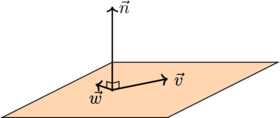
To find the equation of the plane, we need to either be given a point of the plane and the normal vector, or a point of the plane and two directions of the plane. If we are given the first, the normal vector gives us the  and
and  parameters of the equation, we can find
  by replacing the point. If two directions are given, we can simply use the vector equation of the plane. However, it is much more helpful to use the Cartesian equation of the plane. In that case, we simply use
  .
.
Example: Find the vector and Cartesian equations of the plane passing through the point  with direction vectors
  and
and  .
.
![\[\pi:\begin{pmatrix}x\\y\\z\end{pmatrix} = \begin{pmatrix} 1 \\ -2 \\ 3 \end{pmatrix} + t\begin{pmatrix} 2 \\ 1 \\ -1 \end{pmatrix} + s\begin{pmatrix} 1 \\ -3 \\ 2 \end{pmatrix}\]](https://mathematics.lu/wp-content/ql-cache/quicklatex.com-a3c56bc193fa4c99e5d1fbdfd974b1cf_l3.png "Rendered by QuickLaTeX.com")
 :
:![\[\vec{n} = \vec{v}_1 \times \vec{v}_2 = \begin{pmatrix} 1\cdot2-(-3)\cdot(-1) \\ 1\cdot(-1)-2\cdot2 \\ 2\cdot(-3)-1\cdot1 \end{pmatrix}=\begin{pmatrix} -1 \\ -5 \\ -7 \end{pmatrix}\]](https://mathematics.lu/wp-content/ql-cache/quicklatex.com-4ebd49d9261a5d1c56f0f089f450230e_l3.png "Rendered by QuickLaTeX.com")
![\[-x-5y-7z+d=0\implies-1-5\cdot(-2)-7\cdot3+d=0\]](https://mathematics.lu/wp-content/ql-cache/quicklatex.com-05661825a619b4c3ec56583daf4d66d9_l3.png "Rendered by QuickLaTeX.com")
![\[\implies d=12\implies\pi:-x-5y-7z+12=0\]](https://mathematics.lu/wp-content/ql-cache/quicklatex.com-44cf54a362b1e669ac835824bc95ee6b_l3.png "Rendered by QuickLaTeX.com")
Example: Determine the Cartesian equation of the plane that passes through the point  and is oriented perpendicular to the normal vector
  .
.
 ,
,  , and
, and ![\[3x - 2y + 5z + d = 0\]](https://mathematics.lu/wp-content/ql-cache/quicklatex.com-2af525799bca299b4b532b4157bee6ae_l3.png "Rendered by QuickLaTeX.com")
 into the expression to isolate the unknown constant offset component
 ![\[3(4) - 2(1) + 5(-2) + d = 0\]](https://mathematics.lu/wp-content/ql-cache/quicklatex.com-a7ed41c5b0c4fec402a78c66f8f1f717_l3.png "Rendered by QuickLaTeX.com")
![\[12 - 2 - 10 + d = 0 \implies 0 + d = 0 \implies d = 0\]](https://mathematics.lu/wp-content/ql-cache/quicklatex.com-ed0d4a8c37db419c1dee4481cb9fda45_l3.png "Rendered by QuickLaTeX.com")
![\[3x - 2y + 5z = 0\]](https://mathematics.lu/wp-content/ql-cache/quicklatex.com-60c007aa83151c94ad91b8986c8de496_l3.png "Rendered by QuickLaTeX.com")
Like we said before, three points that are not collinear define a plane. We can see this in the next example.
Example: Find the Cartesian equation of the plane passing through the three given points  ,
,  , and
, and  .
.
 and
and  by subtracting the coordinate parameters of anchor point
  from points
  and
and  :
:![\[\vec{v}_1 = \vec{AB} = \begin{pmatrix} 3 - 1 \\ -1 - 3 \\ 6 - 2 \end{pmatrix} = \begin{pmatrix} 2 \\ -4 \\ 4 \end{pmatrix}\]](https://mathematics.lu/wp-content/ql-cache/quicklatex.com-b708fe3cfa4ff067be05165e7a327174_l3.png "Rendered by QuickLaTeX.com")
![\[\vec{v}_2 = \vec{AC} = \begin{pmatrix} 5 - 1 \\ 2 - 3 \\ 0 - 2 \end{pmatrix} = \begin{pmatrix} 4 \\ -1 \\ -2 \end{pmatrix}\]](https://mathematics.lu/wp-content/ql-cache/quicklatex.com-02905336e2e55ab68f564f8e9be75d53_l3.png "Rendered by QuickLaTeX.com")
 and
and  . Compute the perpendicular normal vector
 ![\[\vec{n} = \vec{v}_1 \times \vec{v}_2 = \begin{pmatrix} u_y v_z - u_z v_y \\ u_z v_x - u_x v_z \\ u_x v_y - u_y v_x \end{pmatrix}\]](https://mathematics.lu/wp-content/ql-cache/quicklatex.com-61f7539d46345008d1a6d90c731bdd4f_l3.png "Rendered by QuickLaTeX.com")
![\[\vec{n} = \begin{pmatrix} (-4 \cdot -2) - (4 \cdot -1) \\ (4 \cdot 4) - (2 \cdot -2) \\ (2 \cdot -1) - (-4 \cdot 4) \end{pmatrix} = \begin{pmatrix} 8 - (-4) \\ 16 - (-4) \\ -2 - (-16) \end{pmatrix} = \begin{pmatrix} 12 \\ 20 \\ 14 \end{pmatrix}\]](https://mathematics.lu/wp-content/ql-cache/quicklatex.com-1049d80b7e69495a56c0eba988b892ec_l3.png "Rendered by QuickLaTeX.com")
![\[12(x - 1) + 20(y - 3) + 14(z - 2) = 0\]](https://mathematics.lu/wp-content/ql-cache/quicklatex.com-ac59f5fb1f0561125d97e4fcf146f3c8_l3.png "Rendered by QuickLaTeX.com")
![\[12x - 12 + 20y - 60 + 14z - 28 = 0\]](https://mathematics.lu/wp-content/ql-cache/quicklatex.com-8675fc9c27223bb622de7109ef881d6a_l3.png "Rendered by QuickLaTeX.com")
![\[12x + 20y + 14z - 100 = 0\]](https://mathematics.lu/wp-content/ql-cache/quicklatex.com-652fd7f5cac64da9623aac729fa8ddf3_l3.png "Rendered by QuickLaTeX.com")
 to reduce it to its simplest geometric form:
![\[6x + 10y + 7z - 50 = 0\]](https://mathematics.lu/wp-content/ql-cache/quicklatex.com-273fe48dcc556c1d7b5c8cef923787f6_l3.png "Rendered by QuickLaTeX.com")
Special Planes
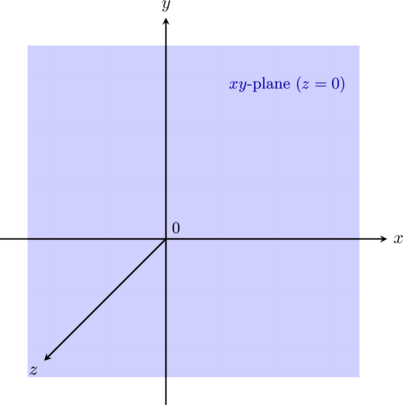
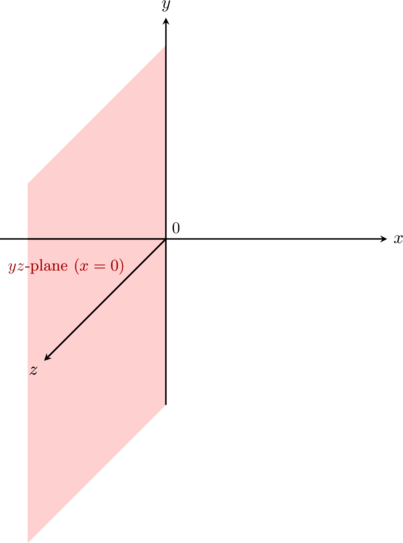
Some planes have special equations, specifically we have three particularly important planes to see:
The  -plane with equation
  .
.
The  -plane with equation
  .
.
The  -plane with equation
  .
.
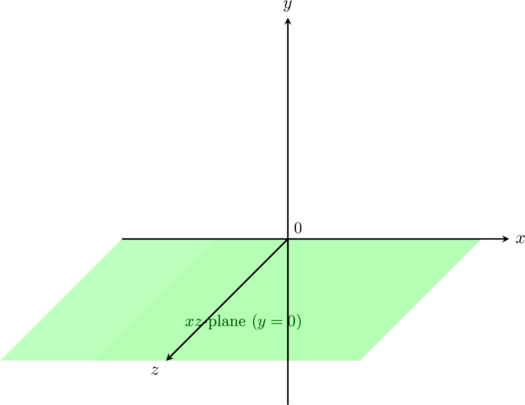
Relative Position of Planes
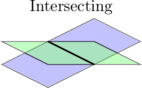
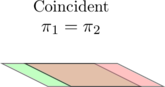
This section should remind you a lot of lines in 2 dimensions. Two planes can either be parallel or they intersect. They could also be the same plane written differently. In summary we have the following scenarios:
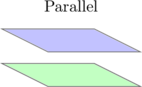
Definition (Parallel Planes): Two distinct planes in three-dimensional space are defined as parallel if their corresponding normal vectors point along identical or opposite paths, meaning one normal vector is a scalar multiple of the other.
![\[\pi_1 \parallel \pi_2 \iff \vec{n}_1 = k\vec{n}_2 \quad (k \neq 0)\]](https://mathematics.lu/wp-content/ql-cache/quicklatex.com-b478dad41a9596872e895114cac52327_l3.png "Rendered by QuickLaTeX.com")
Example: Determine whether the two planes  and
and  are parallel planes:
![\[\pi_1: 2x - 4y + 6z - 5 = 0 \quad \text{and} \quad \pi_2: -x + 2y - 3z + 8 = 0\]](https://mathematics.lu/wp-content/ql-cache/quicklatex.com-869ff33c043a3f68d5ed8501d4111eb5_l3.png "Rendered by QuickLaTeX.com")
 and
and  directly from the coefficients of the lowercase Cartesian equations:
![\[\vec{n}_1 = \begin{pmatrix} 2 \\ -4 \\ 6 \end{pmatrix}, \quad \vec{n}_2 = \begin{pmatrix} -1 \\ 2 \\ -3 \end{pmatrix}\]](https://mathematics.lu/wp-content/ql-cache/quicklatex.com-15852ea490e6e460966c7b4a21cf223d_l3.png "Rendered by QuickLaTeX.com")
 relating the corresponding coordinates of the two normal vectors:
![\[\vec{n}_1 = -2\vec{n}_2 \implies \begin{pmatrix} 2 \\ -4 \\ 6 \end{pmatrix} = -2\begin{pmatrix} -1 \\ 2 \\ -3 \end{pmatrix}\]](https://mathematics.lu/wp-content/ql-cache/quicklatex.com-c9f0bfa0b5ea9f5758ba0fd973d8cb24_l3.png "Rendered by QuickLaTeX.com")
 , but for the constant terms, the ratio is
  . Therefore, the planes are strictly parallel and never touch.
We can easily understand why the intersection of two planes should be a line, except for the obvious cases where they are parallel or coincident. To find the equation of that line, we create a system of equations, using each equation of the plane. This will give us two equations with 3 variables. There must be infinite solutions to these (again, except for the obvious cases). To find said line, replace one coordinate with a parameter  . Then, you can find the other two coordinates as a function of this and conclude the equation of the line accordingly.
Example: Find the line of intersection  between the two planes and given by their Cartesian equations:
![\[\pi_1: x - y + 2z - 1 = 0 \quad \text{and} \quad \pi_2: 2x + y - z - 5 = 0\]](https://mathematics.lu/wp-content/ql-cache/quicklatex.com-95ab9f7bcf92f4e1a1538504c77c7292_l3.png "Rendered by QuickLaTeX.com")
![\[\begin{cases} x - y + 2z = 1 \quad \text{(Eq. 1)} \\ 2x + y - z = 5 \quad \text{(Eq. 2)} \end{cases}\]](https://mathematics.lu/wp-content/ql-cache/quicklatex.com-8dd6618eb285f29e00285ec4a959cda8_l3.png "Rendered by QuickLaTeX.com")
 with the real parameter
 ![\[z = t\]](https://mathematics.lu/wp-content/ql-cache/quicklatex.com-269de7c3c4bffd2fe99935b02680826f_l3.png "Rendered by QuickLaTeX.com")
 back into the original system and isolate the constant terms to rewrite the equations in terms of
  and
and  :
:![\[\begin{cases} x - y = 1 - 2t \quad \text{(Eq. 3)} \\ 2x + y = 5 + t \quad \text{(Eq. 4)} \end{cases}\]](https://mathematics.lu/wp-content/ql-cache/quicklatex.com-e3d86f4214549caca1eb170ea9c7bb51_l3.png "Rendered by QuickLaTeX.com")
![\[(x - y) + (2x + y) = (1 - 2t) + (5 + t)\]](https://mathematics.lu/wp-content/ql-cache/quicklatex.com-900f841c1e8fcf7763615f3cc7ccbdae_l3.png "Rendered by QuickLaTeX.com")
![\[3x = 6 - t \implies x = 2 - \frac{1}{3}t\]](https://mathematics.lu/wp-content/ql-cache/quicklatex.com-77014eddcff8fb33e8003b826818dc68_l3.png "Rendered by QuickLaTeX.com")
![\[\left(2 - \frac{1}{3}t\right) - y = 1 - 2t\]](https://mathematics.lu/wp-content/ql-cache/quicklatex.com-20eef384de37ab8698579f60235df59e_l3.png "Rendered by QuickLaTeX.com")
![\[-y = 1 - 2t - 2 + \frac{1}{3}t\]](https://mathematics.lu/wp-content/ql-cache/quicklatex.com-99d4753f1771d6b0b50bcf84415cdf1e_l3.png "Rendered by QuickLaTeX.com")
![\[-y = -1 - \frac{5}{3}t \implies y = 1 + \frac{5}{3}t\]](https://mathematics.lu/wp-content/ql-cache/quicklatex.com-af50d9b38f2f2116c47271cc955905a2_l3.png "Rendered by QuickLaTeX.com")
![\[\ell: \begin{pmatrix} x \\ y \\ z \end{pmatrix} = \begin{pmatrix} 2 \\ 1 \\ 0 \end{pmatrix} + t\begin{pmatrix} -\frac{1}{3} \\ \frac{5}{3} \\ 1 \end{pmatrix}\]](https://mathematics.lu/wp-content/ql-cache/quicklatex.com-aa79347ac4f35f5c80d8a4ba6d874c80_l3.png "Rendered by QuickLaTeX.com")
 to obtain whole numbers:
![\[\vec{v}_{\text{new}} = 3 \cdot \begin{pmatrix} -\frac{1}{3} \\ \frac{5}{3} \\ 1 \end{pmatrix} = \begin{pmatrix} -1 \\ 5 \\ 3 \end{pmatrix}\]](https://mathematics.lu/wp-content/ql-cache/quicklatex.com-5b156ef68d8327b48de94068acd74742_l3.png "Rendered by QuickLaTeX.com")
![\[\ell: \begin{cases} x = 2 - t \\ y = 1 + 5t \\ z = 3t \end{cases}\]](https://mathematics.lu/wp-content/ql-cache/quicklatex.com-141c0e2dec2eef514a94108e818b968a_l3.png "Rendered by QuickLaTeX.com")
Exercises
For each pair of vectors below, compute their cross product using the component-wise spatial formula.
- 1.
 and
and 
- 2.
 and
and 
- 3.
 and
and 
Construct two direction vectors within the plane from the given coordinates, calculate the normal vector using the cross product, and determine the Cartesian plane equation in the standard form  .
.
- 1.
 ,
,  , and
, and 
- 2.
 ,
,  , and
, and 
- 3.
 ,
,  , and
, and 
For each configuration, state the vector equation of the plane. Then, use the vector product to extract the coordinates of the normal vector and convert the layout into Cartesian form .
- 1. Point
 with direction vectors
  and
and 
- 2. Point
 with direction vectors
  and
and 
- 3. Point
 with direction vectors
  and
and 
Find the standard Cartesian equation for each plane given its anchor coordinate point and orthogonal vector parameters.
- 1. Point
 and normal vector
- 2. Point
 and normal vector
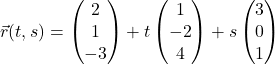
For each given vector equation of a plane, identify the two direction vectors, calculate the normal vector using the cross product, and determine the equivalent Cartesian equation in the form .
- 1.
- 2.
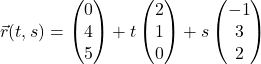
- 3.
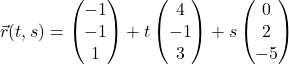
For each Cartesian equation, determine three distinct points that satisfy the equation. Use one point as an anchor and find two non-parallel direction vectors to write the plane’s vector equation  .
.
- 1.

- 2.

- 3.

For each pair of planes below, set up a system of linear equations using their Cartesian equations. Solve the system by replacing one variable with a parameter to determine the parametric equations of the resulting line of intersection .
- 1.

- 2.

- 3.
