In this page, we continue our examples of calculating basic probabilities except we also integrate some useful formulas for different types of exercises. The three formulas to understand are:


We will see how to use each of these in its own setting. The reason for these formulas is that we rely less on the context of the story to find probabilities, since this is not always given.
Complement
This one has been used since S4. The probability of an event happening or not happening must add up to 1. In other words, the probability of an event not happening equals 1 minus the probability of an event happening.
The idea being, sometimes it is easier to understand the probability by looking at the complement.
Example: A fair coin is tossed  times in succession. Find the probability of getting Heads at least once during the experiment.
 possible outcomes in the sample space
 and summing up every combination that contains one, two, three, or four Heads, we can solve this problem efficiently by looking at the opposite scenario using the complement rule.


 . We find the joint probability of four consecutive Tails by multiplying the individual probabilities together:

 . Subtracting the probability of getting all Tails from


 (or a
 chance) of getting Heads at least once across four fair coin tosses.
Union/Intersection
This formula is easier to remember by visualising it:
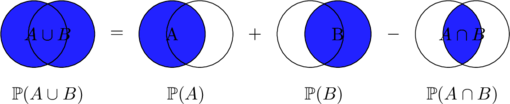
That is, when we take everything in either A or B, we are counting the elements that in A and in B twice, therefore, we subtract this probability once. Let us see an example:
Example: A standard deck of  playing cards is thoroughly shuffled. A single card is drawn at random from the deck. Find the probability that the card drawn is a Heart or a Queen.

 .
 Hearts in a deck:


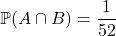

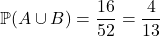
 (which is approximately
 or a
 chance).
The next example will take the context out of the story, so we have no choice but to use the formula.
Example: In a class of university students, the probability that a randomly selected student owns a laptop is  , and the probability that they own a tablet is
 . The probability that they own a laptop, a tablet, or both devices is
 . Find the probability that a randomly chosen student owns both a laptop and a tablet.






 (or a
 chance).
Unlike a coin toss or die roll, we cannot understand probabilities from the story by looking at outcomes.
Conditional Probability
We have used this formula intuitively. The formula states: 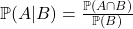 . The symbol
 denotes the probability of A given/assuming B.
In the same way as we used this in Venn diagrams, we calculate conditional probability by saying “out of B”, how many “are also in A”? The formula is the same but with probabilities.
Example: Two standard, fair six-sided dice are rolled simultaneously. Let event  be the event that the sum of the two dice is strictly greater than
 . Let event
 be the event that the first die shows an even number. Calculate the conditional probability
 .

 ). The second die can be any number from
 total elements in our restricted universe:




 )
 ,
 ,
 , or
 ):
 )
 [sum=9],
 [sum=10]
 [sum=9],
 [sum=10],
 [sum=11],
 [sum=12]

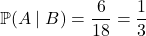
 (or approximately
 ) probability that the sum of both dice will be greater than
Exercises
Two standard, fair six-sided dice are rolled simultaneously. Find the probability of each event, using the complement rule where appropriate:
- The sum of the two numbers showing face up is exactly
 .
- The sum of the two numbers showing face up is strictly greater than
 .
A high-precision assembly line produces microchips. The probability of any individual microchip being defective is  . A quality control engineer randomly selects microchips to inspect from a large batch. Find the probability that:
- All three selected microchips are completely free of defects.
- At least one of the selected microchips is defective.
A standard deck of playing cards is thoroughly shuffled, and a single card is drawn at random. Let event be drawing a Spade ( ) and event be drawing a Face card (Jack, Queen, or King). Find the following probabilities, making explicit use of the addition formula:
- The probability of drawing a card that is both a Spade and a Face card (
 ).
- The probability of drawing a card that is a Spade or a Face card (
 ).
At a local sports club, the probability that a randomly chosen member plays tennis is  , and the probability that they play badminton is
 . The probability that a member plays tennis, badminton, or both sports is
 . Find the probability that a randomly selected member plays both tennis and badminton.
Two fair, six-sided dice are rolled simultaneously. Let event be the event that the sum of the numbers showing face up is exactly . Let event be the event that the two dice show different numbers (no doubles). Calculate the conditional probability .
Two fair, six-sided dice are rolled simultaneously. Let event be the event that the product of the two numbers showing face up is an even number. Let event be the event that the second die shows a prime number ( , , or
 ). Calculate the conditional probability .
At a secondary school, a student is selected at random. Let event be the event that the student belongs to the Music Club, and event be the event that the student belongs to the Art Club. You are given the following probabilities:
- Probability a student is in the Music Club:

- Probability a student is in the Art Club:

- Probability a student is in the Music Club, Art Club, or both:

Calculate the following probabilities, making explicit use of your core probability formulas:
- The probability that the student does not belong to the Music Club (
 ).
- The probability that the student belongs to both the Music Club and the Art Club ().
- The probability that the student belongs to the Music Club, assuming they are already a member of the Art Club ().
A tech corporation audits its employee professional credentials. An employee is selected at random. Let event be the event that the employee holds a Cloud Computing certification, and event be the event that they hold a Cyber Security certification. The following data is recorded:
- Probability of a Cloud certification:

- Probability of a Cyber Security certification:

- Probability they hold both certifications simultaneously:

Determine the following performance metrics:
- The probability that the selected employee does not hold a Cyber Security certification (
 ).
- The probability that the employee holds a Cloud certification, a Cyber Security certification, or both ().
- The probability that the employee holds a Cyber Security certification, assuming that they already hold a Cloud Computing certification (
 ).