In this page, we discuss the idea of independence in probability, how to show that events are independent, and how to use the fact that they are independent to calculate probabilities.
Let us look at tree diagrams more closely, now that we understand what conditional probability is. Say there are two instances in an experiment. For the first instance, we can have either A, B, or C. For the second, either D happed or it does not. The probability we would write in each branch of the second instance will depend on the event that took place in the first instance.
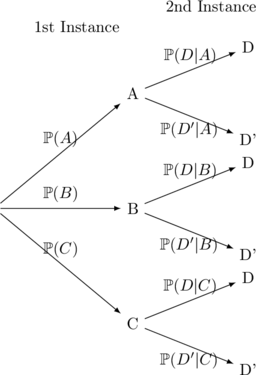
This is an important distinction, not to be confused with  .
Definition
The basic/intuitive definition is the following: two events  and
 are independent if one happening does not affecting the likelihood the another one happening.
Definition (Independent Events): Two events and are said to be independent if the occurrence of one event has absolutely no effect on the probability of the occurrence of the other event. Mathematically, this relationship is confirmed if and only if any of the following three equivalent formulas hold true:
1. The Multiplication Rule (Intersection):

2. Conditional Probability of given :

3. Conditional Probability of given :

Conceptual Context: The conditional formulas explicitly show that knowing event happened does not change the likelihood of event (and vice versa). If any one of these three equations is true, the other two are automatically true, proving the events are independent.
If we flip a coin and it landed on heads, the likelihood of flipping it again and it landing on heads again is still the same. This is because knowing what happened to the coin before is irrelevant. Just one of many examples of independence.
Claim (Equivalence of Independence Conditions): For any two events and with  and
 , the following three conditions are logically equivalent. If any single statement is true, the other two are automatically true, proving that the events are independent:



 . Recall the formal definition of conditional probability:
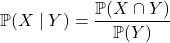
 :

 is verified.

 :

 is verified.
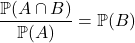
 to isolate the intersection:
 is verified.
That is, when we are asked to show that two events are independent, we can use either of the three formulas above to show it.
Proving Independence
In this section, we show how to use the definition/formulas above to show that two events are independent.
Example: A standard, fair six-sided die is rolled twice in succession. Let event be the event that the first die lands on a  . Let event be the event that the sum of the results of both rolls is exactly
 . Prove that events and are independent.
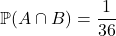
 for rolling a six-sided die twice consists of
 equally likely corporate outcomes, meaning
 .
 and
 :


 and
 :


 means the first die is a


Let us see another example, one that is more visual.
Example: The likelihood of rain on a given day and whether a teacher is late to school (given that it rained, or it did not) can be modelled below. Are the events “Rain” ( ) and “Late” (
 ) independent?
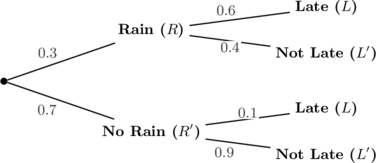
 ). An easier equivalent check is to see if knowing whether it rained changes the conditional probability of being late:



 , the probability of being late is significantly dependent on weather conditions. Knowing whether it rained or not directly changes the likelihood of arrival punctuality. Therefore, the events “Rain” and “Late” are not independent (they are dependent events).
Our final example will use the formulas we practised in the previous page:
Example: Assume that  ,
 , and
 . Are and independent?




 . If they are equal, then the events are independent:

 and
 , we can see that:

Using Independence
Repeated experiments like coin tosses and die rolls are independent. Knowing this, finding probabilities can be rather easy by focusing on each event separately.
Example: Three standard, fair six-sided dice are rolled simultaneously. Because the outcome of each die does not affect the others, the rolls are independent events. Find the probability of each of the following events:
- All three dice land on a
 .
- None of the dice land on a .
- At least one die lands on a .
 . Instead of counting outcomes manually, we can multiply individual roll probabilities directly.
 . Using the multiplication rule for independent events:

 . Since the rolls are independent, we multiply the probabilities of getting a non-

 “. Therefore, we can use the complement rule to subtract the result from part (2) from


 (or approximately
 ) probability of rolling at least one
Instead of looking at all 216 outcomes, it is much easier to focus on each roll separetely. The same could be done with other events like “first outcome is prime”, “the second outcome is more than 4”, and “the third outcome is less than 6”, to name a few events.
Example: A biased coin has a probability of landing on Heads of  . Find the minimum number of times this coin must be tossed so that the probability of getting Heads at least once is at least
 .
 be the number of independent coin tosses. We want to find the smallest integer

 ).





 and flip the inequality sign:

 ) or base-10 logarithm (
 ) of both sides to isolate


 , the value of
 is a negative number (approximately
 ). Dividing both sides by a negative number flips the inequality sign back:


 .
Of course, we could have also taken a logarithm with any other base.
Exercises
A fair, six-sided die is rolled twice. Let event be the event that the first die shows a  . Let event be the event that both dice land on the exact same number (doubles). Prove numerically whether events and are independent or dependent.
A fair, six-sided die is rolled twice. Let event be the event that the second die lands on a  . Let event be the event that the sum of the outcomes is exactly . Evaluate the appropriate multiplication formula to determine if events and are independent or dependent.
A card is drawn at random from a standard, well-shuffled deck of  playing cards. Let event be drawing a red card (Hearts or Diamonds). Let event be drawing a King. Prove numerically, using the multiplication rule for intersections, whether events and are mathematically independent or dependent.
A local coffee shop tracks whether customers buy a pastry depending on the type of drink they order. The tree diagram below models whether a customer orders a hot drink ( ) or an iced drink (
 ), and whether they purchase a pastry (
 ) or not (
 ):
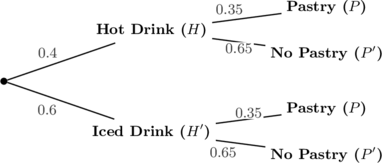
Are the events “Hot Drink” () and “Pastry” () independent? Justify your answer by comparing the relevant conditional probabilities from the tree diagram.
Assume that  ,
 , and
 . Determine whether the events and are independent or dependent. Justify your answer algebraically using your core probability formulas.
A fair coin is tossed five times in succession. Utilizing the multiplication and complement properties of independent outcomes, calculate the probability of each event:
- All five tosses result in Heads.
- All five tosses result in Tails.
- At least one toss results in Heads.
Three standard, fair six-sided dice are rolled simultaneously. Assuming the outcomes are independent, find the probability of each of the following events:
- All three dice land on an even number (
 , , or ).
- None of the dice land on an even number.
- At least one die lands on an even number.
A biased coin is constructed such that its probability of landing on Heads is  . Find the minimum number of independent times this coin must be tossed so that the probability of obtaining Heads at least once is strictly greater than or equal to
 .