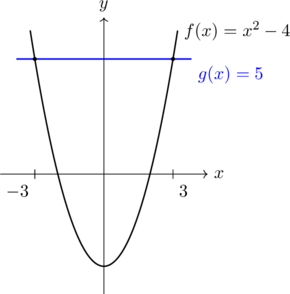
We know from using the Newton-Leibniz theorem that the area under the curve of a function  with primitive
  taken from
  to
to  is given by:
![\[\int_a^bf(x)dx=F(b)-F(a)\]](https://mathematics.lu/wp-content/ql-cache/quicklatex.com-300133fef82513d50118f489b9f9b379_l3.png "Rendered by QuickLaTeX.com")
The reality is that we need to adapt this depending on the function. This formula represents the net area between the curve of a function
and the  -axis.
Motivation
Say we want to find the total area enclosed between the graph of  and the -axis from
  to
to  .
.
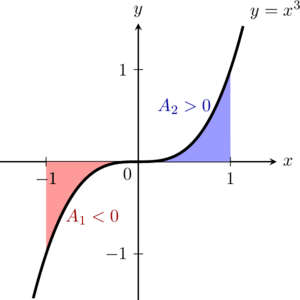
If we blindly compute the definite integral across the entire interval using the Newton-Leibniz formula, we get:
![\[\int_{-1}^{1} x^3 \, dx = \frac{x^4}{4} \Bigg|_{-1}^{1} = \frac{1}{4} - \frac{(-1)^4}{4} = 0\]](https://mathematics.lu/wp-content/ql-cache/quicklatex.com-b34d843873086ad6e48817ad19d4f50a_l3.png "Rendered by QuickLaTeX.com")
However, the total physical area cannot be zero because we see two regions and area is always non-negative.
How do we fix this? The problem comes from our function changing sign within the given interval. Therefore, if we put our function in absolute value, that will fix our problem. However, this is only helpful when we have a calculator to find the integral. We should still learn how to do this without relying on a calculator.
Total Area
To fix our opening problem, we follow the steps below:
- Separate the integral into appropriate intervals: Identify where the function changes signs by finding its roots (-intercepts).
- Set up the area formula with a minus sign for negative regions: To prevent cancellation, we place a minus sign in front of every integral for which the function is below the -axis in that interval of integration.
- Evaluate each integral separately via Newton-Leibniz.
- Add the results.
Example: Find the total area enclosed between the graph of and the -axis from to .
The definite integral tracks signed area. On the interval ![[-1, 0]](https://mathematics.lu/wp-content/ql-cache/quicklatex.com-084e50e9dcc4282931315aa2a6337d2e_l3.png "Rendered by QuickLaTeX.com") , the function dips below the -axis, yielding a negative integral value (
, the function dips below the -axis, yielding a negative integral value ( ). On
). On ![[0, 1]](https://mathematics.lu/wp-content/ql-cache/quicklatex.com-dffd9df7963df3c64a98c28cb5e7e715_l3.png "Rendered by QuickLaTeX.com") , the function stays above the axis, yielding an equal positive value (
, the function stays above the axis, yielding an equal positive value ( ). When integrated as a single piece, these regions cancel each other out (
 ).
).
 at
at ![\[\text{Total Area} = -\int_{-1}^{0} x^3 \, dx + \int_{0}^{1} x^3 \, dx\]](https://mathematics.lu/wp-content/ql-cache/quicklatex.com-fdd0390e004bb5ba382c4389cc073f2e_l3.png "Rendered by QuickLaTeX.com")
![\[\text{Total Area} = -\left[ \frac{x^4}{4} \right]_{-1}^{0} + \left[ \frac{x^4}{4} \right]_{0}^{1}\]](https://mathematics.lu/wp-content/ql-cache/quicklatex.com-13f266d6b9f414f9da9e18fba30e1ce7_l3.png "Rendered by QuickLaTeX.com")
![\[\text{Total Area} = -\left( 0 - \frac{(-1)^4}{4} \right) + \left( \frac{(1)^4}{4} - 0 \right)\]](https://mathematics.lu/wp-content/ql-cache/quicklatex.com-5ee52fe5699564f8248775a13e6b2e27_l3.png "Rendered by QuickLaTeX.com")
![\[\text{Total Area} = -\left( -\frac{1}{4} \right) + \frac{1}{4}\]](https://mathematics.lu/wp-content/ql-cache/quicklatex.com-7881cb91d8d66c27ab6f4adf8b0eb8d0_l3.png "Rendered by QuickLaTeX.com")
![\[\text{Total Area} = \frac{1}{4} + \frac{1}{4} = \frac{1}{2}\]](https://mathematics.lu/wp-content/ql-cache/quicklatex.com-2a7e620dfeeb57bae0c0030ad762a28a_l3.png "Rendered by QuickLaTeX.com")
Let us see another example.
Example: Below is the graph of  . Find the total geometric area enclosed between and the -axis from to
  .
.
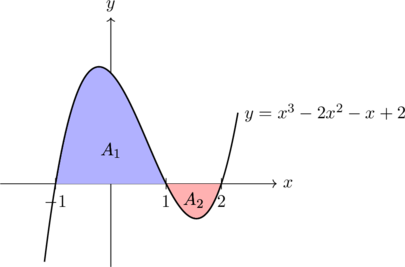
 reveals the roots at
 ![[-1, 1]](https://mathematics.lu/wp-content/ql-cache/quicklatex.com-66c17e240f5e7fd4ea51af9e1301d35e_l3.png "Rendered by QuickLaTeX.com") and dips below the
and dips below the ![[1, 2]](https://mathematics.lu/wp-content/ql-cache/quicklatex.com-6a1f4ecd197bf9d62f6c007c1d518b5e_l3.png "Rendered by QuickLaTeX.com") . We must split our area computation into these two sub-intervals.
. We must split our area computation into these two sub-intervals.![\[\text{Total Area} = \int_{-1}^{1} (x^3 - 2x^2 - x + 2) \, dx - \int_{1}^{2} (x^3 - 2x^2 - x + 2) \, dx\]](https://mathematics.lu/wp-content/ql-cache/quicklatex.com-dd9789fdc6e397e1813996ece886947d_l3.png "Rendered by QuickLaTeX.com")
![\[F(x) = \frac{x^4}{4} - \frac{2x^3}{3} - \frac{x^2}{2} + 2x\]](https://mathematics.lu/wp-content/ql-cache/quicklatex.com-0ad8b2adce5a02df4816099e3839066d_l3.png "Rendered by QuickLaTeX.com")
![\[F(1) = \frac{1}{4} - \frac{2}{3} - \frac{1}{2} + 2 = \frac{3 - 8 - 6 + 24}{12} = \frac{13}{12}\]](https://mathematics.lu/wp-content/ql-cache/quicklatex.com-35bdc2ceddb1ee3621c22bf82ca2c27d_l3.png "Rendered by QuickLaTeX.com")
![\[F(-1) = \frac{1}{4} + \frac{2}{3} - \frac{1}{2} - 2 = \frac{3 + 8 - 6 - 24}{12} = -\frac{19}{12}\]](https://mathematics.lu/wp-content/ql-cache/quicklatex.com-b7cbf827d7cf81c8028f95f5c2c5cb8d_l3.png "Rendered by QuickLaTeX.com")
![\[F(2) = \frac{16}{4} - \frac{16}{3} - \frac{4}{2} + 4 = 4 - \frac{16}{3} - 2 + 4 = 6 - \frac{16}{3} = \frac{2}{3} = \frac{8}{12}\]](https://mathematics.lu/wp-content/ql-cache/quicklatex.com-684875be583a3ab7484aae364f278e83_l3.png "Rendered by QuickLaTeX.com")
![\[A_1 = F(1) - F(-1) = \frac{13}{12} - \left(-\frac{19}{12}\right) = \frac{32}{12} = \frac{8}{3}\]](https://mathematics.lu/wp-content/ql-cache/quicklatex.com-d102913b3e56cb38dff4270062e04320_l3.png "Rendered by QuickLaTeX.com")
![\[A_2 = F(2) - F(1) = \frac{8}{12} - \frac{13}{12} = -\frac{5}{12}\]](https://mathematics.lu/wp-content/ql-cache/quicklatex.com-0bf10b7bc4fa9cf6d721a617ca544e49_l3.png "Rendered by QuickLaTeX.com")
![\[\text{Total Area} = A_1 - A_2 = \frac{32}{12} - \left(-\frac{5}{12}\right) = \frac{37}{12} \approx 3.083\]](https://mathematics.lu/wp-content/ql-cache/quicklatex.com-114fd3aaca026efb39f7f17ebf37aff9_l3.png "Rendered by QuickLaTeX.com")
We can either find  and
and  as areas (and so they cannot be negative) and simply say
![\[Area=A_1+A_2\]](https://mathematics.lu/wp-content/ql-cache/quicklatex.com-6339267be4b3b07809acff89bf3d8403_l3.png "Rendered by QuickLaTeX.com")
Or find
and as integrals (so will be negative because the function is below the -axis) and then subtract them, as in the example above.We may not always be given the graph of the function, so it may be up to use to understand if it is above the
-axis or below the -axis in each interval.
Area Between Curves
If we are given two functions and  and asked for the area between them, it is implied that these functions will intersect. To find the area between the two functions, we could find the area below the graph of a function, the area below the other, and subtract them. However, an easier approach would be to take the difference of functions. This will be a new function and the area between this new function and the -axis is equivalent to the area between the functions.
The only problem with this is that we need to account for where the new function is positive/negative. This is the same as understand which function  or
or  is the greater one.
Example: Find the total geometric area enclosed between the cubic polynomial  and the linear function
  .
.
To see where the curves cross and which function sits on top over different intervals, let us inspect the graph below:
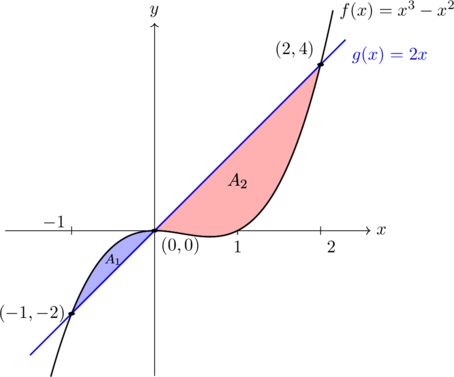
![\[x^3 - x^2 = 2x \implies x^3 - x^2 - 2x = 0\]](https://mathematics.lu/wp-content/ql-cache/quicklatex.com-bd160d320e061ea6288658e96da030a0_l3.png "Rendered by QuickLaTeX.com")
![\[x(x^2 - x - 2) = 0 \implies x(x - 2)(x + 1) = 0\]](https://mathematics.lu/wp-content/ql-cache/quicklatex.com-bd596bd6d76b4459ec2292dfaad2f1d9_l3.png "Rendered by QuickLaTeX.com")
![[0, 2]](https://mathematics.lu/wp-content/ql-cache/quicklatex.com-e250a581660e7bfe3221162fa4497625_l3.png "Rendered by QuickLaTeX.com") .
.![\[\text{Total Area} = A_1 + A_2 = \int_{-1}^{0} \big( (x^3 - x^2) - 2x \big) \, dx + \int_{0}^{2} \big( 2x - (x^3 - x^2) \big) \, dx\]](https://mathematics.lu/wp-content/ql-cache/quicklatex.com-334540d854c2c2f35d3432134d2c619c_l3.png "Rendered by QuickLaTeX.com")
![\[\text{Total Area} = \int_{-1}^{0} (x^3 - x^2 - 2x) \, dx + \int_{0}^{2} (-x^3 + x^2 + 2x) \, dx\]](https://mathematics.lu/wp-content/ql-cache/quicklatex.com-ca0738bdadfb68578fb6352163631cee_l3.png "Rendered by QuickLaTeX.com")
![\[\text{First Primitive } F_1(x) = \frac{x^4}{4} - \frac{x^3}{3} - x^2\]](https://mathematics.lu/wp-content/ql-cache/quicklatex.com-160c6b1906c39d70a5ba2f24fd4d4f9b_l3.png "Rendered by QuickLaTeX.com")
![\[\text{Second Primitive } F_2(x) = -\frac{x^4}{4} + \frac{x^3}{3} + x^2\]](https://mathematics.lu/wp-content/ql-cache/quicklatex.com-be5e5b23baf9657ef161a729cccaf6a9_l3.png "Rendered by QuickLaTeX.com")
![\[F_1(0) = 0\]](https://mathematics.lu/wp-content/ql-cache/quicklatex.com-5e4c51c6bb41d4a90496ae29d36f265b_l3.png "Rendered by QuickLaTeX.com")
![\[F_1(-1) = \frac{(-1)^4}{4} - \frac{(-1)^3}{3} - (-1)^2 = \frac{1}{4} + \frac{1}{3} - 1 = \frac{3 + 4 - 12}{12} = -\frac{5}{12}\]](https://mathematics.lu/wp-content/ql-cache/quicklatex.com-e81d9757f9b25596c0e9ffd35daaa359_l3.png "Rendered by QuickLaTeX.com")
![\[A_1 = F_1(0) - F_1(-1) = 0 - \left(-\frac{5}{12}\right) = \frac{5}{12}\]](https://mathematics.lu/wp-content/ql-cache/quicklatex.com-6ded46883e8515ed48b2fbd3f06717ef_l3.png "Rendered by QuickLaTeX.com")
![\[F_2(2) = -\frac{2^4}{4} + \frac{2^3}{3} + 2^2 = -4 + \frac{8}{3} + 4 = \frac{8}{3} = \frac{32}{12}\]](https://mathematics.lu/wp-content/ql-cache/quicklatex.com-da6feda3957f2f008f5ad82a5297a7ef_l3.png "Rendered by QuickLaTeX.com")
![\[F_2(0) = 0\]](https://mathematics.lu/wp-content/ql-cache/quicklatex.com-df8c56098fe7212624ab851a13c60eb7_l3.png "Rendered by QuickLaTeX.com")
![\[A_2 = F_2(2) - F_2(0) = \frac{32}{12} - 0 = \frac{32}{12}\]](https://mathematics.lu/wp-content/ql-cache/quicklatex.com-a1c83dd9881d8568395ec0c079a5a820_l3.png "Rendered by QuickLaTeX.com")
![\[\text{Total Area} = \frac{5}{12} + \frac{32}{12} = \frac{37}{12} \approx 3.083\]](https://mathematics.lu/wp-content/ql-cache/quicklatex.com-63f9468225bf93aeb64a53093718eb75_l3.png "Rendered by QuickLaTeX.com")
Exercises
Find the exact geometric area enclosed between the graph of each function and the -axis over the given interval. Use the provided vector plots for reference.
1.  from
from  to
to  .
.
2.  from to .
3. from to .
4.  from to .
Find the area enclosed between the curves of the given functions. Determine their intersection points algebraically to find the limits of integration.
1. Enclosed by  and
and  .
.
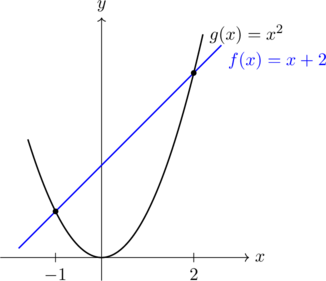
2. Enclosed by  and .
and .
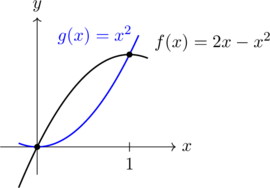
3. Enclosed by  and
and  .
.
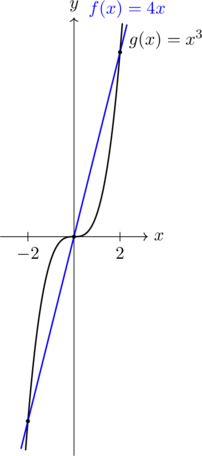
4. Enclosed by  and
and  .
.