In this section, we cover the following topics from the programme: Introduction, definite/indefinite integrals, properties of the integral, improper integrals, area under the curve of a function, area between two functions, volume of solid of revolution and arc length.
Previous knowledge required: Knowledge and properties of derivatives.
Opening Problem
Say we want to find the area of the function  in the interval
 ![[0,1]](https://mathematics.lu/wp-content/ql-cache/quicklatex.com-99fed59e349f642e322b4e39314b1ff6_l3.png "Rendered by QuickLaTeX.com") . We know that this area must be between 0 and 1 since the graph is inside a
. We know that this area must be between 0 and 1 since the graph is inside a  square (whose area is 1). How can we increase this precision? We can take rectangles that are always slightly above the graph of our function or slightly below and add their areas to end up with an approximation.
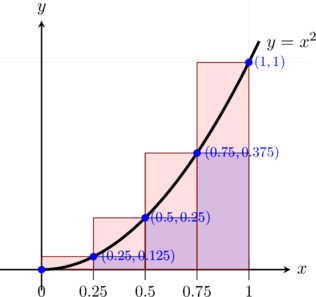
The desired area can be approximated as the sum of the areas of the lower (or upper) rectangles. The more rectangles we take, the more we refine our technique, the more we will get a better approximation.
If we take the 3 violet rectangles for the lower sum, the length of each rectangle is 0.25, the heights of the rectangle we can find using the function . These heights are:  and
and  . The sum is therefore:
![\[\text{Lower Area}=0.25\cdot0.125+0.25\cdot0.25+0.25\cdot0.375=0.1875\]](https://mathematics.lu/wp-content/ql-cache/quicklatex.com-b55a79e69680ac61658a7b24e8855b42_l3.png "Rendered by QuickLaTeX.com")
![\[\text{Upper Area}=0.25\cdot0.125+0.25\cdot0.125+0.25\cdot0.375+0.25\cdot1=0.40625\]](https://mathematics.lu/wp-content/ql-cache/quicklatex.com-ffafbf6b6e522456fa7c6a65f60a4468_l3.png "Rendered by QuickLaTeX.com")
The real answer, which we will give meaning to in a few minutes, is:
 .
.
The Riemann Integral
With our opening problem understood, we can define what is meant by an integral.
Definition: Let  be an integrable function on
  . A function
  is called a primitive function of if
  for any
  .
.
The term antiderivative is sometimes used to also mean this. Since the derivative of a constant is 0, if is a primitive function of , then so is  ,
,  , … and similarly with any constant addition.
Example: We know that if  then
then  . Therefore, we say that
  is a primitive of
  . However, we could also have a different primitive
  (or using any other constant) and the derivative of this is still
  . This is why we refer to the collection of such functions (these are all the same up to a constant) as the indefinite integral.
Definition: The collection of all primitive functions is called the indefinite integral of .
Below is a list of common integrals we can easily understand from our knowledge of derivatives:
|  |
 |  |
 |  |
 |  |
The  refers to all the different primitive functions. The symbol
  serves to indicate with respect to which variable we are integrating. The symbol
  marks the integral. The last two integrals should not make a big appearance, but we know them from knowing the derivatives of
  and .
and .
Example: To find the integral of  , we think of
  as
as  and use the formula
  . Here
  so:
so:
![\[\int xdx=\int x^1dx=\frac{x^2}{2}+C\]](https://mathematics.lu/wp-content/ql-cache/quicklatex.com-48513f33160390904554951e2e10e3d3_l3.png "Rendered by QuickLaTeX.com")
 because we can look say that
  so
so  in this case. We can also understand that
  because we know the primitive function. The derivative of
  is
is  .
.
Let us see another example more in detail.
Example: Find the indefinite integral of the function  using the power rule for integration.
![\[\int x^4 \, dx\]](https://mathematics.lu/wp-content/ql-cache/quicklatex.com-20e805f6c3e14e4b5d3ca9b8703e67ca_l3.png "Rendered by QuickLaTeX.com")

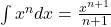
![\[\int x^n \, dx = \frac{x^{n+1}}{n+1} + C \quad (\text{for } n \neq -1)\]](https://mathematics.lu/wp-content/ql-cache/quicklatex.com-37540bbb7c143d7cc2872b8c6524d918_l3.png "Rendered by QuickLaTeX.com")
 .
.![\[\int x^4 \, dx = \frac{x^{4+1}}{4+1} + C = \frac{x^5}{5} + C\]](https://mathematics.lu/wp-content/ql-cache/quicklatex.com-d74bc5027b2f08a4ca0624d13c223b92_l3.png "Rendered by QuickLaTeX.com")
We defined the integral as the area under a curve , but so far we have only found primitive functions. Our next theorem (the fundamental theorem of calculus) will link the primitive function and integral to the area calculation that we did above.
Theorem (Newton-Leibniz Formula): Let be an integrable function with primitive . Then, the area under the curve of from  to
to  is given by:
![\[\int_a^b f(x)dx = F(b) - F(a)\]](https://mathematics.lu/wp-content/ql-cache/quicklatex.com-504fc7f559b1f4c397201b3d5d576b22_l3.png "Rendered by QuickLaTeX.com")
The expression  is called the definite integral of
  , it calculates the net area between the function and the -axis over the specific interval
 ![[a,b]](https://mathematics.lu/wp-content/ql-cache/quicklatex.com-8271afabffdbf2d86bd6a57374946f66_l3.png "Rendered by QuickLaTeX.com") . When no interval is assigned, i.e.: when we take , we refer to it as the indefinite integral.
. When no interval is assigned, i.e.: when we take , we refer to it as the indefinite integral.
A small disclaimer here: If your function is negative anywhere in the interval , then that area will be counted as negative. We can think of the integral as how much “more” area is above the -axis. We will get used to this after a few examples.
Example: In our opening problem, we had:
![\[Area=\int_0^1 x^2dx=\frac{x^3}{3}\Bigg|_0^1=\frac{1^3}{3}-\frac{0^3}{3}=\frac{1}{3}\]](https://mathematics.lu/wp-content/ql-cache/quicklatex.com-3729c6eb6ed7079dcf253a3703bc955e_l3.png "Rendered by QuickLaTeX.com")
is 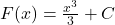 .
.
What happened with ? Since it is constant, it is cancelled when we calculate  because it appears twice (once with each sign). Let us see it more in detail:
![\[\int_0^1f(x)dx=\frac{x^3}{3}+C\Big|_0^1=\underbrace{\left(\frac{1^3}{3}+C\right)}_{F(b)}-\underbrace{\left(\frac{0^3}{3}+C\right)}_{F(a)}=\frac{1}{3}+C-0-C=\frac{1}{3}\]](https://mathematics.lu/wp-content/ql-cache/quicklatex.com-41ab80a17b0838fda1e25961f51aeb2a_l3.png "Rendered by QuickLaTeX.com")
 cancelling is a common occurrence when we have a definite integral, so we can ignore it entirely as above.
We have used the word “integrable” a few times. Within the S7 programme, what makes a function “integrable” is not defined or discussed, the word is added for correctness. In simple terms, a function is integrable on some interval when we can calculate the net area over the given interval. This is similar to how not every function is differentiable everywhere. The function
is not integrable on because the area is infinite (we have discussed already that it has a vertical asymptote at  ).
).Properties of Integral
The properties we can expect from the integral are relatively straightforward.
Claim: If and  are integrable and
  and
and  are constants, then:
![\[\int \big(f(x) \pm g(x)\big)dx = \int f(x)dx \pm \int g(x) dx\]](https://mathematics.lu/wp-content/ql-cache/quicklatex.com-6a6fd794d0f99ec67912dbf7b60c5c6c_l3.png "Rendered by QuickLaTeX.com")
![\[\int k \cdot f(x)dx = k \cdot \int f(x) \, dx\]](https://mathematics.lu/wp-content/ql-cache/quicklatex.com-b5eb3f4b509c4901878600e21205dbe1_l3.png "Rendered by QuickLaTeX.com")
![\[\int \big(k_1 \cdot f(x) \pm k_2\cdot g(x)\big)dx = k_1 \int f(x)dx \pm k_2 \int g(x)dx\]](https://mathematics.lu/wp-content/ql-cache/quicklatex.com-6f8d7f7c246ea14496e752fd1ae747bc_l3.png "Rendered by QuickLaTeX.com")
These will become a second nature with a bit of practice. Either way, it should not surprise us to see these properties, we know that integration and differentiation are connected, and the derivative works in the same way!
Example: To calculate the integral of  we separate them into more workable integrals:
![\[\int(10x^4+3x-1)dx=\int10x^4dx+\int3xdx-\int1dx=10\int x^4dx+3\int xdx-1\int dx\]](https://mathematics.lu/wp-content/ql-cache/quicklatex.com-48b7bc1a4f43548886882f39a1cc7fac_l3.png "Rendered by QuickLaTeX.com")
![\[=10\cdot\frac{x^5}{5}+3\cdot\frac{x^2}{2}-1\cdot x+C=2x^5+1.5x^2-x+C\]](https://mathematics.lu/wp-content/ql-cache/quicklatex.com-c7d84b73528e4a1f37ff49921958aeeb_l3.png "Rendered by QuickLaTeX.com")
 .
.
Claim: Let and be two integrable functions. Assume that  for all
 ![x \in [a,b]](https://mathematics.lu/wp-content/ql-cache/quicklatex.com-1945621430a1c2ace5ebf91723c91d8a_l3.png "Rendered by QuickLaTeX.com") . Then:
. Then:
![\[\int_a^b f(x)dx\geq\int_a^b g(x)dx\]](https://mathematics.lu/wp-content/ql-cache/quicklatex.com-7d72b72651551215e5bec48827516ca1_l3.png "Rendered by QuickLaTeX.com")
Think about this property as follows: if a function is greater than another function on some interval, it makes sense that it will have a bigger net area between its graph and the -axis.
You will have noticed by now that a symbol is recurring in every integral. The symbol indicates that the integral is being taken with respect to the variable . You will not see functions with many variables, so this seems less necessary, but we must include it nonetheless. Moreover, if you recall that we defined the integral as an area, represents the infinitesimally small lengths of the rectangles we draw in our Darboux sums. This is more background knowledge, so do not worry if it seems difficult.
When we can find C
The indefinite integral is a set of functions, all differing by a constant. We could be given a point on the graph of and use that to find the specific function that is a primitive and whose graph goes via that point.
Example: Find the primitive function of the polynomial  given that
  .
.
![\[F(x) = \int (3x^2 - 4x + 5) \, dx = x^3 - 2x^2 + 5x + C\]](https://mathematics.lu/wp-content/ql-cache/quicklatex.com-1d53e23da2b85cd45d770215a037d0c0_l3.png "Rendered by QuickLaTeX.com")
 and set the expression equal to the known output value of
  :
:![\[F(2) = (2)^3 - 2(2)^2 + 5(2) + C = 7 \implies 8 - 8 + 10 + C = 7 \implies C = -3\]](https://mathematics.lu/wp-content/ql-cache/quicklatex.com-7ee30672e8b87c93892010863567b1e7_l3.png "Rendered by QuickLaTeX.com")
 .
.More Exercises
Find the indefinite integrals (primitives) of the following functions:


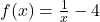

Evaluate the following definite integrals:


Show that the function  is a primitive of
  by calculating the derivative
  .
.
Find the shaded area under the curve for the following cases:
1.  from to
  .
.
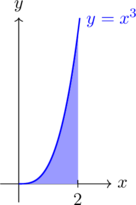
2.  from to
  .
.