Given the graph of an integrable function  on some interval
  to
to  , the integral
  represents the net area between the graph of the function and the
  -axis.
An improper integral is a special type of integral which we will discuss in this section. The technique to find such an integral is not difficult, and we will see that even though some areas may at first seem infinite, they will in fact be finite. We begin with a definition.
Definition: An improper integral is a definite integral meeting at least one of the following two conditions:
- Infinite Intervals: One or both of the limits of integration are infinite, meaning the interval over which you integrate is unbounded (for example,
 or
or  ).
). - Finite Interval with Discontinuity: The integrand function approaches infinity at some point within or at the boundaries of the interval of integration
![[a, b]](https://mathematics.lu/wp-content/ql-cache/quicklatex.com-458a76d7f1dc15e9dc8be46976f8197d_l3.png "Rendered by QuickLaTeX.com") , creating a vertical asymptote.
, creating a vertical asymptote.
We evaluate an improper integral as follows:
- An integral of the form
 becomes
  . We evaluate this integral and then take
  .
. - An integral of the form
 is evaluated analogously. I.e.: Taking
  .
. - An integral of the form
 can be divided into two integrals as above and calculated separately. If either part is infinity, the total part is infinity.
 - An integral of the form
 where at some point
  the function has a vertical asymptote can be decomposed into two integrals (before and after said point). E.g.:
![\[\int_{-1}^1 \frac{1}{x}dx=\int_{-1}^0 f(x)dx+\int_0^1 f(x)dx\]](https://mathematics.lu/wp-content/ql-cache/quicklatex.com-4f140b33b148b7482f25b894c4249240_l3.png "Rendered by QuickLaTeX.com")
Then each integral is calculated respectively.
If the limit yields a finite value, the integral converges. If the limit does not exist or equals infinity, the integral diverges.
Improper Integrals Over Infinite Intervals
Taking into consideration that the integral represents the area, you could think that every integral with an infinite integral will be infinite. However, when your function has a horizontal asymptote at  , your integral might end up being finite. This is very closely related to an optional topic in advanced maths called Infinite Series and in the sequences part of the programme in 5 periods you discuss infinite sums (e.g.: with geometric sequences). Since an integral is by definition an infinite sum, it makes sense these are related.
Example: Evaluate the following improper integral  to determine whether it converges or diverges.
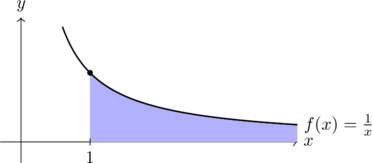
 ), we replace it with a variable
  and take the limit as
  :
:![\[\int_1^\infty \frac{1}{x} \, dx = \lim_{b \to \infty} \int_1^b \frac{1}{x} \, dx\]](https://mathematics.lu/wp-content/ql-cache/quicklatex.com-a1eef16b43128f986c78d30ee9f27876_l3.png "Rendered by QuickLaTeX.com")
 is the natural logarithm function
  :
:![\[\lim_{b \to \infty} \int_1^b \frac{1}{x} \, dx = \lim_{b \to \infty} \Big[ \ln|x| \Big]_1^b\]](https://mathematics.lu/wp-content/ql-cache/quicklatex.com-7433708177ce24ff1e7217fe2d83b031_l3.png "Rendered by QuickLaTeX.com")
 :
:![\[\lim_{b \to \infty} \Big[ \ln|x| \Big]_1^b = \lim_{b \to \infty} \big( \ln(b) - \ln(1) \big)\]](https://mathematics.lu/wp-content/ql-cache/quicklatex.com-fa2c679664cf93a5735017c760eb32f2_l3.png "Rendered by QuickLaTeX.com")
 , the expression simplifies cleanly to:
![\[\lim_{b \to \infty} \ln(b)\]](https://mathematics.lu/wp-content/ql-cache/quicklatex.com-d5c8ca8ad6bf452e43ebc26bad35b39e_l3.png "Rendered by QuickLaTeX.com")
![\[\lim_{b \to \infty} \ln(b) = \infty\]](https://mathematics.lu/wp-content/ql-cache/quicklatex.com-0c92f744257b37afa06d496dc09e02f9_l3.png "Rendered by QuickLaTeX.com")
Example: Evaluate the following improper integral  to determine whether it converges or diverges.
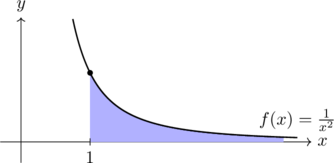
![\[\int_1^\infty \frac{1}{x^2} \, dx = \lim_{b \to \infty} \int_1^b x^{-2} \, dx\]](https://mathematics.lu/wp-content/ql-cache/quicklatex.com-885b6abe657f16f4b3c7347a2c8456ef_l3.png "Rendered by QuickLaTeX.com")
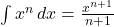 ), we integrate
  to get
  or
or  :
:![\[\lim_{b \to \infty} \int_1^b x^{-2} \, dx = \lim_{b \to \infty} \left[ -\frac{1}{x} \right]_1^b\]](https://mathematics.lu/wp-content/ql-cache/quicklatex.com-314054bffee3dcabb63e35d50961ca6b_l3.png "Rendered by QuickLaTeX.com")
![\[\lim_{b \to \infty} \left[ -\frac{1}{x} \right]_1^b = \lim_{b \to \infty} \left( -\frac{1}{b} - \left(-\frac{1}{1}\right) \right)\]](https://mathematics.lu/wp-content/ql-cache/quicklatex.com-a40bab841f818fef30a8637f9256c065_l3.png "Rendered by QuickLaTeX.com")
 :
:![\[\lim_{b \to \infty} \left( 1 - \frac{1}{b} \right)\]](https://mathematics.lu/wp-content/ql-cache/quicklatex.com-88b5379c8dd52bf0773c2ae0596fe3fd_l3.png "Rendered by QuickLaTeX.com")
 vanishes cleanly to
  :
:![\[1 - 0 = 1\]](https://mathematics.lu/wp-content/ql-cache/quicklatex.com-86fa8235b6981a366f32bbe89608ea8a_l3.png "Rendered by QuickLaTeX.com")
The next example will show an integral where both endpoints of the interval are infinity. This integral does not form part of the 5 periods programme (this is seen in advanced maths), but we can simply accept the fact that  and still take advantage of an example that covers one of our special cases.
Example: Evaluate the following improper integral  to determine whether it converges or diverges.
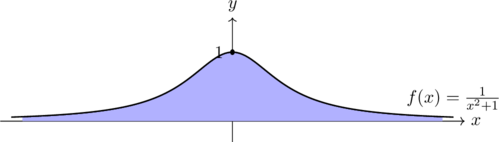
![\[\int_{-\infty}^{\infty} \frac{1}{x^2+1} \, dx = \int_{-\infty}^{0} \frac{1}{x^2+1} \, dx + \int_{0}^{\infty} \frac{1}{x^2+1} \, dx\]](https://mathematics.lu/wp-content/ql-cache/quicklatex.com-d6ee4bcbb6d2ff28c3b0d5d0dc2b0fff_l3.png "Rendered by QuickLaTeX.com")
 and
and ![\[\int_{-\infty}^{\infty} \frac{1}{x^2+1} \, dx = \lim_{a \to -\infty} \int_{a}^{0} \frac{1}{x^2+1} \, dx + \lim_{b \to \infty} \int_{0}^{b} \frac{1}{x^2+1} \, dx\]](https://mathematics.lu/wp-content/ql-cache/quicklatex.com-605d108823c8fdcf818ca9e2a04e1385_l3.png "Rendered by QuickLaTeX.com")
 is the inverse tangent function,
  :
:![\[= \lim_{a \to -\infty} \Big[ \arctan(x) \Big]_{a}^{0} + \lim_{b \to \infty} \Big[ \arctan(x) \Big]_{0}^{b}\]](https://mathematics.lu/wp-content/ql-cache/quicklatex.com-bd65d1ed0849bd9f8cd8654b7a9a3559_l3.png "Rendered by QuickLaTeX.com")
![\[= \lim_{a \to -\infty} \big( \arctan(0) - \arctan(a) \big) + \lim_{b \to \infty} \big( \arctan(b) - \arctan(0) \big)\]](https://mathematics.lu/wp-content/ql-cache/quicklatex.com-257623418df0a118ce2f96415786f861_l3.png "Rendered by QuickLaTeX.com")
 , this simplifies directly to:
![\[= \lim_{a \to -\infty} \big( -\arctan(a) \big) + \lim_{b \to \infty} \arctan(b)\]](https://mathematics.lu/wp-content/ql-cache/quicklatex.com-dc1872f8309e05ce8018d353c5ee5e23_l3.png "Rendered by QuickLaTeX.com")
 ,
,  . As
. As  ,
,  :
:![\[= -\left(-\frac{\pi}{2}\right) + \frac{\pi}{2}\]](https://mathematics.lu/wp-content/ql-cache/quicklatex.com-eaf876301830c861bb8b9ef6f9d33796_l3.png "Rendered by QuickLaTeX.com")
![\[= \frac{\pi}{2} + \frac{\pi}{2} = \pi\]](https://mathematics.lu/wp-content/ql-cache/quicklatex.com-a32865fcf6fa69a34b11df5866867653_l3.png "Rendered by QuickLaTeX.com")
 .
.Common Mistake with Improper Integrals
When taking an improper integral of the form , a common mistake is to try and evaluate the integral “simultaneously”. Our method tells us we need to divide this into two integrals:
![\[\int_{-\infty}^0 f(x)dx+\int_0^\infty f(x)dx\]](https://mathematics.lu/wp-content/ql-cache/quicklatex.com-32de13f5a5a52c7d91bd8a64dd27bd03_l3.png "Rendered by QuickLaTeX.com")
However, often students will forget this and calculate everything as one limit so the
 seems to cancel out (depending on the function) due to the minus between them. Let us see this in an example.
Example: Evaluate the improper integral  to determine whether it converges or diverges.
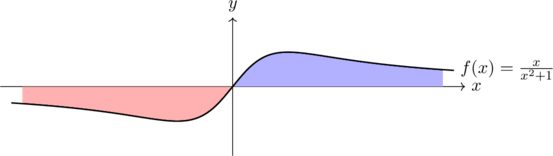
 ). Students often try to evaluate the entire bounds at once using a single limit:
![\[\lim_{b \to \infty} \left[ \frac{1}{2}\ln(x^2+1) \right]_{-b}^{b} = \lim_{b \to \infty} \left( \frac{1}{2}\ln(b^2+1) - \frac{1}{2}\ln((-b)^2+1) \right) = \infty - \infty = 0\]](https://mathematics.lu/wp-content/ql-cache/quicklatex.com-7622a4334fb01058e072b786ce9357c6_l3.png "Rendered by QuickLaTeX.com")
 is an indeterminate form. It does not equal zero. We cannot cancel out the infinite components unless the formal rules of improper integration are followed strictly.
![\[\int_{-\infty}^{\infty} \frac{x}{x^2+1} \, dx = \lim_{a \to -\infty} \int_{a}^{0} \frac{x}{x^2+1} \, dx + \lim_{b \to \infty} \int_{0}^{b} \frac{x}{x^2+1} \, dx\]](https://mathematics.lu/wp-content/ql-cache/quicklatex.com-62a5fe11b64433d4e9476daff266b1db_l3.png "Rendered by QuickLaTeX.com")
 , the indefinite primitive function is
  :
:![\[= \lim_{a \to -\infty} \left[ \frac{1}{2}\ln(x^2+1) \right]_{a}^{0} + \lim_{b \to \infty} \left[ \frac{1}{2}\ln(x^2+1) \right]_{0}^{b}\]](https://mathematics.lu/wp-content/ql-cache/quicklatex.com-9aa1896d5d883f60d28a7315a1d838dc_l3.png "Rendered by QuickLaTeX.com")
 ):
):![\[\lim_{b \to \infty} \left( \frac{1}{2}\ln(b^2+1) - \frac{1}{2}\ln(0^2+1) \right) = \lim_{b \to \infty} \left( \frac{1}{2}\ln(b^2+1) - 0 \right) = \infty\]](https://mathematics.lu/wp-content/ql-cache/quicklatex.com-d62ee24b4e1663dddd72cbecaa1ddb5d_l3.png "Rendered by QuickLaTeX.com")
Improper Integral over a Finite Interval with Discontinuity
We cover our final case, where the function has a point of discontinuity within the interval of integration. Just because your function has a vertical asymptote it does not imply that the integral will be infinite.
Example: Evaluate the improper integral  to determine whether it converges or diverges.
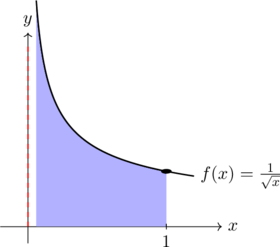
 has a point of discontinuity at the lower bound
 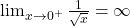 ).
). and evaluate the limit as
 ![\[\int_0^1 \frac{1}{\sqrt{x}} \, dx = \lim_{t \to 0^+} \int_t^1 x^{-1/2} \, dx\]](https://mathematics.lu/wp-content/ql-cache/quicklatex.com-a1a5e778c3622e95b8003a5ccae5153c_l3.png "Rendered by QuickLaTeX.com")
 :
:![\[\int x^{-1/2} \, dx = \frac{x^{1/2}}{1/2} = 2\sqrt{x}\]](https://mathematics.lu/wp-content/ql-cache/quicklatex.com-038acfe6e9859745b79a4be0722e5681_l3.png "Rendered by QuickLaTeX.com")
![\[\lim_{t \to 0^+} \left[ 2\sqrt{x} \right]_t^1\]](https://mathematics.lu/wp-content/ql-cache/quicklatex.com-d2d4b81608dc9495d227c1db75d38c65_l3.png "Rendered by QuickLaTeX.com")
![\[\lim_{t \to 0^+} \Big( 2\sqrt{1} - 2\sqrt{t} \Big) = \lim_{t \to 0^+} \Big( 2 - 2\sqrt{t} \Big)\]](https://mathematics.lu/wp-content/ql-cache/quicklatex.com-c06b039a5db928d1b1a66ff7b08f62c5_l3.png "Rendered by QuickLaTeX.com")
 cleanly vanishes to
 ![\[2 - 2\sqrt{0} = 2 - 0 = 2\]](https://mathematics.lu/wp-content/ql-cache/quicklatex.com-fe5832b51008a41b4dc6162856336601_l3.png "Rendered by QuickLaTeX.com")
Exercises
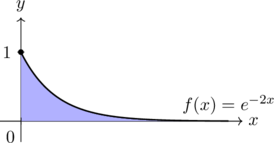
Determine whether each of the following improper integrals converges or diverges. If it converges, find its exact value.
1. Evaluate 
2. Evaluate 
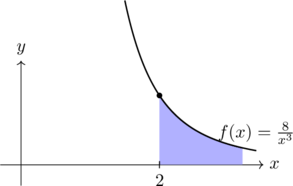
3. Evaluate 
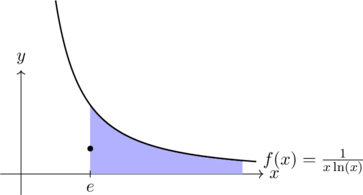
4. Evaluate 
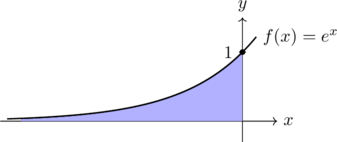
5. Evaluate 
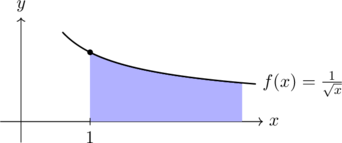
Determine whether each of the following Type II improper integrals converges or diverges. If it converges, find its exact value.
1. Evaluate 
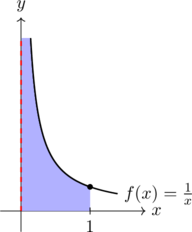
2. Evaluate 
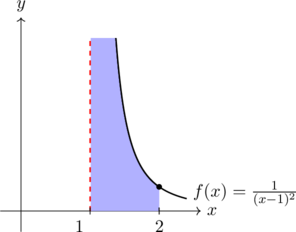
3. Evaluate 
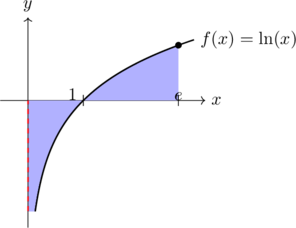
Determine whether the following improper integral converges or diverges. If it converges, find its exact value. Disclaimer: This type of integral should no longer be in the programme, but the hint below tells you how to approach it.
![\[\int_{-\infty}^{\infty} e^{-|x|} \, dx\]](https://mathematics.lu/wp-content/ql-cache/quicklatex.com-7c2a8064ce59f7bbb99ccaadd367ae33_l3.png "Rendered by QuickLaTeX.com")
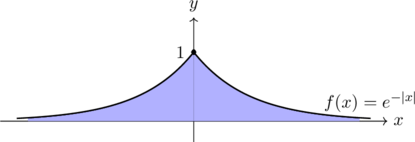
Hint: To integrate a function with absolute value, split the integral at  into two separate halves with independent limits:
![\[\int_{-\infty}^{\infty} e^{-|x|} \, dx = \int_{-\infty}^{0} e^{x} \, dx + \int_{0}^{\infty} e^{-x} \, dx\]](https://mathematics.lu/wp-content/ql-cache/quicklatex.com-af0b2a0c19492e246bd410c9f6d748cd_l3.png "Rendered by QuickLaTeX.com")
does not change so you can understand what the absolute value does to the variable.
Analyse the behaviour of the following improper integral based on the value of the constant exponent  :
:
![\[\int_{1}^{\infty} x^n \, dx\]](https://mathematics.lu/wp-content/ql-cache/quicklatex.com-28450024b0405b90ecb1cfb937f7d4a9_l3.png "Rendered by QuickLaTeX.com")
Find a condition on for which this improper integral converges, and the condition for which it diverges.
Hint: Make sure to test the specific case where  separately, as it uses a different integration rule.