You have already seen the main formula back in S6. The scalar product can be defined by using the angle between the two vectors. From this, we can conclude a formula to find the angle between two vectors:
![\[\vec{u}\cdot\vec{v}=\|\vec{u}\|\cdot\|\vec{v}\|\cdot\cos(\theta)\implies \cos(\theta)=\frac{\vec{u}\cdot\vec{v}}{\|\vec{u}\|\cdot\|\vec{v}\|}\]](https://mathematics.lu/wp-content/ql-cache/quicklatex.com-4e06df8f8cbad448133ccf06d961aa03_l3.png "Rendered by QuickLaTeX.com")
If we want the acute angle
 created by two vectors
  and
and  we adjust the formula slightly by adding absolute value.
 ![\[\cos(\theta)=\frac{|\vec{u}\cdot\vec{v}|}{\|\vec{u}\|\cdot\|\vec{v}\|}\]](https://mathematics.lu/wp-content/ql-cache/quicklatex.com-a3b6091cde49a1c1b26ccb98212765b1_l3.png "Rendered by QuickLaTeX.com")
Angle Between Two Vectors
Given by the formula above.
Example: Given the vectors  and
and  in
in  , calculate the acute angle between them.
![\[\vec{u} \cdot \vec{v} = (1 \cdot 0) + (0 \cdot 2) + (-1 \cdot 2) = -2\]](https://mathematics.lu/wp-content/ql-cache/quicklatex.com-a8da80e5db7d9df01caf7b617d9ab890_l3.png "Rendered by QuickLaTeX.com")
![\[\|\vec{u}\| = \sqrt{1^2 + 0^2 + (-1)^2} = \sqrt{2}\]](https://mathematics.lu/wp-content/ql-cache/quicklatex.com-a8d91c31e770410ff6389c4c076c2ce4_l3.png "Rendered by QuickLaTeX.com")
![\[\|\vec{v}\| = \sqrt{0^2 + 2^2 + 2^2} = \sqrt{8} = 2\sqrt{2}\]](https://mathematics.lu/wp-content/ql-cache/quicklatex.com-82ce62ff904f51ca0c6b863746fd5ee3_l3.png "Rendered by QuickLaTeX.com")
![\[\cos(\theta) = \frac{\vec{u} \cdot \vec{v}}{\|\vec{u}\| \|\vec{v}\|} = \frac{-2}{\sqrt{2} \cdot 2\sqrt{2}} = \frac{-2}{4} = -\frac{1}{2}\]](https://mathematics.lu/wp-content/ql-cache/quicklatex.com-a6f7c75fcb284cab15a023dcabc0a169_l3.png "Rendered by QuickLaTeX.com")
![\[\theta = \arccos\left(-\frac{1}{2}\right) = \frac{2\pi}{3} \quad (120^\circ)\]](https://mathematics.lu/wp-content/ql-cache/quicklatex.com-3ef37c9bca91670ab6d934eaef9beba2_l3.png "Rendered by QuickLaTeX.com")
Angle Between Two Lines
The angle between two lines is simply the angle created by the direction vectors of the lines.
Example: Find the acute angle between the two lines  and
and  given by the equations:
![\[\ell_1: \begin{cases} x = 2 + t \\ y = -4 \\ z = 1 - t \end{cases} \quad \text{and} \quad \ell_2: \frac{x - 5}{0} = \frac{y + 1}{2} = \frac{z - 3}{2}\]](https://mathematics.lu/wp-content/ql-cache/quicklatex.com-df7956f790891101ec7db88fc35bb463_l3.png "Rendered by QuickLaTeX.com")
![\[\vec{u} = \begin{pmatrix} 1 \\ 0 \\ -1 \end{pmatrix} \quad \text{and} \quad \vec{v} = \begin{pmatrix} 0 \\ 2 \\ 2 \end{pmatrix}\]](https://mathematics.lu/wp-content/ql-cache/quicklatex.com-086c3dea3a03a0c44e4848b578a7cd59_l3.png "Rendered by QuickLaTeX.com")
![\[\cos(\alpha) = -\frac{1}{2} \implies \alpha = 120^\circ\]](https://mathematics.lu/wp-content/ql-cache/quicklatex.com-4749bb5b70d4b8a7eca4c5f3dbf34462_l3.png "Rendered by QuickLaTeX.com")
![\theta \in [0, 90^\circ]](https://mathematics.lu/wp-content/ql-cache/quicklatex.com-6980e3f89f66080c418450ba04e79a18_l3.png "Rendered by QuickLaTeX.com") using the absolute value of the dot product matrix:
using the absolute value of the dot product matrix:![\[\cos(\theta) = \frac{|\vec{u} \cdot \vec{v}|}{\|\vec{u}\| \|\vec{v}\|} = \left|-\frac{1}{2}\right| = \frac{1}{2}\]](https://mathematics.lu/wp-content/ql-cache/quicklatex.com-e8e51330e27921893ab25f62466739bc_l3.png "Rendered by QuickLaTeX.com")
![\[\theta = \arccos\left(\frac{1}{2}\right) = 60^\circ \quad \left(\frac{\pi}{3}\right)\]](https://mathematics.lu/wp-content/ql-cache/quicklatex.com-8e6eadd49614b26c32cddb8047c66210_l3.png "Rendered by QuickLaTeX.com")
In this case, we chose an easier example just for the purposes of simplicity. The method is literally the same as with vectors.
Angle Between Two Planes
The angle between two planes is calculated using the normal vectors. We can use simple geometry to understand that the formula remains exactly the same, though we will see that the case between a line and a plane changes our formula slightly.
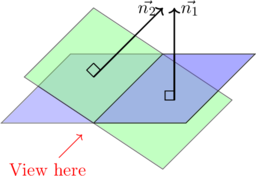
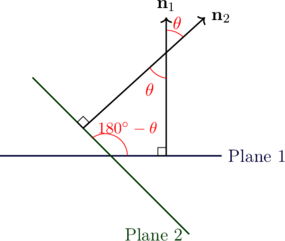
That is, if  and
and  are two planes with normal vectors
  and
and  , the angle between them can be calculated as:
![\[\cos(\theta)=\frac{|\vec{n}_1\cdot\vec{n}_2|}{\|\vec{n}_1\|\cdot\|\vec{n_2}\|}\]](https://mathematics.lu/wp-content/ql-cache/quicklatex.com-ff961b61f1ae5390de94721f5932e0e4_l3.png "Rendered by QuickLaTeX.com")
Example: Calculate the acute angle between the two planes and given by their Cartesian equations:
![\[\pi_1: x - z + 4 = 0 \quad \text{and} \quad \pi_2: 2y + 2z - 7 = 0\]](https://mathematics.lu/wp-content/ql-cache/quicklatex.com-6deb2492220e93e4ff20358a82000ec8_l3.png "Rendered by QuickLaTeX.com")
![\[\vec{n}_1 = \begin{pmatrix} 1 \\ 0 \\ -1 \end{pmatrix} \quad \text{and} \quad \vec{n}_2 = \begin{pmatrix} 0 \\ 2 \\ 2 \end{pmatrix}\]](https://mathematics.lu/wp-content/ql-cache/quicklatex.com-a3366fec32c3024d7fea4278d5800825_l3.png "Rendered by QuickLaTeX.com")
![\[\cos(\theta) = \frac{|\vec{n}_1 \cdot \vec{n}_2|}{\|\vec{n}_1\| \|\vec{n}_2\|} = \frac{|(1 \cdot 0) + (0 \cdot 2) + (-1 \cdot 2)|}{\sqrt{1^2 + 0^2 + (-1)^2} \cdot \sqrt{0^2 + 2^2 + 2^2}}\]](https://mathematics.lu/wp-content/ql-cache/quicklatex.com-b4b7ac9145bca9201275cf2a78da2a8a_l3.png "Rendered by QuickLaTeX.com")
![\[\cos(\theta) = \frac{|-2|}{\sqrt{2} \cdot \sqrt{8}} = \frac{2}{4} = \frac{1}{2}\]](https://mathematics.lu/wp-content/ql-cache/quicklatex.com-4166c29c0ec7e69bf453055380bd2d6f_l3.png "Rendered by QuickLaTeX.com")
Angle Between a Plane and a Line
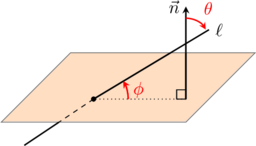
Example: Calculate the acute angle between the line  and the plane
  given by their respective equations:
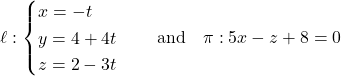
![\[\ell: \begin{cases} x = 2 + t \\ y = -4 \\ z = 1 - t \end{cases} \quad \text{and} \quad \pi: 2y + 2z - 7 = 0\]](https://mathematics.lu/wp-content/ql-cache/quicklatex.com-8db511930c4d0d1c4602fbb65a62caba_l3.png "Rendered by QuickLaTeX.com")
 from their layout parameters:
![\[\vec{u} = \begin{pmatrix} 1 \\ 0 \\ -1 \end{pmatrix} \quad \text{and} \quad \vec{n} = \begin{pmatrix} 0 \\ 2 \\ 2 \end{pmatrix}\]](https://mathematics.lu/wp-content/ql-cache/quicklatex.com-cc4ed23913437d1155eba5f32b93f527_l3.png "Rendered by QuickLaTeX.com")
![\[\sin(\theta) = \frac{|\vec{u} \cdot \vec{n}|}{\|\vec{u}\| \|\vec{n}\|}\]](https://mathematics.lu/wp-content/ql-cache/quicklatex.com-4e2d55274935dd7a28a9c76b845c99da_l3.png "Rendered by QuickLaTeX.com")
![\[\sin(\theta) = \frac{|-2|}{\sqrt{2} \cdot \sqrt{8}} = \frac{2}{4} = \frac{1}{2}\]](https://mathematics.lu/wp-content/ql-cache/quicklatex.com-887cef002e503d46060b9e9935f77725_l3.png "Rendered by QuickLaTeX.com")
![\[\theta = \arcsin\left(\frac{1}{2}\right) = 30^\circ \quad \left(\frac{\pi}{6}\right)\]](https://mathematics.lu/wp-content/ql-cache/quicklatex.com-cf0da638561c3333c861b8f1ea1beb5d_l3.png "Rendered by QuickLaTeX.com")
Exercises
Extract the direction vectors for each pair of lines below and apply the absolute dot product formula to determine the exact acute angle between them.
- 1.
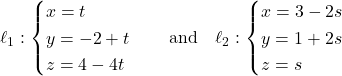
- 2.

- 3.

- 4.
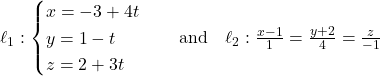
Identify the components of the normal vectors from the lowercase Cartesian plane equations below to compute the acute angle of intersection separating the two plane structures.
- 1.

- 2.

- 3.

- 4.

Extract the line’s direction vector and the plane’s normal vector. Apply the complementary absolute sine product formula to calculate the acute inclination angle between the line path and the plane surface layer.
- 1.

- 2.

- 3.

- 4.