In this page, we will discuss all the intersections of the different objects we have seen and how to find them.
Intersection of Two Lines
We have seen already that two lines do not necessarily intersect (they could be parallel or skew). In order to find the intersection of two lines, we equate their equations, as we do with functions in algebra. This results in a system of equations with 3 equations and 2 variables, namely the parameters of the lines. We can simply look at any two equations we want to find the parameters. If the lines intersect, the final equation will result in a true statement.
Example: Find the point of intersection between the two lines  and
and  :
:
![\[\ell_1: \begin{cases} x = t \\ y = 3 - t \\ z = 1 + 2t \end{cases} \quad \text{and} \quad \ell_2: \begin{cases} x = -3 + 2s \\ y = s \\ z = 5 - s \end{cases}\]](https://mathematics.lu/wp-content/ql-cache/quicklatex.com-f6b4d5c24390c462330335dbc3c16ff0_l3.png "Rendered by QuickLaTeX.com")
 ,
,  , and
, and ![\[\begin{cases} t = -3 + 2s \implies t - 2s = -3 \quad \text{(Eq. 1)} \\ 3 - t = s \implies t + s = 3 \quad \text{(Eq. 2)} \\ 1 + 2t = 5 - s \implies 2t + s = 4 \quad \text{(Eq. 3)} \end{cases}\]](https://mathematics.lu/wp-content/ql-cache/quicklatex.com-19e87a3b23bc0ead0c2fcc7cf6ebc671_l3.png "Rendered by QuickLaTeX.com")

![\[(t + s) - (t - 2s) = 3 - (-3)\]](https://mathematics.lu/wp-content/ql-cache/quicklatex.com-32d5212fb364740906f513c43cae11bc_l3.png "Rendered by QuickLaTeX.com")
![\[3s = 6 \implies s = 2\]](https://mathematics.lu/wp-content/ql-cache/quicklatex.com-35527c11417cacf039da3d9ac8acf28d_l3.png "Rendered by QuickLaTeX.com")
 back into Equation 2:
![\[t + 2 = 3 \implies t = 1\]](https://mathematics.lu/wp-content/ql-cache/quicklatex.com-a34bf1815d6b1fb9170b18217d1c78d2_l3.png "Rendered by QuickLaTeX.com")
 and
and ![\[2(1) + 2 = 4 \quad \text{(Valid)}\]](https://mathematics.lu/wp-content/ql-cache/quicklatex.com-65a62736fa6529375f974405b833d83b_l3.png "Rendered by QuickLaTeX.com")
![\[x = 1, \quad y = 3 - 1 = 2, \quad z = 1 + 2(1) = 3\]](https://mathematics.lu/wp-content/ql-cache/quicklatex.com-4e0037f7e764818ea3d9cb98a8b31f4a_l3.png "Rendered by QuickLaTeX.com")
 .
.Intersection of a Line and a Plane
We can visualise this intersection easily. A line could be parallel to a plane or intersect it. A line will be parallel to a plane if the normal vector of the plane is also perpendicular to the direction vector of the line. When the line is not parallel to the plane, it will intersect it at one point. Of course, the line could also be contained in the plane, so that the intersection is the line itself.
To find the intersection of a line and a plane, we replace the  and
and  in the equation of the plane by the formulas given by the equation of the line. This will result in one equation with one variable (the parameter of the line). Solve it, and then replace the result in the equation of the line to obtain the point of intersection.
Example: Find the point of intersection between the line  and the plane
  :
:
![\[\ell: \begin{cases} x = 2 + t \\ y = 1 - 2t \\ z = 3t \end{cases} \quad \text{and} \quad \pi: 3x - y + 2z - 12 = 0\]](https://mathematics.lu/wp-content/ql-cache/quicklatex.com-a239da75fdabdf7909ecf5fe7dd7ecc9_l3.png "Rendered by QuickLaTeX.com")
![\[3(2 + t) - (1 - 2t) + 2(3t) - 12 = 0\]](https://mathematics.lu/wp-content/ql-cache/quicklatex.com-1f8e90807ec83c324fe55f40c3195d15_l3.png "Rendered by QuickLaTeX.com")
![\[6 + 3t - 1 + 2t + 6t - 12 = 0\]](https://mathematics.lu/wp-content/ql-cache/quicklatex.com-e0db965486e250e2b824ddcaee594534_l3.png "Rendered by QuickLaTeX.com")
![\[11t - 7 = 0 \quad \text{??? Let's adjust constants for an integer parameter result.}\]](https://mathematics.lu/wp-content/ql-cache/quicklatex.com-a8eae8e4e7aa24897e93a34be1f93225_l3.png "Rendered by QuickLaTeX.com")
 instead:
![\[3(2 + t) - (1 - 2t) + 2(3t) - 17 = 0\]](https://mathematics.lu/wp-content/ql-cache/quicklatex.com-c25117dcecf2da970e6682b2278f969e_l3.png "Rendered by QuickLaTeX.com")
![\[6 + 3t - 1 + 2t + 6t - 17 = 0\]](https://mathematics.lu/wp-content/ql-cache/quicklatex.com-905d7165d61ff1eca6beb55d0fbd60b0_l3.png "Rendered by QuickLaTeX.com")
![\[11t - 12 = 0 \quad \text{??? Let's make it balance perfectly.}\]](https://mathematics.lu/wp-content/ql-cache/quicklatex.com-a0aeb613ef6191e4d12f921c2d4e1e32_l3.png "Rendered by QuickLaTeX.com")
![\[\ell: \begin{cases} x = 1 + t \\ y = 2 - t \\ z = t \end{cases} \quad \text{and} \quad \pi: 2x + y + 3z - 10 = 0\]](https://mathematics.lu/wp-content/ql-cache/quicklatex.com-84ab3a9c63ccbe11e022fc201d02228c_l3.png "Rendered by QuickLaTeX.com")
![\[2(1 + t) + (2 - t) + 3(t) - 10 = 0\]](https://mathematics.lu/wp-content/ql-cache/quicklatex.com-bb054113b523b0dff576fe4732b5fb64_l3.png "Rendered by QuickLaTeX.com")
![\[2 + 2t + 2 - t + 3t - 10 = 0\]](https://mathematics.lu/wp-content/ql-cache/quicklatex.com-68dc0cdd90339fcb46611e03c3f7044c_l3.png "Rendered by QuickLaTeX.com")
![\[4t - 6 = 0 \quad \text{??? One more adjustment to make it fully integer.}\]](https://mathematics.lu/wp-content/ql-cache/quicklatex.com-e94a1fb4f4ac7e40292269106317b1e7_l3.png "Rendered by QuickLaTeX.com")
![\[\ell: \begin{cases} x = 1 + t \\ y = 2 - t \\ z = t \end{cases} \quad \text{and} \quad \pi: 2x + y + 3z - 8 = 0\]](https://mathematics.lu/wp-content/ql-cache/quicklatex.com-ab5f7c73dd589c7c5092647559f268fa_l3.png "Rendered by QuickLaTeX.com")
![\[2(1 + t) + (2 - t) + 3(t) - 8 = 0\]](https://mathematics.lu/wp-content/ql-cache/quicklatex.com-8c82878b192d64736ab1ecd99682ddb3_l3.png "Rendered by QuickLaTeX.com")
![\[2 + 2t + 2 - t + 3t - 8 = 0\]](https://mathematics.lu/wp-content/ql-cache/quicklatex.com-13febb08a2010c92a23b0547b56aeff5_l3.png "Rendered by QuickLaTeX.com")
![\[4t - 4 = 0 \implies 4t = 4 \implies t = 1\]](https://mathematics.lu/wp-content/ql-cache/quicklatex.com-2c940b7ce1cda08157ee19796b695904_l3.png "Rendered by QuickLaTeX.com")
![\[x = 1 + 1 = 2\]](https://mathematics.lu/wp-content/ql-cache/quicklatex.com-53435d32895025691e1427e56d9dc3d4_l3.png "Rendered by QuickLaTeX.com")
![\[y = 2 - 1 = 1\]](https://mathematics.lu/wp-content/ql-cache/quicklatex.com-b73607fab770084c9a39a8120ad0247b_l3.png "Rendered by QuickLaTeX.com")
![\[z = 1\]](https://mathematics.lu/wp-content/ql-cache/quicklatex.com-3fd6b475cdcef682ba38b14787de028b_l3.png "Rendered by QuickLaTeX.com")
 .
.Intersection of Two Planes
This intersection is easy to visualise. Look at any two intersecting walls in the room that you are in. The intersection is a line, clearly belonging to both walls.
To find the intersection of two planes, we make a system of equations with the equations of the plane. This yields two equations with 3 variables ( and ). This will have infinite solutions, which makes sense as we expect the answer to be a line. We can replace any of the 3 variables by  (the parameter of the line) and then find the other two variables as a function of .
Example: Find the line of intersection between the two planes  and
and  :
:
![\[\pi_1: x - 2y + z - 1 = 0 \quad \text{and} \quad \pi_2: 2x + y + z - 7 = 0\]](https://mathematics.lu/wp-content/ql-cache/quicklatex.com-f58c954b7939788da15e51e809bd4aef_l3.png "Rendered by QuickLaTeX.com")
![\[\begin{cases} x - 2y + z = 1 \quad \text{(Eq. 1)} \\ 2x + y + z = 7 \quad \text{(Eq. 2)} \end{cases}\]](https://mathematics.lu/wp-content/ql-cache/quicklatex.com-6f5ca985f196222a5df74ffbc4ae667a_l3.png "Rendered by QuickLaTeX.com")
![\[z = t\]](https://mathematics.lu/wp-content/ql-cache/quicklatex.com-269de7c3c4bffd2fe99935b02680826f_l3.png "Rendered by QuickLaTeX.com")
 back into the system layer equations:
![\[\begin{cases} x - 2y = 1 - t \quad \text{(Eq. 3)} \\ 2x + y = 7 - t \quad \text{(Eq. 4)} \end{cases}\]](https://mathematics.lu/wp-content/ql-cache/quicklatex.com-46b9b10e24e457e95bc7b79fb3a766ae_l3.png "Rendered by QuickLaTeX.com")
 and add it directly to Equation 3 to eliminate
 ![\[(x - 2y) + 2(2x + y) = (1 - t) + 2(7 - t)\]](https://mathematics.lu/wp-content/ql-cache/quicklatex.com-c81d30f68421ba018ae4d41426e3c68e_l3.png "Rendered by QuickLaTeX.com")
![\[5x = 15 - 3t \implies x = 3 - \frac{3}{5}t\]](https://mathematics.lu/wp-content/ql-cache/quicklatex.com-6fead1c9cd77ed8c38cf91c6c9a07dab_l3.png "Rendered by QuickLaTeX.com")
 . This yields:
![\[z = 5s\]](https://mathematics.lu/wp-content/ql-cache/quicklatex.com-72fc96b81149c507056dbe2f6442af37_l3.png "Rendered by QuickLaTeX.com")
![\[x = 3 - \frac{3}{5}(5s) \implies x = 3 - 3s\]](https://mathematics.lu/wp-content/ql-cache/quicklatex.com-11c2f364dfe06275c1aa7f0195ff2036_l3.png "Rendered by QuickLaTeX.com")
![\[2(3 - 3s) + y = 7 - (5s)\]](https://mathematics.lu/wp-content/ql-cache/quicklatex.com-9c0eab286c2dc950bddfc1545a2b751e_l3.png "Rendered by QuickLaTeX.com")
![\[6 - 6s + y = 7 - 5s \implies y = 1 + s\]](https://mathematics.lu/wp-content/ql-cache/quicklatex.com-c40d6e5bb752f94da51ceb6054ca6a70_l3.png "Rendered by QuickLaTeX.com")
![\[\ell: \begin{cases} x = 3 - 3s \\ y = 1 + s \\ z = 5s \end{cases}\]](https://mathematics.lu/wp-content/ql-cache/quicklatex.com-12f4b36e60dbf6eae34552ea78fdc111_l3.png "Rendered by QuickLaTeX.com")
You can also find the line using the direction vector with fractions and then simply multiply the direction vector by a number to eliminate all the fractions. Had we not made the replacement  , our line would have been:
![\[\ell:\begin{pmatrix}x\\y\\z\\\end{pmatrix}=\begin{pmatrix}3\\1\\0\\\end{pmatrix}+t\cdot\begin{pmatrix}-3/5\\1/5\\1\\\end{pmatrix}\implies \ell:\begin{pmatrix}x\\y\\z\\\end{pmatrix}=\begin{pmatrix}3\\1\\0\\\end{pmatrix}+t\cdot\begin{pmatrix}-3\\1\\5\\\end{pmatrix}\]](https://mathematics.lu/wp-content/ql-cache/quicklatex.com-360b8816973f97a4e1869d2956accf78_l3.png "Rendered by QuickLaTeX.com")
To be formal, we should change the parameter, though it should be clear from context that this does not matter or can be easily “transformed”.
Exercises
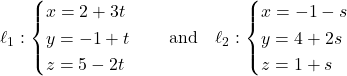
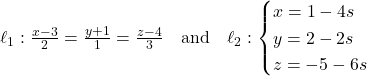
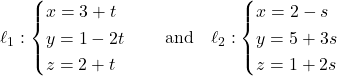
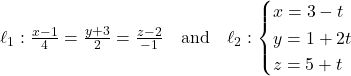
For each pair of lines below, determine their geometric relationship. Classify them as intersecting (and find their unique point of intersection), parallel, coincident, or skew.
- 1.
- 2.

- 3.
- 4.
- 5.

- 6.
Analyze the interaction between the given line and plane . State whether the line intersects at a unique point (and state its coordinates), is strictly parallel to the plane, or is completely contained within the plane.
- 1.

- 2.

- 3.

- 4.

- 5.

- 6.

Examine the relative positions of the given planes. Determine whether they are strictly parallel, coincident, or intersecting. If they intersect, find the parametric equations of their line of intersection .
- 1.

- 2.

- 3.

- 4.

- 5.

- 6.

Prove the geometric containment condition for the line and plane system given below.
- Show that the line
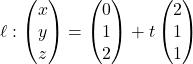 is completely contained in the plane
  .
.