We have seen that the integral can be used to calculate areas. We can also use the integral to find the length of a curve or even the volume of the shape created by rotating the graph of a function about the  -axis.
Solid of Revolution
Imagine sticking a straight metal skewer directly along the -axis and spinning the paper at a full 360-degree rotation. Take a function  from
from  to
to  . Using the metal skewer, we spin the paper and the flat 2D shape of the graph of starts spinning, it carves out a solid, 3D object in space. The straight line along the -axis stays completely still, forming the solid core centre of the object.
The curve spins through the air, forming the smooth outer crust/shell of the object.
Theorem (Volume of a Solid of Revolution – Disk Method): Let be a continuous and non-negative function on the closed interval ![[a, b]](https://mathematics.lu/wp-content/ql-cache/quicklatex.com-458a76d7f1dc15e9dc8be46976f8197d_l3.png "Rendered by QuickLaTeX.com") . When the region enclosed under the curve
. When the region enclosed under the curve  and the -axis is rotated
  around the -axis, the volume
  of the resulting three-dimensional solid is given by:
![\[V = \pi \int_a^b \big[f(x)\big]^2 \, dx\]](https://mathematics.lu/wp-content/ql-cache/quicklatex.com-6cfd2a1fbc9d966d7592e399a2a92084_l3.png "Rendered by QuickLaTeX.com")
To use this formula properly, you should work in steps. First write the formula, then replace and square it. Then, calculate the integral. If you are allowed a calculator which can do these integral calculations by itself, you can simply input ![[f(x)]^2](https://mathematics.lu/wp-content/ql-cache/quicklatex.com-758766202adb60dec277d3b315f61e40_l3.png "Rendered by QuickLaTeX.com") without expanding or simplifying your expression.
without expanding or simplifying your expression.
Example: Find the volume of the solid generated by revolving the region bounded by the curve  , the -axis,
  , and
, and  around the -axis.
![V = \pi \int_a^b [f(x)]^2 dx](https://mathematics.lu/wp-content/ql-cache/quicklatex.com-40b4553c7fa8f34a1062166498fb56fa_l3.png "Rendered by QuickLaTeX.com") . Plugging in our boundaries (
. Plugging in our boundaries ( ,
,  ) and our radius function
  gives:
![\[V = \pi \int_1^4 \big(x^2\big)^2 \, dx\]](https://mathematics.lu/wp-content/ql-cache/quicklatex.com-9d10671f94ddf23688c38a7236bf05dc_l3.png "Rendered by QuickLaTeX.com")
 ) simplifies the expression inside the integral:
![\[V = \pi \int_1^4 x^4 \, dx\]](https://mathematics.lu/wp-content/ql-cache/quicklatex.com-64079b43d9c41392fb81a6d35b2a0e21_l3.png "Rendered by QuickLaTeX.com")
 gives
gives  :
:![\[V = \pi \left[ \frac{x^5}{5} \right]_1^4\]](https://mathematics.lu/wp-content/ql-cache/quicklatex.com-d44bc56317092eb5d0bf582392a0d75a_l3.png "Rendered by QuickLaTeX.com")
 and subtract the lower bound at
  :
:![\[V = \pi \left( \frac{4^5}{5} - \frac{1^5}{5} \right)\]](https://mathematics.lu/wp-content/ql-cache/quicklatex.com-38b1a3736f1e6aec3ff2668b9dda119b_l3.png "Rendered by QuickLaTeX.com")
![\[V = \pi \left( \frac{1024}{5} - \frac{1}{5} \right)\]](https://mathematics.lu/wp-content/ql-cache/quicklatex.com-7c7f208ddf8ef692b6c993c8b1ca85dd_l3.png "Rendered by QuickLaTeX.com")
![\[V = \pi \left( \frac{1023}{5} \right) = 204.6\pi \approx 642.77 \text{ cubic units}\]](https://mathematics.lu/wp-content/ql-cache/quicklatex.com-cb67160327dbadccfef5681e69d23a62_l3.png "Rendered by QuickLaTeX.com")
Arc Length of a Function
Given some function from to we can use integrals to calculate the length of the curve that is the graph of . This is done as follows:
Theorem (Arc Length of a Function): Let be a smooth function such that its first derivative  is continuous on the closed interval . The arc length
  of the curve from
  to
to  is given by the definite integral:
![\[S = \int_{a}^{b} \sqrt{1 + \left[f'(x)\right]^2} \, dx\]](https://mathematics.lu/wp-content/ql-cache/quicklatex.com-e486dd10af687ba93455b85bd345b4b2_l3.png "Rendered by QuickLaTeX.com")
Here we are also required to work in steps. First find the derivative . Then replace into the formula and simplify if necessary. If the resulting expression is simple enough, you may be able to find the integral without a technological tool. Let us see an example of how we apply this formula.
Example: Set up the definite integral required to calculate the exact arc length of the curve  on the closed interval
 ![[0, 1]](https://mathematics.lu/wp-content/ql-cache/quicklatex.com-dffd9df7963df3c64a98c28cb5e7e715_l3.png "Rendered by QuickLaTeX.com") . Then, use a calculator to approximate the total length to
. Then, use a calculator to approximate the total length to  decimal places.
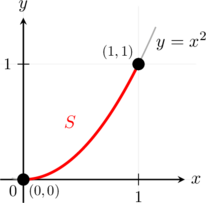
![\[f'(x) = 2x\]](https://mathematics.lu/wp-content/ql-cache/quicklatex.com-50f28b00d9ec7452635f2a218eac4ec9_l3.png "Rendered by QuickLaTeX.com")
 and our integration interval bounds
  and
and  into the standard arc length theorem equation:
![\[S = \int_{0}^{1} \sqrt{1 + (2x)^2} \, dx\]](https://mathematics.lu/wp-content/ql-cache/quicklatex.com-d407fe21304de749e67af72de842fefe_l3.png "Rendered by QuickLaTeX.com")
![\[S = \int_{0}^{1} \sqrt{1 + 4x^2} \, dx\]](https://mathematics.lu/wp-content/ql-cache/quicklatex.com-e2e03696866c36d82ed94a8cd993e88f_l3.png "Rendered by QuickLaTeX.com")
![\[S = \int_{0}^{1} \sqrt{1 + 4x^2} \, dx \approx1.4789...\]](https://mathematics.lu/wp-content/ql-cache/quicklatex.com-67fe3ba5804c489a587efb673d735cdf_l3.png "Rendered by QuickLaTeX.com")
Exercises
Calculate the volume of the solid generated by rotating the region bounded by the given curves around the -axis over the specified intervals.
1.  , the -axis, from
  to .
to .
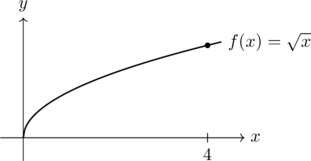
2.  , the -axis, from to
  .
.
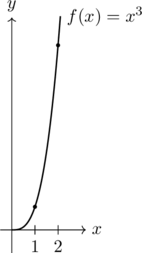
3.  , the -axis, from to
  .
.
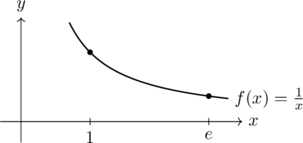
Prove the classical geometric volume formula for a cone,  , using the disk integration method.
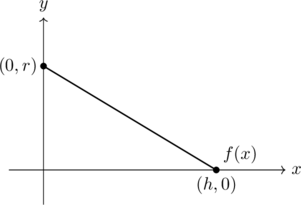
Consider a straight line starting at the point  on the
  -axis and slanting down to hit the -axis at the point
  . When the area beneath this linear profile line is spun around the -axis, it carves out a perfect cone with base radius
  and height
  . Refer to the graph below:
Steps to Complete the Proof:
- Find the equation of the line as a function of and .
- Use the formula for the solid of revolution volume with boundaries:
 and
and  .
. - Apply the Newton-Leibniz formula.
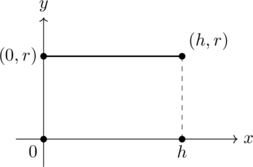
Prove the classical geometric volume formula for a cylinder,  , by applying the volume formula to the constant function
  from
from  to
to  .
.
For each of the following simple polynomial functions on their specified closed intervals, find the exact derivative expression, set up the definite integral for arc length, and then use your graphic or scientific calculator to compute the numerical result. Round all final answers to decimal places.

on
![[0, 2]](https://mathematics.lu/wp-content/ql-cache/quicklatex.com-e250a581660e7bfe3221162fa4497625_l3.png "Rendered by QuickLaTeX.com")

on

on

on
![[1, 3]](https://mathematics.lu/wp-content/ql-cache/quicklatex.com-70d1a084cbfd68b8d2f6cc936b93c538_l3.png "Rendered by QuickLaTeX.com")
- Differentiate the polynomial function to determine
 .
. - Set up the arc length definite integral expression using the formula
 .
. - Evaluate the integral with a calculator.