Derivatives are particularly useful when we study motion. If the position of an object changes with time, we can use derivatives to describe how the object is moving. Similarly, a change in velocity over time will yield an acceleration that could also change as a function of time.
Turns out the first and second derivative are key points in these problems.
The important thing is to think about what each derivative means. Do not just differentiate mechanically: ask yourself, What does this answer tell me about the motion of the object?
In the examples that follow, you will use these relationships to describe the motion of an object. You may be asked to find the velocity or acceleration at a particular time, determine when an object is at rest, decide whether it is moving forwards or backwards, or understand when it is speeding up or slowing down.
Displacement, Velocity, and Acceleration
Let  represent the displacement (or position) of an object at time
 . The velocity tells us how quickly the displacement is changing. Therefore, velocity is the derivative of displacement or:

 , the object is momentarily at rest.
We can go one step further. The acceleration tells us how quickly the velocity is changing. Therefore, acceleration is the derivative of velocity, that is:


- Displacement is typically measured from a reference point (origin). A positive displacement means we have moved forward from our starting position, a negative displacement means we have moved backwards.
- A positive velocity means the object is moving forward. A negative velocity means it is moving backwards. A velocity equal to 0 means it is at rest.
- A positive acceleration implies that the velocity increases with time. A negative acceleration is defined analogously. Acceleration equal to 0 implies the speed is constant.
- The term “initial conditions” in word problems refer to the beginning of the experiment, so at
 .
- All the functions
 ,
 , and
 depend on (time).
- A motion diagram describes how the particle/object has moved in the experiment.
- The total distance travelled is not the same as the displacement. If you move 4 metres to the right, and then 3 to the left, you will have moved 7 metres in total, but you will be displaced 1 metre away from your starting point.
Word Problems
Our first example will simply deal with the concept of average and instantaneous rate of change of displacement, which we now know is the velocity.
Example: A vehicle departs from a checkpoint. The function  gives the distance of the vehicle from the checkpoint, where the distance
 is in meters and the time is in seconds.
- How far is the vehicle from the checkpoint after
 seconds?
- Determine the average speed (in m/s) of the vehicle during the first seconds (from
 to
 ).
- Determine the instantaneous speed (in m/s) of the vehicle at the time seconds.
- At what time does the vehicle reach an instantaneous speed of
 ?

 :

 , substitute the values into the formula:

 seconds:
 . Differentiate the polynomial term using the power rule:


 and solve for

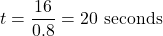
 away. Its average speed over that interval is
 , and its exact instantaneous speed at the
 . It reaches a speed of
 .
We can also discuss movement of a particle or an object given these functions and study exactly when they change direction (when the velocity changes sign), when they stop, and what their distance from the origin is, or the total distance travelled in the journey.
Example: A particle moves in a straight line with position relative to an origin  given by

where  is measured in seconds.
- Find an expression for the velocity
 and an expression for the acceleration
 as a function of .
- Find the initial position, velocity, and acceleration, and describe the particle’s initial motion.
- Find the position of the particle at the instants when it changes direction.
- Draw a motion diagram of the particle.
- Find the total distance traveled by the particle in the first 5 seconds.
 :

 :




 to the left of the origin
 , it is moving to the right. Because
 , its acceleration is directed to the left, meaning it is initially slowing down.
 ):

 and
 . Let us compute the positions at these times:


 (turning left) and at
 (turning right again).

 : travels from
 to
 .
 to
 .

 to
 .

Exercises
A surveillance drone takes off vertically from its landing pad. Its altitude from the ground is modeled by the function  , where the distance is given in meters and the time is measured in seconds.
- How high is the drone above the landing pad after
 seconds?
- Determine the average speed (in m/s) of the drone during the first seconds.
- Determine the instantaneous speed (in m/s) of the drone at the time
 seconds.
- At what time does the drone reach an instantaneous vertical speed of
 ?
An electric scooter accelerates from rest down a straight test track. The function  represents the distance traveled by the scooter from the starting line, where is in meters and is in seconds.
- How far is the scooter from the starting line after
 seconds?
- Determine the average speed (in m/s) of the scooter during the first seconds.
- Determine the instantaneous speed (in m/s) of the scooter at the time
 seconds.
- At what time does the scooter reach an instantaneous speed of
 ?
During a physics experiment, a motorized dynamics cart moves along a linear track. Its position relative to a sensor is given by the function  , where is given in meters and is in seconds.
- How far is the cart from the sensor after
 seconds?
- Determine the average speed (in m/s) of the cart during the first seconds.
- Determine the instantaneous speed (in m/s) of the cart at the time
 seconds.
- At what time does the cart reach an instantaneous speed of
 ?
A magnetic slider inside a precision laboratory instrument moves along a linear track. Its position relative to a zero reference origin is given by the function:

where is measured in seconds.
- Find an expression for the component’s velocity and its acceleration as a function of time.
- Determine the initial position, velocity, and acceleration parameters, and describe the movement at that instant.
- Find the exact positions of the component when the direction of travel changes.
- Draw a motion diagram.
- Calculate the total distance travelled by the component during the first seconds of tracking.
An automated test vehicle drives back and forth along a straight hallway. Its displacement relative to a calibrated marker is governed by the model:

where represents the active monitoring timeframe in seconds.
- Derive expressions for both the velocity and the acceleration of the vehicle.
- Evaluate the initial system metrics (
 ,
 ,
 ) and give a description of the vehicle’s initial speed changes and direction.
- Identify the time and position of the vehicle when it turns around to reverse its direction.
- Draw a motion diagram tracking the path of the vehicle.
- Find the total distance moved by the car across the first seconds of testing.
A manufacturing cylinder extends and retracts under high-pressure gas controls. The stroke displacement of its central shaft from a safety baseline housing line follows the equation:

where maps running intervals in seconds.
- Express the velocity and acceleration as a function of .
- Record the initial conditions (position, velocity, and acceleration) and describe the motion.
- When is the mechanism changing direction?
- Draw a motion diagram demonstrating the movement of the mechanism.
- Calculate the total distance traversed by the piston mechanism during the first seconds of cycling.