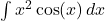
In this page, we will discuss two important techniques for integration that are seen in 5 periods. Namely: Integration by substitution and integration by parts.
Knowledge required: Rules for derivatives (product and chain rule), basic integrals.
As a reminder, we have the following list:
 |  |
 |  |
 |  |
 |  |
 |  |
 |  |
 |  |
Moreover, we know the following properties of integrals for any two functions and  and for any constant
 .


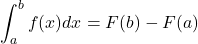
Finally, the Newton Leibniz Theorem states that for some integrable function with primitive  we have:
Motivation for Integration by Substitution
When given an integral our only tool to understand the answer is whether the function appears on our list. This gives a very limited number of options to find integrals.
Integration by substitution is a method used to simplify integrals by “changing variables”. It is the analogue to the chain rule from differentiation. If a function is composed with another, substitution helps us undo the composition to integrate more easily. The goal is to obtain an easier expression to integrate.
Opening Problem: Say we are asked to find  . This function is not on our table. However, we would possibly guess that the answer should be the same thing (after all,
 ). Then: we would say:

 is:

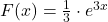 . Let us try finding the derivative again and see if we are right.

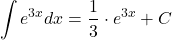
Substitution is a method that helps us predict that extra step (given by the chain rule) and prepare for it accordingly.
How to Use Integration by Substitution
Given an integral of the form:  , integration by substitution consists on defining a new function
 . We cannot just replace by
 because we still have the
 factor of the integral. To fix this, we also need to substitute the . If we derive each side according to its own variable, we get:

Therefore, we can substitute both
 and in the original integral to get:

This will result in an easier integral to use. Below is the formal statement and proof, as an optional read.
Theorem (Integration by Substitution): Let be a differentiable function and let  be a continuous function where
 . Then, the integral of their composite product can be expressed as:

 be a primitive (antiderivative) of
 . If we differentiate the composite function
 with respect to

 back into the derivative equation:


 :

 and

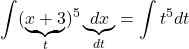
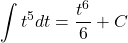
Example: Find the integral  .
 to just be some variable

 , the derivative of
 . Therefore, we have:


Example: Find the integral  .

 :






Example: Find the integral  .

 . Also, we must replace the
 , we can solve for

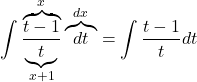



Not every substitution will be evident and we could also choose the wrong function to substitution. We will know this is the case if after replacing we are left somewhere with the old variable.
When Substitution is Immediate/Not Necessary
When instead of an your variable is a translation of , so  with
 a constant, the substitution should be immediate.
Example: Find the integral without using substitution.
 , so we aren’t changing the value):
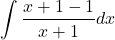
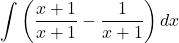
 :
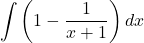
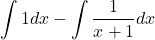
 is
 is
 (since the derivative of
 is just

Check Your Understanding (Substitution)
Find the integral  , where
 and
 are constants.
Solution: We use substitution by letting the exponent be our new variable:

and are constants):


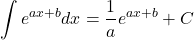
Find the integral  , where and are constants.
Solution: Let  . Then
 , which means
 .
Substituting these into the expression:
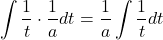
 is
 :

Find the integral  .
Solution: Notice that the numerator is the derivative of the denominator. We let:


and  directly into the integral:
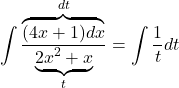
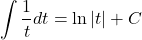

Integration by Parts
Just like substitution is the analogue to the chain rule, we have an analogue for the product rule. This is called integration by parts. It is used when you have an integral with a product of functions.
Theorem (Integration by Parts): If and are differentiable functions, then the integral of their product can be expressed as:



 . We simply move one of the integrals on the right side to get the desired result:

The way to use it is the following, look at your integral and choose what function you want to play the role of and which one plays the role of  . Regardless of your choice, you will have to find
 and . Then, simply copy paste each function into its formula. If done correctly, you will be left with an integral that is easier.
Example: Find the integral  .
 . Let:




Here we chose to be because once we find its derivative, the will disappear. Similarly, we do not want to choose to be a function that we do not know how to integrate, so many of these examples are somewhat self-guiding.
Example: Find the integral  .



Example: Find the integral  .




Special Cases of Integration by Parts
Some integrals will require you to use integration by parts twice (or even more). Otherwise, there is a common trick that is useful when the integration by parts creates an integral that is equally challenging as the first one. The examples below are meant to show you how to interact with those.
Example: Find the integral  using integration by parts twice.






Intuitively, as soon as we choose  we know that integration by parts will leave us with
 in our next integral. Therefore, it should be clear that a second integration by parts will make the disappear completely and leave us just with .
Our next example is sometimes referred to as the “looping integral trick”. We recognise an expression that will recreate our original integral.
Example: Find the integral  .


 . Keeping our assignment consistent, let:






Definite Integrals with Substitution and Integration by Parts
The techniques we have seen also have a counterpart when we use definite integrals (the Newton-Leibniz Theorem). For integration by parts, nothing changes. However, for substitution, the interval changes accordingly.
Theorem (Definite Integration by Substitution): If is a differentiable function on the interval  and is continuous, combining substitution with the Newton-Leibniz formula gives:

Example: Evaluate the definite integral 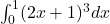 .
 .
 , which gives
 . Substituting these into the integral gives:

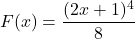
 using our original limits of integration:




Theorem (Definite Integration by Parts): If and are differentiable functions on the closed interval , then combining integration by parts with the Newton-Leibniz formula gives:

Example: Evaluate the definite integral  .

 to
 :
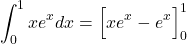
 and subtract the lower bound
 :



Exercises
Evaluate the following integrals using the suggested substitution :
 using the substitution

 using the substitution

 using the substitution

 using the substitution

 using the substitution

 using the substitution

 using the substitution

 using the substitution

Evaluate these integrals by identifying the appropriate substitution yourself:





Evaluate the following integrals using algebraic manipulation in the numerator (adding and subtracting the same constant) to separate the fractions.
Example Hint: For  , you can write
 .


Evaluate the following integrals using the suggested  and
 :
 (Let
 )
 (Let
 )
 (Let
 )
 (Let
 )
Identify and and evaluate the following:



Evaluate the following definite integrals using the appropriate technique (substitution or integration by parts):


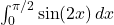
Evaluate the following integrals using integration by parts twice, then gather the target integral on the left-hand side to solve:


Evaluate the following integrals by applying the integration by parts method successively two times: