In this page, we apply our knowledge of periodic functions to real-life situations and word problems. Using examples such as tidal waves, ocean levels, daylight hours, Ferris wheels, and other repeating phenomena, we see how mathematical models can be used to describe patterns that occur regularly over time.
We need to interpret information from word problems, identify key features such as the amplitude, period, midline, and phase shift, and use trigonometric functions to model and predict future events.
Understanding the Parameters from Instructions
In the examples below, we are given the instructions and we need to understand the parameters.
Example: In the harbor of a coastal town, the water depth changes periodically with the tides. A oceanographer records the following observations:
- The water depth reaches a minimum value of 8 meters at the time
 hours.
- Exactly six hours later, the water depth reaches a maximum value of 14 meters.
- Twelve hours after the first minimum was recorded, the water depth returns to its minimum value of 8 meters.
- Explain in words, without performing any calculations, why the water depth
 can be modeled by a function of the form
 , where is in meters and
 is in hours.
- Determine the period of the model.
- Determine the amplitude of the model.
- Find the values of all parameters
 ,
 ,
 , and
 .
 hours.
 and the minimum value
 :


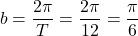
 ) after its ascending midline crossing point. Since
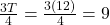 hours, and our minimum occurs at

 hours.
 ,
 ,
 , and
 , yielding the final modeled equation
 .
The next example is, in essence, the typical example for calculating  and just given with some context.
Example: The lowest low-tide level at a particular bay is chosen as the reference baseline. The water height can be modeled by the following function  :

where is the time (in hours) and  is the water height at time (in meters). The graph of the function over a 24-hour period is shown below:
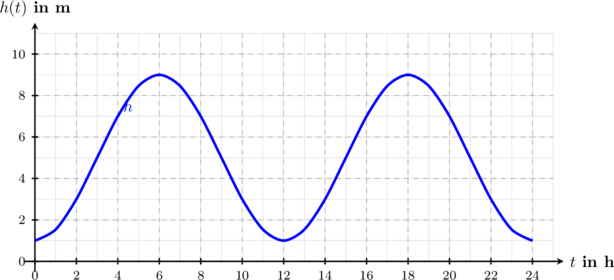
- Graphically read the values of parameters and .
- Using the graph, determine the value of parameter .




 and
 .
 ) is the horizontal distance required for the wave to complete one full repeating cycle. Looking at the graph, the curve begins at a minimum at
 hours. Therefore, the period is:

Word Problems
In the word problems below, we identify the parameters that are given to us and use them along with the function to find unknowns.
Example: A large ferris wheel at an amusement park rotates at a constant speed. A rider’s height (in meters) above the ground minutes after the ride begins can be modeled by the periodic function:

- Identify the maximum and minimum heights a rider reaches above the ground, and state the amplitude of the function.
- Calculate the period of the function and interpret what it represents in the context of the ride.
- Determine the rider’s height above the ground exactly 3 minutes after the ride begins.
 by an amount equal to its vertical scaling coefficient
 . We find the extrema by evaluating the highest and lowest outputs:


 . It represents the radius of the ferris wheel.
 . We compute the horizontal cycle duration using the standard period formula:

 . In this context, it represents the time required for the ferris wheel to complete one full revolution.
 minutes


 , the expression evaluates to:

 and a maximum height of
 with an amplitude of
 . The ferris wheel completes one full revolution every
 -minute mark, the rider reaches the highest point of the ride at exactly
 above the ground.
The next example is one where we also interpret the context into understanding a situation modelled with a trigonometric function. The function used below is cosine although you will quickly understand that nothing changes from the typical understanding you have of the sine function.
Example: The water depth in a harbor basin can be described by the following function  , where is the time after midnight (in hours) and
 is the water depth at time (in meters):

- Interpret the meaning of the number 5 in the expression of within the context of this exercise.
- Calculate the water depth at 4:30 AM.
- Indicate, within the context of this exercise, how to interpret the values of that are solutions to the equation
 .
 , the constant term 5 represents the vertical shift or the midline axis of the function. In the context of this problem, it means that the average (or mean) water depth in the harbor basin is 5 meters, around which the tides oscillate up and down by 2.4 meters.
 hours. Substitute



 represents the instantaneous rate of change of the water depth with respect to time. Setting
Our final example combines a bit of everything that was given in the examples above, finding parameters based on the function given, understanding the meaning of the parameters, graph sketching, and finding values using the function.
Example: The function  can be used to model the altitude (in meters) of a passenger on a giant observation Ferris wheel, where is the elapsed time in minutes after departure.
- Determine the period of the Ferris wheel.
- Determine the amplitude of the Ferris wheel.
- Estimate the altitude of a passenger
 minutes after departure.
- At what height above the ground is the boarding platform located?
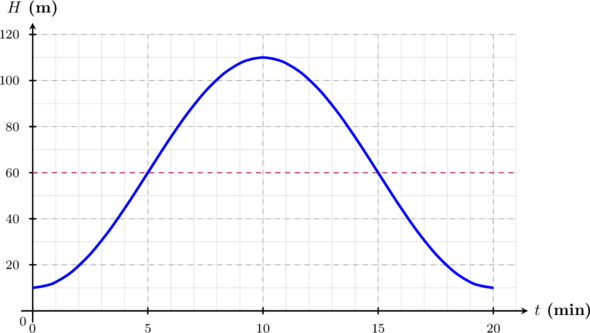
- Sketch a graph of the function for one complete cycle.
 . Using our standard horizontal cycle formula:

 minutes, which represents the time required to complete one full revolution.

 meters, which corresponds to the physical radius of the observation wheel.


 meters.

 , the expression evaluates to:

 meters above the ground.
 , an amplitude of
 ), and a horizontal shift of
 units to the right, we map one full
Exercises
The water depth  (in meters) at a deep-water shipping port fluctuates with the tides. On a specific day, the depth hours after midnight is modeled by the function:

- Find the maximum and minimum water depths at this port, and state the amplitude of the tidal function.
- Determine the period of the function and interpret its meaning in the context of the tidal system.
- Calculate the exact water depth at 8:00 AM, rounding your answer to two decimal places.
A large industrial wind turbine rotates at a fixed rate. The height (in meters) of the tip of one specific blade above the ground seconds after passing its lowest point is given by:

- Explain the geometric and physical meaning of the constant
 in this model.
- Calculate how many seconds it takes for the wind turbine to complete one full 360-degree rotation.
- Determine the height of the blade tip above the ground at
 seconds.
The average daily maximum temperature  (in degrees Celsius) in a desert community can be approximated as a function of the month of the year
 (where
 represents January,
 February, etc.) using the model:

- Determine the highest and lowest average maximum temperatures experienced by this community over a full year.
- Calculate the average daily maximum temperature during the month of October (
 ).
- Find the value of where the function first reaches its vertical midline value while increasing, and name the corresponding month.
During quiet rest, the velocity of air flow  (in liters per second) into or out of a person’s lungs can be modeled as a function of time (in seconds) by the model:
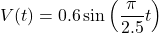
Positive values denote inhalation (air flowing into the lungs), while negative values denote exhalation (air flowing out).
- Determine the maximum rate of air flow during inhalation.
- Find the duration of one complete respiratory cycle (one full inhalation and one full exhalation block).
- Calculate the air flow velocity at
 seconds, and describe what the person’s respiratory state is at this moment.
Passengers board a giant tourist observation wheel from an elevated platform. A rider’s height in meters above the ground minutes after boarding is modeled by:

- Determine the time required for the Star Observation Wheel to make one complete revolution.
- Calculate the height above the ground of the passenger boarding platform (
 ).
- Calculate the exact mathematical derivative expression
 to represent the instantaneous vertical speed of the capsule.
A high-frequency laboratory tuning fork is struck, emitting a pure acoustic tone. The microscopic displacement  (in millimeters) of the tip of the metal prong from its neutral rest position after milliseconds is described by:

- State the amplitude of the prong vibration.
- Calculate the period of the sound vibration in milliseconds.
- Calculate the exact value of the displacement at
 milliseconds.