This is the main theorem in the complex numbers unit. Our motivation is the following:
How many solutions are there to the equation  ? We have two solutions
  and
and  .
.
What about  ? If the square root gives you two solutions, why does the cubic root only give us 1? The reality is that it gives us 3 solutions, we are used to always think of the real solution, but there are two more solutions that are complex numbers.
Motivational Example: Verify that  ,
,  , and
, and  are all valid solutions to the cubic equation
  by directly cubing each expression.
To prove these are solutions, we will expand each number to the third power using basic algebra and distributive laws, rather than solving for them from scratch.
1. Verification of
This is the immediate real solution:
![\[z^3 = (2)^3 = 2 \cdot 2 \cdot 2 = 8\]](https://mathematics.lu/wp-content/ql-cache/quicklatex.com-65d804a762c67bc1e1546c5513fa1fc6_l3.png "Rendered by QuickLaTeX.com")
Thus, is a valid solution.
2. Verification of
We first calculate the square of the expression,  :
:
![\[z^2 = (-1 - i\sqrt{3})(-1 - i\sqrt{3})\]](https://mathematics.lu/wp-content/ql-cache/quicklatex.com-f711da45bb6ce317ffa0c721895273c4_l3.png "Rendered by QuickLaTeX.com")
![\[z^2 = (-1)(-1) + (-1)(-i\sqrt{3}) + (-i\sqrt{3})(-1) + (-i\sqrt{3})(-i\sqrt{3})\]](https://mathematics.lu/wp-content/ql-cache/quicklatex.com-ec1adea35c2f4b81b2f840930891499b_l3.png "Rendered by QuickLaTeX.com")
![\[z^2 = 1 + i\sqrt{3} + i\sqrt{3} + i^2(3)\]](https://mathematics.lu/wp-content/ql-cache/quicklatex.com-e67464990deeb35aaf8def49854452e2_l3.png "Rendered by QuickLaTeX.com")
Substitute  into the equation:
![\[z^2 = 1 + 2i\sqrt{3} - 3 = -2 + 2i\sqrt{3}\]](https://mathematics.lu/wp-content/ql-cache/quicklatex.com-5097c381a809782c17faadc44f4c30fe_l3.png "Rendered by QuickLaTeX.com")
Now, we multiply this result by the linear term to find the cube,  :
:
![\[z^3 = (-2 + 2i\sqrt{3})(-1 - i\sqrt{3})\]](https://mathematics.lu/wp-content/ql-cache/quicklatex.com-dce4b35ef7b0296d9283dab24d6a7733_l3.png "Rendered by QuickLaTeX.com")
![\[z^3 = (-2)(-1) + (-2)(-i\sqrt{3}) + (2i\sqrt{3})(-1) + (2i\sqrt{3})(-i\sqrt{3})\]](https://mathematics.lu/wp-content/ql-cache/quicklatex.com-4c44b7047a89bbfbbffc06385a0508b0_l3.png "Rendered by QuickLaTeX.com")
![\[z^3 = 2 + 2i\sqrt{3} - 2i\sqrt{3} - 2i^2(3)\]](https://mathematics.lu/wp-content/ql-cache/quicklatex.com-f34b51877fb90bcd8aaef3a73bb74afd_l3.png "Rendered by QuickLaTeX.com")
Notice the imaginary middle terms cancel out perfectly. Substitute to finish:
![\[z^3 = 2 - 6(-1) = 2 + 6 = 8\]](https://mathematics.lu/wp-content/ql-cache/quicklatex.com-cba27c585964a1b6709e8def41daea85_l3.png "Rendered by QuickLaTeX.com")
Thus, is a valid solution.
3. Verification of
We expand the square of this expression similarly:
![\[z^2 = (-1 + i\sqrt{3})(-1 + i\sqrt{3})\]](https://mathematics.lu/wp-content/ql-cache/quicklatex.com-a1a5072eb3c6beea6c143bc9cbb83885_l3.png "Rendered by QuickLaTeX.com")
![\[z^2 = (-1)(-1) + (-1)(i\sqrt{3}) + (i\sqrt{3})(-1) + (i\sqrt{3})(i\sqrt{3})\]](https://mathematics.lu/wp-content/ql-cache/quicklatex.com-607d11b3774ede6015a7048b0c0cef13_l3.png "Rendered by QuickLaTeX.com")
![\[z^2 = 1 - i\sqrt{3} - i\sqrt{3} + i^2(3)\]](https://mathematics.lu/wp-content/ql-cache/quicklatex.com-3bf4df80dbccc44f6485103065934925_l3.png "Rendered by QuickLaTeX.com")
![\[z^2 = 1 - 2i\sqrt{3} - 3 = -2 - 2i\sqrt{3}\]](https://mathematics.lu/wp-content/ql-cache/quicklatex.com-c08133f3c1576139e4dd832d91276ef8_l3.png "Rendered by QuickLaTeX.com")
Now, we multiply this result by the remaining linear term to find the cube:
![\[z^3 = (-2 - 2i\sqrt{3})(-1 + i\sqrt{3})\]](https://mathematics.lu/wp-content/ql-cache/quicklatex.com-8723306ff45bbc1aebe6fce64c59a481_l3.png "Rendered by QuickLaTeX.com")
![\[z^3 = (-2)(-1) + (-2)(i\sqrt{3}) + (-2i\sqrt{3})(-1) + (-2i\sqrt{3})(i\sqrt{3})\]](https://mathematics.lu/wp-content/ql-cache/quicklatex.com-11caaf27ff3b552914114cf8e0590d84_l3.png "Rendered by QuickLaTeX.com")
![\[z^3 = 2 - 2i\sqrt{3} + 2i\sqrt{3} - 2i^2(3)\]](https://mathematics.lu/wp-content/ql-cache/quicklatex.com-f23da302e1f62cf5e1412db375bb966b_l3.png "Rendered by QuickLaTeX.com")
The imaginary components cancel out again. Substitute :
Thus, is a valid solution.
Motivation Note: While expanding these by hand works for power 3, imagine trying to find or check solutions for equations like  . This tedious polynomial expansion shows why we need a geometric approach using angles and lengths, which leads directly to De Moivre’s Theorem.
The De Moivre theorem helps us in either of the following cases:
- Calculating powers/products of complex numbers,
- Calculating roots of complex numbers,
- Solving equations of the form
 .
.
De Moivre Theorem – Exponential Case
Theorem (De Moivre’s Theorem for Powers): If  is a complex number expressed in polar form and
  is any integer, then raising the complex number to the power of multiplies the argument by and raises the modulus to the power of :
![\[z^n = \big[r(\cos\theta + i\sin\theta)\big]^n = r^n(\cos(n\theta) + i\sin(n\theta))\]](https://mathematics.lu/wp-content/ql-cache/quicklatex.com-3d53f92b0af02791fb2219ceac0fc356_l3.png "Rendered by QuickLaTeX.com")
This theorem demonstrates that raising a complex number to an integer power corresponds geometrically to scaling its distance from the origin by  and rotating its angle around the origin by a factor of .
This helps us make some calculations faster:
Example: Evaluate  by applying De Moivre’s Theorem. Express the final result in standard Cartesian form
  .
.
 to polar form
 and
and  (First Quadrant):
 ):
): 

![\[z = 2\left(\cos\left(\frac{\pi}{3}\right) + i\sin\left(\frac{\pi}{3}\right)\right)\]](https://mathematics.lu/wp-content/ql-cache/quicklatex.com-84250a36e2d9a5bdb182958348ecd578_l3.png "Rendered by QuickLaTeX.com")

 . Substituting our parameters yields:
![\[z^5 = 2^5\left(\cos\left(5 \cdot \frac{\pi}{3}\right) + i\sin\left(5 \cdot \frac{\pi}{3}\right)\right)\]](https://mathematics.lu/wp-content/ql-cache/quicklatex.com-c0be015d64d3e1defe6527e74cd62649_l3.png "Rendered by QuickLaTeX.com")
![\[z^5 = 32\left(\cos\left(\frac{5\pi}{3}\right) + i\sin\left(\frac{5\pi}{3}\right)\right)\]](https://mathematics.lu/wp-content/ql-cache/quicklatex.com-bc4313bfb41c8c5915d0e88dbadb4ba5_l3.png "Rendered by QuickLaTeX.com")
 (
( ) is located in the **fourth quadrant**, where cosine is positive and sine is negative. Using the reference angle
  (
( ), we evaluate the basic trigonometric ratios:
![\[\cos\left(\frac{5\pi}{3}\right) = \cos\left(\frac{\pi}{3}\right) = \frac{1}{2}\]](https://mathematics.lu/wp-content/ql-cache/quicklatex.com-29c3d2b83a392d9af39092f643e94ea8_l3.png "Rendered by QuickLaTeX.com")
![\[\sin\left(\frac{5\pi}{3}\right) = -\sin\left(\frac{\pi}{3}\right) = -\frac{\sqrt{3}}{2}\]](https://mathematics.lu/wp-content/ql-cache/quicklatex.com-73685bbbd3aabd0e7145ac1d007b90ca_l3.png "Rendered by QuickLaTeX.com")
![\[z^5 = 32\left(\frac{1}{2} - i\frac{\sqrt{3}}{2}\right)\]](https://mathematics.lu/wp-content/ql-cache/quicklatex.com-8346bb1aa2bb87e302c1d571517ee505_l3.png "Rendered by QuickLaTeX.com")
![\[z^5 = 32\left(\frac{1}{2}\right) - i \cdot 32\left(\frac{\sqrt{3}}{2}\right) = 16 - 16i\sqrt{3}\]](https://mathematics.lu/wp-content/ql-cache/quicklatex.com-ac860fa850692c8e55fc436c152f444d_l3.png "Rendered by QuickLaTeX.com")
This is definitely preferred to have to open brackets on an expression to the fifth power. Just as a reminder, Pascal’s triangle gives the formula:  .
.
The key to using De Moivre in this form is always the same, write your number in polar form, then use the theorem.
De Moivre Theorem – Root Case
Theorem (De Moivre’s Theorem for Roots): If is a non-zero complex number expressed in polar form and is a positive integer, then  has exactly distinct complex -th roots. These roots are given by the formula:
![\[z_k = \sqrt[n]{r} \left( \cos\left(\frac{\theta + 2k\pi}{n}\right) + i\sin\left(\frac{\theta + 2k\pi}{n}\right) \right)\]](https://mathematics.lu/wp-content/ql-cache/quicklatex.com-a67482050660dffb21ab43f3eb429a3e_l3.png "Rendered by QuickLaTeX.com")
where the different solutions are obtained by replacing  by 0, 1, …,
  .
.
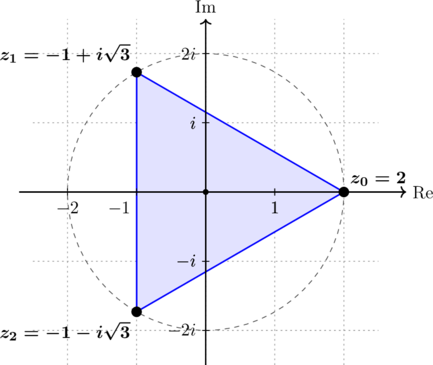
Geometrically, all distinct roots lie perfectly on a circle centred at the origin with a radius of ![\sqrt[n]{r}](https://mathematics.lu/wp-content/ql-cache/quicklatex.com-d85419a90af6af4a2fa5b22d26554b3b_l3.png "Rendered by QuickLaTeX.com") . They are equally spaced around the circle, separated from one another by an angle of
. They are equally spaced around the circle, separated from one another by an angle of  radians. If you are calculating all the fourth roots, each solution will be at a rotation of 90 degrees from the next/previous one. The solutions always form a regular polygon.
Let us now use this theorem to really find all the cubic roots of 8.
Example: Solve the equation by applying De Moivre’s Theorem for roots. Express all distinct solutions in standard Cartesian form .
 into its polar form, apply the root formula, and evaluate it for index steps
  .
.

![\[z^3 = 8(\cos(0) + i\sin(0))\]](https://mathematics.lu/wp-content/ql-cache/quicklatex.com-66114b5fa21f37d0c245d69590773a2c_l3.png "Rendered by QuickLaTeX.com")
 , the solutions are given by:
![\[z_k = \sqrt[3]{8} \left( \cos\left(\frac{0 + 2k\pi}{3}\right) + i\sin\left(\frac{0 + 2k\pi}{3}\right) \right) = 2 \left( \cos\left(\frac{2k\pi}{3}\right) + i\sin\left(\frac{2k\pi}{3}\right) \right)\]](https://mathematics.lu/wp-content/ql-cache/quicklatex.com-4924d7a7e48d35b66ee5e23c1c118ea2_l3.png "Rendered by QuickLaTeX.com")
 :
:![\[z_0 = 2(\cos(0) + i\sin(0)) = 2(1 + i \cdot 0) = 2\]](https://mathematics.lu/wp-content/ql-cache/quicklatex.com-46e86d2960531f9d06f6642de6b46b56_l3.png "Rendered by QuickLaTeX.com")
 :
: , which lies in the second quadrant (negative cosine, positive sine):
![\[z_1 = 2\left(\cos\left(\frac{2\pi}{3}\right) + i\sin\left(\frac{2\pi}{3}\right)\right) = 2\left(-\frac{1}{2} + i\frac{\sqrt{3}}{2}\right) = -1 + i\sqrt{3}\]](https://mathematics.lu/wp-content/ql-cache/quicklatex.com-3ce33b25a2ded3d4e3df40f1ad48bd30_l3.png "Rendered by QuickLaTeX.com")
 :
: , which lies in the third quadrant (negative cosine, negative sine):
![\[z_2 = 2\left(\cos\left(\frac{4\pi}{3}\right) + i\sin\left(\frac{4\pi}{3}\right)\right) = 2\left(-\frac{1}{2} - i\frac{\sqrt{3}}{2}\right) = -1 - i\sqrt{3}\]](https://mathematics.lu/wp-content/ql-cache/quicklatex.com-afe3b5a10c387da820274abdd0b183c1_l3.png "Rendered by QuickLaTeX.com")
Some Applications of the De Moivre Theorem
The examples below show how useful De Moivre’s theorem can be for dealing with complex numbers and powers.
Example: Evaluate the product  by applying De Moivre’s Theorem. Express the final answer in standard Cartesian form .

 , the coordinates are
  (First Quadrant):
 ):
): 
 ):
): 
 yields:
![\[(1 + i)^4 = (\sqrt{2})^4 \left( \cos\left(4 \cdot \frac{\pi}{4}\right) + i\sin\left(4 \cdot \frac{\pi}{4}\right) \right)\]](https://mathematics.lu/wp-content/ql-cache/quicklatex.com-939c6e4e8bce6e1ae831a986b6e8c0fd_l3.png "Rendered by QuickLaTeX.com")
![\[(1 + i)^4 = 4 (\cos\pi + i\sin\pi)\]](https://mathematics.lu/wp-content/ql-cache/quicklatex.com-f25f4f8517714d181cb0fd662c018c68_l3.png "Rendered by QuickLaTeX.com")

 , the coordinates are
  (Fourth Quadrant):
 ):
): 
 ):
): 
 yields:
![\[(1 - i\sqrt{3})^6 = 2^6 \left( \cos\left(6 \cdot \left(-\frac{\pi}{3}\right)\right) + i\sin\left(6 \cdot \left(-\frac{\pi}{3}\right)\right) \right)\]](https://mathematics.lu/wp-content/ql-cache/quicklatex.com-64c0fd8664666883739ad083a0b4ac04_l3.png "Rendered by QuickLaTeX.com")
![\[(1 - i\sqrt{3})^6 = 64 (\cos(-2\pi) + i\sin(-2\pi))\]](https://mathematics.lu/wp-content/ql-cache/quicklatex.com-2ace3ddf95dd4a238244a57c4160707c_l3.png "Rendered by QuickLaTeX.com")
 is coterminal with
  , so we can write this as:
![\[(1 - i\sqrt{3})^6 = 64 (\cos(0) + i\sin(0))\]](https://mathematics.lu/wp-content/ql-cache/quicklatex.com-986792c30929b2842e9f3ab9eeeaa881_l3.png "Rendered by QuickLaTeX.com")
![\[\text{Product} = [4 (\cos\pi + i\sin\pi)] \cdot [64 (\cos(0) + i\sin(0))]\]](https://mathematics.lu/wp-content/ql-cache/quicklatex.com-5a8ffd5e4310a0392679c38fa3b13145_l3.png "Rendered by QuickLaTeX.com")
![\[\text{Product} = (4 \cdot 64) \cdot (\cos(\pi + 0) + i\sin(\pi + 0))\]](https://mathematics.lu/wp-content/ql-cache/quicklatex.com-7e3a8483956923293d580b778434f4fb_l3.png "Rendered by QuickLaTeX.com")
![\[\text{Product} = 256 (\cos\pi + i\sin\pi)\]](https://mathematics.lu/wp-content/ql-cache/quicklatex.com-2552bedc412edb534cfd1961ec457e6a_l3.png "Rendered by QuickLaTeX.com")
 (
( ):
):![\[\cos\pi = -1\]](https://mathematics.lu/wp-content/ql-cache/quicklatex.com-bc3f21fcd90335f6440b1fbaa38ddf0b_l3.png "Rendered by QuickLaTeX.com")
![\[\sin\pi = 0\]](https://mathematics.lu/wp-content/ql-cache/quicklatex.com-87a60aadbafc6c512071b24adaa40fd3_l3.png "Rendered by QuickLaTeX.com")
![\[\text{Product} = 256 (-1 + i \cdot 0) = -256\]](https://mathematics.lu/wp-content/ql-cache/quicklatex.com-ec330eae6b09520e3d62585551496aee_l3.png "Rendered by QuickLaTeX.com")
Example: Prove that  is a real number. Find its exact value using Euler’s form.
 in exponential polar form
 and sits directly on the positive vertical axis, giving it an argument of
  . Using Euler’s formula (
 ), we write the base as:
![\[i = 1 \cdot e^{i\frac{\pi}{2}} = e^{i\frac{\pi}{2}}\]](https://mathematics.lu/wp-content/ql-cache/quicklatex.com-cb588631c7d187101921d9e47be90d47_l3.png "Rendered by QuickLaTeX.com")
![\[i^i = \left(e^{i\frac{\pi}{2}}\right)^i\]](https://mathematics.lu/wp-content/ql-cache/quicklatex.com-6bc4f6b8b1bd1a3548bf8245505399f2_l3.png "Rendered by QuickLaTeX.com")
 ):
):![\[i^i = e^{\left(i\frac{\pi}{2} \cdot i\right)} = e^{i^2\frac{\pi}{2}}\]](https://mathematics.lu/wp-content/ql-cache/quicklatex.com-3d74f20a3ff91db8645e3b755bb086df_l3.png "Rendered by QuickLaTeX.com")
![\[i^i = e^{(-1)\frac{\pi}{2}} = e^{-\frac{\pi}{2}}\]](https://mathematics.lu/wp-content/ql-cache/quicklatex.com-23d1dbee2359fac2b4860ad73f50c5f8_l3.png "Rendered by QuickLaTeX.com")
 , which is approximately
  . In particular, this is a real number.
We have used it above to find powers and products of complex numbers. We can also use it in a more general form to show other properties.
Example: Prove that if  , then
  for any integer , where
  is the argument of .
 , we can write
 ![\[z = 1(\cos\theta + i\sin\theta) = \cos\theta + i\sin\theta\]](https://mathematics.lu/wp-content/ql-cache/quicklatex.com-d80cba37ab1db688c596ecdbb6e705e4_l3.png "Rendered by QuickLaTeX.com")
![\[z^n = \cos(n\theta) + i\sin(n\theta)\]](https://mathematics.lu/wp-content/ql-cache/quicklatex.com-bb24b72bf11b2c392233ecdb4189fb1e_l3.png "Rendered by QuickLaTeX.com")

![\[z^{-n} = \cos(-n\theta) + i\sin(-n\theta)\]](https://mathematics.lu/wp-content/ql-cache/quicklatex.com-a018ad831199e66b3c0fdf26d5eec2c7_l3.png "Rendered by QuickLaTeX.com")
 and
and  ), we can rewrite this negative power expression as:
![\[z^{-n} = \cos(n\theta) - i\sin(n\theta)\]](https://mathematics.lu/wp-content/ql-cache/quicklatex.com-ea554abeefa3071d5e93a26f4bdd95a5_l3.png "Rendered by QuickLaTeX.com")
 :
:![\[z^n + z^{-n} = \big(\cos(n\theta) + i\sin(n\theta)\big) + \big(\cos(n\theta) - i\sin(n\theta)\big)\]](https://mathematics.lu/wp-content/ql-cache/quicklatex.com-212182e73a6accc344faacf5d6c6c5ca_l3.png "Rendered by QuickLaTeX.com")
 and
and  cancel each other out completely:
![\[z^n + z^{-n} = \cos(n\theta) + \cos(n\theta) = 2\cos(n\theta)\]](https://mathematics.lu/wp-content/ql-cache/quicklatex.com-828487bb75f67085755a56f0b8b5b028_l3.png "Rendered by QuickLaTeX.com")
Our final example will show how we can use De Moivre’s theorem cleverly without necessarily having to use the formula.
Example: Find all fourth roots of 16.
 ). For fourth roots (
![\[\text{Spacing Angle} = \frac{2\pi}{4} = \frac{\pi}{2} \quad (90^\circ)\]](https://mathematics.lu/wp-content/ql-cache/quicklatex.com-04d6bcd6b6216162129628cd36a89d6b_l3.png "Rendered by QuickLaTeX.com")
 . Therefore, our first root lies on the positive real axis at a distance of 2 from the origin:
![\[w_0 = 2\]](https://mathematics.lu/wp-content/ql-cache/quicklatex.com-80ee9b606ca24d8a8d49786d419ce9aa_l3.png "Rendered by QuickLaTeX.com")
 ) and are separated by
  , we can find the next solutions purely by rotating
  anti-clockwise around the circle:
 by
by 


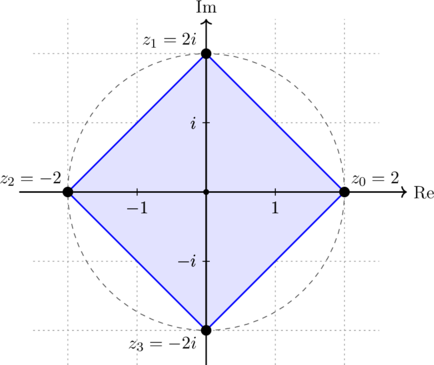
 ,
,  , and
, and  . Geometric spacing allows us to map the full solution space instantly once a single root is established.
Exercises
Evaluate each of the following expressions by applying De Moivre’s Theorem. Express your final answers in standard Cartesian form . For numbers starting in Cartesian form, remember to convert them to polar form first.
- 1.

- 2.

- 3.
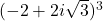
- 4.
![\left[2\left(\cos\left(\frac{\pi}{4}\right) + i\sin\left(\frac{\pi}{4}\right)\right)\right]^4](https://mathematics.lu/wp-content/ql-cache/quicklatex.com-8ad9e17a4d853ce6af05b8aa2486bde4_l3.png "Rendered by QuickLaTeX.com")
- 5.
![\left[\sqrt{3}\left(\cos\left(\frac{5\pi}{6}\right) + i\sin\left(\frac{5\pi}{6}\right)\right)\right]^6](https://mathematics.lu/wp-content/ql-cache/quicklatex.com-d470711efac6451fc0bb2163da1703c8_l3.png "Rendered by QuickLaTeX.com")
Find all distinct complex solutions for each of the following equations by applying De Moivre’s Theorem for roots. Express your final answers in standard Cartesian form .
- 1.

- 2.

- 3.

- 4.

- 5.

- 6.

Apply De Moivre’s Theorem and the even/odd trigonometric properties to solve the following multi-part problem.
Let be a complex number on the unit circle such that and its argument is .
- Prove that the subtraction of its reciprocal from its power satisfies the general identity:
![\[z^n - z^{-n} = 2i\sin(n\theta)\]](https://mathematics.lu/wp-content/ql-cache/quicklatex.com-7cc1b8498c225f8ceb7333067a704a9a_l3.png "Rendered by QuickLaTeX.com")
- Using this identity, find the exact value of
 given that
  .
.