In maths, we are often interested in understanding what rule governs a certain condition. Today’s lesson focuses on that very topic in the context of complex numbers.
Example: What can be said about all the complex numbers  satisfying that:
  ?
?
Solution: The answer is that they must be positive real numbers! If they form 0 degrees with the real axis, then the imaginary part is zero ( ), which means
  . Since they point along the positive side of the real axis,
  must be greater than zero, so
  .
.
Definition (Complex Locus): A complex locus is a geometric path, curve, or region formed in the complex plane by a set of points whose coordinates all satisfy a specific algebraic condition or equation involving a complex variable .
Instead of mapping standard and  variables, a complex locus uses geometric constraints based on lengths, distances, and angles from a fixed point. Common examples include:
- Circles: Defined by equations like
 , representing all points whose distance from a fixed center point
  is exactly equal to a radius
  .
. - Lines and Rays: Defined by equations like
 , representing a straight line ray starting at a point
  and shooting outward at a constant fixed angle
  .
. - Perpendicular Bisectors: Defined by equations like
 , representing the straight line of all points that are perfectly equidistant from two distinct complex anchor points and
  .
.
Example: What is the locus of all points that have the same fixed modulus?
Solution: We know that the modulus is the distance from the origin. If we fix this distance, then all the points with this modulus create a circle with its center at the origin and a radius equal to the given modulus. Algebraically, this is expressed as  , where is the constant modulus value.
Let us now show some of the examples that we mentioned above and why that is the case.
Circles
An easy way to conclude this is by noticing that  represents the distance between two complex numbers and . However, let us show formally how the locus is understood.
Claim (Geometric Locus of a Circle): Given a fixed complex number , the geometric locus of all points satisfying the equation (where  ) is a circle centered at the point with a radius of .
![\[z = x + iy\]](https://mathematics.lu/wp-content/ql-cache/quicklatex.com-4bde04059fb0882cb2caba991f2ab107_l3.png "Rendered by QuickLaTeX.com")
![\[z_1 = x_1 + iy_1\]](https://mathematics.lu/wp-content/ql-cache/quicklatex.com-08367b7d1260588bd5f620ec2c2b3715_l3.png "Rendered by QuickLaTeX.com")
![\[|z - z_1| = |(x + iy) - (x_1 + iy_1)|\]](https://mathematics.lu/wp-content/ql-cache/quicklatex.com-96fb22b2eadf00455bbd6c28276be96b_l3.png "Rendered by QuickLaTeX.com")
![\[|(x - x_1) + i(y - y_1)| = r\]](https://mathematics.lu/wp-content/ql-cache/quicklatex.com-705cf11523e4601be76649e9914cadf9_l3.png "Rendered by QuickLaTeX.com")
![\[\sqrt{(x - x_1)^2 + (y - y_1)^2} = r\]](https://mathematics.lu/wp-content/ql-cache/quicklatex.com-22fb834165734ee070216182516d96a5_l3.png "Rendered by QuickLaTeX.com")
![\[(x - x_1)^2 + (y - y_1)^2 = r^2\]](https://mathematics.lu/wp-content/ql-cache/quicklatex.com-6f92e5167f277979378ea29e34d8922a_l3.png "Rendered by QuickLaTeX.com")
 , which corresponds to the complex point
 Example: Identify the center and radius of the circular locus described by the complex equation  . Sketch the locus on the complex plane.
![\[|z - (3 - 4i)| = 5\]](https://mathematics.lu/wp-content/ql-cache/quicklatex.com-f74917dac16942cb6a5e058c970018ba_l3.png "Rendered by QuickLaTeX.com")
![\[|(x+iy)-3+4i|=5\]](https://mathematics.lu/wp-content/ql-cache/quicklatex.com-e10816005768a34629996b36adbf3e6d_l3.png "Rendered by QuickLaTeX.com")
![\[\implies|(x-3)+(y+4)i|=5\]](https://mathematics.lu/wp-content/ql-cache/quicklatex.com-a383ae8e2297c6dd664f5d37c6d761f1_l3.png "Rendered by QuickLaTeX.com")
![\[\implies \sqrt{(x-3)^2+(y+4)^2}=5\]](https://mathematics.lu/wp-content/ql-cache/quicklatex.com-1595e9473c361449d314fd559d7e7dfc_l3.png "Rendered by QuickLaTeX.com")
![\[\implies (x-3)^2+(y+4)^2=5^2\]](https://mathematics.lu/wp-content/ql-cache/quicklatex.com-0b7ae81b21447d739f0078467236b504_l3.png "Rendered by QuickLaTeX.com")
 , which maps to the Cartesian point
  .
. .
. to
to  is exactly 5 units.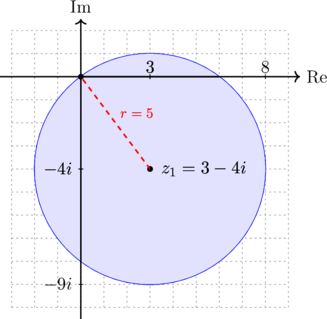
Rays and Lines
Claim (Geometric Ray in the Complex Plane): The locus of points satisfying the complex equation represents a half-line or ray that starts at the point and extends infinitely in the direction making a fixed angle with the positive real axis.
![\[\arg(z - z_0) = \theta \iff z = z_0 + re^{i\theta} \quad \text{for } r > 0\]](https://mathematics.lu/wp-content/ql-cache/quicklatex.com-f46e9781da36b6ec329c456df40a0474_l3.png "Rendered by QuickLaTeX.com")
 . Expressing this difference in exponential form yields:
![\[z - z_0 = re^{i\theta}\]](https://mathematics.lu/wp-content/ql-cache/quicklatex.com-d3ddc8b13d814879bae83d84b57c1c73_l3.png "Rendered by QuickLaTeX.com")
 represents the strictly positive distance from
  represents the angle formed with the positive real axis. Substituting the given condition
 ![\[z = z_0 + r(\cos\theta + i\sin\theta), \quad \text{where } r \in (0, \infty)\]](https://mathematics.lu/wp-content/ql-cache/quicklatex.com-072f72e2dbe52b8325c424719140a297_l3.png "Rendered by QuickLaTeX.com")
Example: Determine the geometric locus of points in the complex plane defined by the equation  , and describe its path parameters.
![\[\arg(z - (-1 + i)) = -\frac{\pi}{3}\]](https://mathematics.lu/wp-content/ql-cache/quicklatex.com-367227fecf372e2555a0a10ee244de36_l3.png "Rendered by QuickLaTeX.com")
![\[z_0 = -1 + i, \quad \theta = -\frac{\pi}{3}\]](https://mathematics.lu/wp-content/ql-cache/quicklatex.com-9962d073964d196910301654ef3b2124_l3.png "Rendered by QuickLaTeX.com")
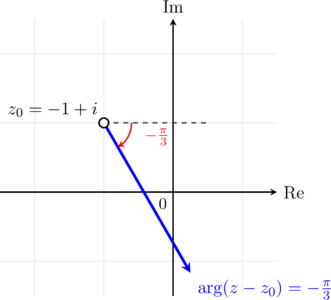
 and shooting outward infinitely at a downward angle of
  relative to the positive real axis direction line.
Bisectors
We finish by showing how to conclude the locus of a perpendicular bisector. The idea is the following, since we know that  is the distance between and , the locus of all complex numbers such that
  is the set of points whose distance from is the same as that for . This is the definition of perpendicular bisector.
Claim (Perpendicular Bisector Locus): The locus of points satisfying the complex equation represents the perpendicular bisector of the line segment joining the two fixed complex points and .
![\[|z - z_1| = |z - z_2| \iff \text{dist}(z, z_1) = \text{dist}(z, z_2)\]](https://mathematics.lu/wp-content/ql-cache/quicklatex.com-b23802356fdd6f4710d0749503e6108e_l3.png "Rendered by QuickLaTeX.com")
 ,
,  , and
, and  represent the complex coordinates in algebraic form. Squaring both sides of the modulus equality yields:
![\[|z - z_1|^2 = |z - z_2|^2\]](https://mathematics.lu/wp-content/ql-cache/quicklatex.com-1a248a5e2a3807026100a3cc1fe25ad6_l3.png "Rendered by QuickLaTeX.com")
![\[(x - x_1)^2 + (y - y_1)^2 = (x - x_2)^2 + (y - y_2)^2\]](https://mathematics.lu/wp-content/ql-cache/quicklatex.com-e2d199ee766312e6775eebcb4b703b72_l3.png "Rendered by QuickLaTeX.com")
 and
and  from both sides simplifies the expression directly:
![\[-2xx_1 + x_1^2 - 2yy_1 + y_1^2 = -2xx_2 + x_2^2 - 2yy_2 + y_2^2\]](https://mathematics.lu/wp-content/ql-cache/quicklatex.com-bbe05c6ad80e8d3dd0cf885b59647ae0_l3.png "Rendered by QuickLaTeX.com")
![\[2(x_2 - x_1)x + 2(y_2 - y_1)y = (x_2^2 + y_2^2) - (x_1^2 + y_1^2)\]](https://mathematics.lu/wp-content/ql-cache/quicklatex.com-89fae8fab4c28cd6842aa24eacb15a8d_l3.png "Rendered by QuickLaTeX.com")
 . The slope of this line is perpendicular to the vector connecting
 Example: Determine the geometric locus of points in the complex plane defined by the equation  , and describe its equation parameters.
![\[z_1 = 3 \implies (3,0), \quad z_2 = i \implies (0,1)\]](https://mathematics.lu/wp-content/ql-cache/quicklatex.com-1500e8ec7af7e2480054c280bf86b771_l3.png "Rendered by QuickLaTeX.com")
 and
and  , then find the negative reciprocal slope:
![\[\text{Midpoint} = \left(\frac{3+0}{2}, \frac{0+1}{2}\right) = (1.5, 0.5)\]](https://mathematics.lu/wp-content/ql-cache/quicklatex.com-00246ceaa21690c71263be76266d5fcb_l3.png "Rendered by QuickLaTeX.com")
![\[\text{Segment Slope } m = \frac{1 - 0}{0 - 3} = -\frac{1}{3} \implies \text{Bisector Slope } m_\perp = 3\]](https://mathematics.lu/wp-content/ql-cache/quicklatex.com-18d759cb0f1ad9ea62037b2e665cab3d_l3.png "Rendered by QuickLaTeX.com")
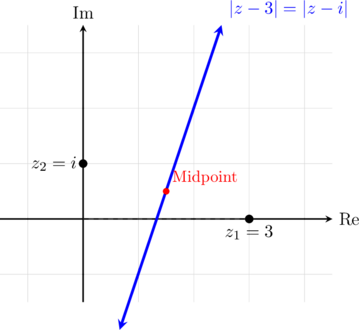
 .
.Exercises
Find and sketch the complex locus satisfying the conditions below:
- 1.

- 2.
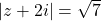
- 3.

Find and sketch the complex locus satisfying the conditions below:
- 1.

- 2.

- 3.

Find and sketch the complex locus satisfying the conditions below:
- 1.

- 2.

- 3.
