We have seen how to calculate the number of arrangements when the order matters (permutation) and when all the objects are taken at a time, possibly with or without repetition. In this page, we extend our knowledge of permutations to include some other cases.
How do we adapt our formula if we do not take all the objects? Simply put, if we take objects, we divide by as this is the number of ways the remaining objects could be arranged.
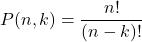
Claim (Partial Permutations / Subset Arrangements): Let and be non-negative integers such that . The total number of unique ways to select objects from a pool of distinct objects and arrange them into a linear sequence without repetition is denoted by or , and is given by the formula:
Proof using the Fundamental Counting Principle and Factorial Algebra:
Suppose we have a set containing distinct objects, and we want to fill exactly sequential slots in a straight linear arrangement:
[Slot 1] [Slot 2] [Slot 3] [Slot ]
We evaluate the number of available choices for each slot step by step, knowing that once an object is placed, it cannot be reused (no repetition):
Slot 1: There are exactly distinct objects available to choose from.
Slot 2: With one item fixed in the first spot, there are exactly choices remaining.
Slot 3: With two objects already allocated, there are exactly choices remaining.
Slot : Following this descending pattern, the number of choices remaining for the final -th slot is given by subtracting the objects that have already been used: .
According to the Fundamental Counting Principle, the total number of unique ordered arrangements is the product of the number of choices available at each individual stage:
To convert this descending product into a compact mathematical formula, we multiply and divide the entire expression by the factorial of the remaining unused items, which is :
By inspecting the numerator, we see that it forms a complete, unbroken descending product of integers from all the way down to , which perfectly matches the definition of . The denominator is explicitly . Substituting these factorial expressions yields:
This logically concludes the algebraic verification of the partial permutation formula.
Examples of this can be creating groups/committees, awarding prizes, and so on.
Example: A competitive math club has distinct members. The club needs to select and elect a President, a Vice-President, and a Treasurer for the upcoming academic year. If no member can hold more than one position concurrently, in how many unique ways can these three leadership roles be filled?
Step 1: Identify the problem type
We are selecting a subset of positions from a total pool of distinct individuals. Because the positions are uniquely titled (President, Vice-President, Treasurer), the order of selection matters. No person can be repeated across roles, so this is a partial permutation modeled by .
Step 2: Apply the partial permutation formula
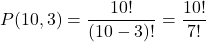
Substitute the pool size and subset size into the standard formula:
Step 3: Expand and simplify the factorials
Expand the numerator’s descending product to cancel out the large block in the denominator:
Conclusion:
There are exactly unique ways to fill the three leadership positions within the club.
Example: A photography exhibition has space to hang exactly paintings side-by-side in a straight row on its main feature wall. If an artist submits a collection of completely distinct paintings, in how many unique ways can the gallery curator select and arrange the paintings to fill the available wall slots?
Step 1: Identify the problem parameters
We need to select a subset of positions from a total pool of distinct paintings. Because the paintings are being arranged in a specific linear order from left to right on the wall, the sequence order matters. Since no single painting can be repeated across multiple slots, this scenario represents a partial permutation modeled by .
Step 2: Apply the partial permutation formula
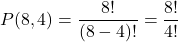
Substitute the pool size and subset size into the standard formula:
Step 3: Expand and simplify the factorials
Expand the descending product in the numerator to cancel out the block in the denominator:
Step 4: Compute the final product value
Conclusion:
The curator has exactly unique ways to choose and arrange the featured paintings on the wall.
Conditions and Complements
The basic principle we use in this section is the following: The number of arrangements that satisfy (CONDITION) is equal to the number of total arrangements minus the number of arrangements that do not satisfy (CONDITION).
Simply put, sometimes it is easier to look at the complement of a condition. To conclude our number, we can simply subtract this complement from the total.
Example: and are students. In how many ways can they be seated in a row if:
there are no restrictions on the seating.
and must sit together.
and must not sit beside one another.
and must sit together.
and must sit at each end of the row.
a. If there are no restrictions, this is simply permuting people in seats, i.e.:
b. If and must sit together, we can reinvent this problem. Instead of students, just pretend there are and Student and Student are treated as a single person. This gives arrangements. However, and have ways of being arranged among themselves ( then , or then ). Therefore, the total number of arrangements is:
c. If and cannot sit together, then we can subtract the arrangements where they sit together () from the unconstrained total arrangements (). In total we have:
d. If and must sit together, we follow the same grouping logic. We consider them as a single person block; their internal arrangement order is . Then, combining this block with individual students and creates distinct macro-objects to arrange, which gives arrangements. In total, we have:
e. If and must sit at each end, we fix them at the boundaries and rearrange the remaining middle part. The students left in the middle can be arranged in ways, and we multiply this by for the inner boundary swaps between and . In total we have:
Notice the trick we used here to combine people into one object. If we want to ensure that 2 people sit together, we can treat them as one. Then, we multiply the number of arrangements by because that is the number of ways we can rearrange the two people we combined. The same logic applies with 3 people and and so on.
Example: A family of six people, composed of 3 children (), 2 parents (), and 1 grandparent (), purchases a row of six consecutive seats at a cinema. In how many unique ways can they be seated if:
there are no restrictions on the seating arrangement.
the 2 parents must sit immediately next to each other.
the 2 parents must not sit beside one another.
all 3 children must sit together in an unbroken block.
the 2 parents must occupy the seats on the outer ends of the row.
a. No restrictions:
With absolutely no constraints, we are simply arranging distinct family members into available sequential chairs. This is a baseline distinct linear permutation:
b. Parents must sit together:
We apply the tie-together block method. Treat the two parents () as a single, combined macro-object. This leaves us with distinct units to arrange (the parent block, the individual children, and the grandparent):
Within their private block group, the two parents can switch left-to-right positions among themselves in ways ( or ). Applying the multiplication rule yields:
c. Parents must not sit together:
To find the number of ways where the parents are separated, apply the complement principle. Subtract the number of arrangements where they are forced together (calculated in part b) from the unconstrained total pool of arrangements (calculated in part a):
d. All 3 children must sit together:
Group all three children () together into a single rigid block object. This leaves distinct macro-units to arrange in the row line (the children block, the separate parents, and the grandparent):
Inside the children’s block, the three individual kids can be scrambled among themselves in unique ways. Multiplying these independent stages together gives:
e. Parents must occupy the outer ends of the row:
Fix the two parents at the hard outer boundaries of the arrangement: one on the far left end and one on the far right end. This leaves the middle seats open to be completely filled by the remaining family members (the children and the grandparent):
Finally, account for the fact that the parents can swap endpoints with each other ( on the left and on the right, or vice versa), which adds a factor of choices:
Exercise
How many different four-digit numbers greater than 6,000 can be formed using the digits 1, 2, 4, 5, 6, and 7 if:
a.
No digit is repeated.
b.
Repetitions are allowed?
Solve each of the following eight independent arrangement scenarios by applying the appropriate permutation principles (distinct linear permutations, partial subset permutations, multiset repetition rules, or positional slot constraints). State each final answer as an exact integer value.
(a)
A software team of 5 front-end developers and 3 back-end engineers lines up side-by-side for a group photo. How many unique linear arrangements can be formed if all 3 back-end engineers must stand together in an unbroken block?
(b)
A local chess club has 12 elite members. In how many unique ways can the club select and elect an ordered list of 3 members to fill three distinct, uniquely titled roles: Club Champion, Team Captain, and Event Coordinator? (No member can hold more than one role).
(c)
A custom manufacturing facility tags items using a 6-character serial string. Each individual slot can be filled by any of the 10 single-digit numbers (0–9) or any of the 26 uppercase letters (A–Z). If full character repetition is allowed across all slots, how many unique serial strings can be generated?
(d)
A graphic design studio is building a linear color-block pattern. How many unique horizontal arrangements can be made by placing 3 identical red flags, 4 identical blue flags, and 2 identical green flags side-by-side in a straight row?
(e)
How many unique five-letter words can be created by arranging the distinct letters V, W, X, Y, and Z exactly once such that the letter V must always fill the first position, and the letter W can never be placed in the last position?
(f)
A security lock requires a unique 4-digit code built by rearranging the distinct digits 2, 3, 5, and 8 exactly once without repetition. How many unique codes can be formed if the final digit of the code must be an even number?
(g)
Determine the total number of unique nine-letter words that can be created by rearranging all of the individual letters from the word TENNESSEE.
(h)
A radio station is scheduling a morning broadcast block consisting of 5 distinct songs. The station manager must select and order exactly 3 rock tracks from an available catalog of 7 distinct rock songs, followed immediately by exactly 2 pop tracks from an available catalog of 5 distinct pop songs. How many unique ordered broadcast sequences can be programmed?
How many different five-digit numbers can be formed from the digits 1, 2, 3, 4, and 5 if:
a.
There are no restrictions on digits and repetitions are allowed.
b.
The number is odd and no repetitions are allowed.
c.
The number is even and repetitions are allowed.
d.
The number is greater than 5,000 and no repetitions are allowed?
A group of seven students, and , are being seated in a single straight row of seven chairs. For each of the following independent scenarios, determine the exact number of unique seating arrangements that can be formed. Simplify your answers to final integer values.
(a)
There are no restrictions on the seating arrangement.
(b)
Students and must sit immediately next to each other.
(c)
Students and must not sit beside one another.
(d)
Students and must sit together in an unbroken block.
(e)
Students and must occupy the two seats at each end of the row.
A modern design firm is setting up a row of eight individual, side-by-side workstation desks for a new creative team. The team consists of 8 distinct professionals: 4 graphic designers (), 2 copywriters (), and 2 account managers (). Evaluate each of the following independent setup scenarios, providing your final answers as exact integer counts.
(a)
There are absolutely no restrictions on how the 8 professionals are assigned to the 8 row desks.
(b)
The 2 copywriters ( and ) must be assigned to desks that are immediately adjacent to one another.
(c)
The 2 copywriters ( and ) must not be assigned to adjacent desks.
(d)
All 4 graphic designers must have their desks grouped together in a single, unbroken block of 4 desks.
(e)
The 2 account managers ( and ) must occupy the desks on the outer ends of the row (one at the far left, and one at the far right).
 if we do not take all the objects? Simply put, if we take
 objects, we divide
 as this is the number of ways the remaining objects could be arranged.
 and
 . The total number of unique ways to select
 or
 , and is given by the formula:
 [Slot
 choices remaining.
 choices remaining.
 objects that have already been used:
 .

 :

 , which perfectly matches the definition of
 distinct members. The club needs to select and elect a President, a Vice-President, and a Treasurer for the upcoming academic year. If no member can hold more than one position concurrently, in how many unique ways can these three leadership roles be filled?
 positions from a total pool of
 distinct individuals. Because the positions are uniquely titled (President, Vice-President, Treasurer), the order of selection matters. No person can be repeated across roles, so this is a partial permutation modeled by
 block in the denominator:



 unique ways to fill the three leadership positions within the club.
 paintings side-by-side in a straight row on its main feature wall. If an artist submits a collection of
 completely distinct paintings, in how many unique ways can the gallery curator select and arrange the paintings to fill the available wall slots?
 positions from a total pool of
 distinct paintings. Because the paintings are being arranged in a specific linear order from left to right on the wall, the sequence order matters. Since no single painting can be repeated across multiple slots, this scenario represents a partial permutation modeled by
 block in the denominator:





 unique ways to choose and arrange the
 and
 are students. In how many ways can they be seated in a row if:
 and
 must sit together.
 and
 people in

 and Student
 arrangements. However,

 ) from the unconstrained total arrangements (

 and
 creates
 arrangements. In total, we have:


 because that is the number of ways we can rearrange the two people we combined. The same logic applies with 3 people and
 and so on.
 ), 2 parents (
 ), and 1 grandparent (
 ), purchases a row of six consecutive seats at a cinema. In how many unique ways can they be seated if:

 individual children, and the

 or
 ). Applying the multiplication rule yields:



 separate parents, and the



 on the left and
 on the right, or vice versa), which adds a factor of

 and
 , are being seated in a single straight row of seven chairs. For each of the following independent scenarios, determine the exact number of unique seating arrangements that can be formed. Simplify your answers to final integer values.
 and
 must sit immediately next to each other.
 and
 must sit together in an unbroken block.
 and
 ), 2 copywriters (
 ), and 2 account managers (
 ). Evaluate each of the following independent setup scenarios, providing your final answers as exact integer counts.
 and
 ) must be assigned to desks that are immediately adjacent to one another.
 and
 ) must occupy the desks on the outer ends of the row (one at the far left, and one at the far right).