These problems are all about maximising or minimising a function. In this context, we will be given a problem where we need to design/conclude a function  and find its maximum/minimum depending on the question at hand.
Recall that given a function , we follow these steps to find its extrema:
- Find the derivative
 .
. - Solve the equation
 .
. - Locate all the solutions to the previous step and the points of discontinuity of on a sign diagram and check the sign of before, after, and in between each of these points.
- Conclude where the original function is increasing/decreasing on your sign diagram.
- Conclude which points are maxima and which are minima.
- Find the
 -coordinate of these points by replacing the solutions to into .
Let us see a simple example:
Example: A rectangular garden is to be constructed using a rock wall as one side of the garden and wire fencing for the other three sides. Given 100 meters of wire fencing:
- Determine the dimensions that would create a garden of maximum area.
- What is the maximum area?
![\[2x + y = 100 \implies y = 100 - 2x\]](https://mathematics.lu/wp-content/ql-cache/quicklatex.com-b7c6d27e29a92e0b6964948dd5333d46_l3.png "Rendered by QuickLaTeX.com")
![\[A(x) = x \cdot y = x \cdot (100 - 2x) = 100x - 2x^2\]](https://mathematics.lu/wp-content/ql-cache/quicklatex.com-c1941d05fb92df9105398eecd1e3ef0a_l3.png "Rendered by QuickLaTeX.com")
![\[A'(x) = -4x + 100\]](https://mathematics.lu/wp-content/ql-cache/quicklatex.com-8b195a520ec1dc10742fd9c1607df484_l3.png "Rendered by QuickLaTeX.com")
![\[A'(x) = 0 \implies -4x + 100 = 0 \implies x = 25\]](https://mathematics.lu/wp-content/ql-cache/quicklatex.com-feba489778f5c76ab87c8de7169bff93_l3.png "Rendered by QuickLaTeX.com")
 is a linear function, it will obviously change sign before and after this solution. Therefore, one side is of length 25m and the other side is of length 50 meters.
 .
. .
.Since the area function ended up being a quadratic model, we could have also just found the vertex of that parabola to conclude the maximum.
Example: What is the maximum area that a rectangle inscribed in a circle of radius  can achieve?
 .
.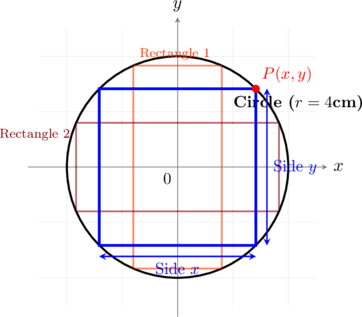
![\[x^2 + y^2 = 8^2 \implies y = \sqrt{64 - x^2}\]](https://mathematics.lu/wp-content/ql-cache/quicklatex.com-12a05aa9ef12e7aadd71d754df33598d_l3.png "Rendered by QuickLaTeX.com")
 of the rectangle is the product of its sides:
![\[A(x) = x \cdot y = x\sqrt{64 - x^2}\]](https://mathematics.lu/wp-content/ql-cache/quicklatex.com-86ea2f7d28bb85e8716cca0907ea4245_l3.png "Rendered by QuickLaTeX.com")
![\[A'(x) = 1 \cdot \sqrt{64 - x^2} + x \cdot \left( \frac{1}{2\sqrt{64 - x^2}} \cdot (-2x) \right)\]](https://mathematics.lu/wp-content/ql-cache/quicklatex.com-525f69bf2f5bedb63418bdff7c4f11c5_l3.png "Rendered by QuickLaTeX.com")
![\[A'(x) = \sqrt{64 - x^2} - \frac{x^2}{\sqrt{64 - x^2}}\]](https://mathematics.lu/wp-content/ql-cache/quicklatex.com-ee63516495ffce925b181649c83afd32_l3.png "Rendered by QuickLaTeX.com")
 )
)![\[\sqrt{64 - x^2} - \frac{x^2}{\sqrt{64 - x^2}} = 0\]](https://mathematics.lu/wp-content/ql-cache/quicklatex.com-6a0464db483dc2f99691c112d72588a3_l3.png "Rendered by QuickLaTeX.com")
![\[\sqrt{64 - x^2} = \frac{x^2}{\sqrt{64 - x^2}}\]](https://mathematics.lu/wp-content/ql-cache/quicklatex.com-12fdd9eb19cb073e993b7123f07821e3_l3.png "Rendered by QuickLaTeX.com")
 :
:![\[64 - x^2 = x^2\]](https://mathematics.lu/wp-content/ql-cache/quicklatex.com-080a8a367054f51956d08c3f325885d6_l3.png "Rendered by QuickLaTeX.com")
![\[64 = 2x^2 \implies x^2 = 32 \implies x = 4\sqrt{2} \quad (x > 0)\]](https://mathematics.lu/wp-content/ql-cache/quicklatex.com-dcb705c9f90d0b92b18c90d9e21e3547_l3.png "Rendered by QuickLaTeX.com")
 verifies a transition from an increasing to a decreasing gradient, confirming a local maximum. Now find the matching side length
 ![\[y = \sqrt{64 - (4\sqrt{2})^2} = \sqrt{64 - 32} = \sqrt{32} = 4\sqrt{2}\text{ cm}\]](https://mathematics.lu/wp-content/ql-cache/quicklatex.com-15cbaa8da8587239ddf909e7d83f45cc_l3.png "Rendered by QuickLaTeX.com")
 , the rectangle with the maximum area is a square. Compute the maximum area:
![\[A = 4\sqrt{2} \times 4\sqrt{2} = 32\text{ cm}^2\]](https://mathematics.lu/wp-content/ql-cache/quicklatex.com-7a87c903fdd95da91a597621650800de_l3.png "Rendered by QuickLaTeX.com")
 , achieved when the rectangle is a square with side lengths of
  .
.Here is another example with a slightly different shape.
Example: A modern playground layout consists of a central rectangle with a single semicircular expansion on one of its shorter sides, while the opposite side is left open for an entryway. The total perimeter of the outer layout walls (the two long straight sides, one short straight side, and the semicircle) is exactly  . Let the length of the straight rectangular sections be
  and the radius of the semicircular end be
  .
.
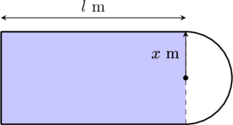
- Show that
 and state the domain of possible values for
  .
. - Find the values of
 and that maximize the area of the central shaded rectangle.
 - What is the maximal shaded rectangular area?
 ), one short width section (
 ), and one semicircle of radius
  :
:![\[P = 2l + 2x + \pi x = 300 \implies 2l = 300 - 2x - \pi x \implies l = 150 - x - \frac{\pi}{2}x\]](https://mathematics.lu/wp-content/ql-cache/quicklatex.com-46a5d76c4ab436b61ac4ee6e879b44ee_l3.png "Rendered by QuickLaTeX.com")
 and
and  . Thus, the domain is
  .
.![\[A(x) = \text{length} \times \text{height} = l \cdot (2x) = \left(150 - x - \frac{\pi}{2}x\right)(2x) = 300x - 2x^2 - \pi x^2\]](https://mathematics.lu/wp-content/ql-cache/quicklatex.com-3d9221654a7ce58536c54ef749809a1b_l3.png "Rendered by QuickLaTeX.com")
![\[A'(x) = 300 - 4x - 2\pi x = 300 - (4 + 2\pi)x\]](https://mathematics.lu/wp-content/ql-cache/quicklatex.com-c9226631419739c7e4eaaf2e41df0290_l3.png "Rendered by QuickLaTeX.com")
![\[A'(x) = 0 \implies 300 - (4 + 2\pi)x = 0 \implies x = \frac{300}{4 + 2\pi} = \frac{150}{2 + \pi}\text{ m} \approx 29.19\text{ m}\]](https://mathematics.lu/wp-content/ql-cache/quicklatex.com-a4e2141bb85d32dbd6a6e13e79705e1b_l3.png "Rendered by QuickLaTeX.com")
![\[l = 150 - \left(\frac{150}{2 + \pi}\right) - \frac{\pi}{2}\left(\frac{150}{2 + \pi}\right) = 150 - \frac{150 + 75\pi}{2 + \pi} = 75\text{ m}\]](https://mathematics.lu/wp-content/ql-cache/quicklatex.com-a449914ee8c787d2c40a6caa94c80491_l3.png "Rendered by QuickLaTeX.com")
![\[A_{\text{max}} = l \cdot (2x) = 75 \cdot \left(\frac{300}{2 + \pi}\right) = \frac{22500}{2 + \pi}\text{ m}^2 \approx 4376.10\text{ m}^2\]](https://mathematics.lu/wp-content/ql-cache/quicklatex.com-ef17c437b1a7b1703f1957024d18d90f_l3.png "Rendered by QuickLaTeX.com")
Kepler’s Problem of Optimisation
This is a famous problem that you can now solve, what is the maximum volume of a cylinder that is inscribed inside a sphere? In other words, we have the following situation (we are already including the answer).
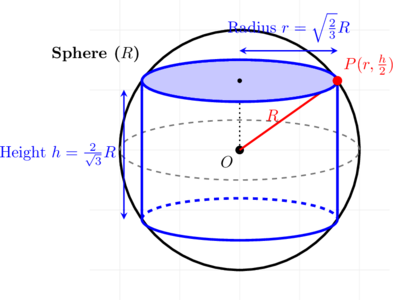
Claim (Kepler’s Cylinder-in-Sphere Optimization): For a right circular cylinder inscribed inside a sphere of fixed radius  , the maximum possible volume of the cylinder occurs when the ratio of its height
  to its base diameter
  is exactly
  , which means the height equals
  .
.
![\[r^2 + \left(\frac{h}{2}\right)^2 = R^2 \implies r^2 = R^2 - \frac{h^2}{4}\]](https://mathematics.lu/wp-content/ql-cache/quicklatex.com-238a5a6ef2e63f4b7e9407ff8796726a_l3.png "Rendered by QuickLaTeX.com")
 constraint equation into the standard formula for the volume of a cylinder (
 ):
):![\[V(h) = \pi \left(R^2 - \frac{h^2}{4}\right)h = \pi R^2 h - \frac{\pi}{4}h^3\]](https://mathematics.lu/wp-content/ql-cache/quicklatex.com-d9d6f43f17edbed4eb449bbb2d9a1d2e_l3.png "Rendered by QuickLaTeX.com")
 )
) with respect to
 ![\[V'(h) = \pi R^2 - \frac{3\pi}{4}h^2\]](https://mathematics.lu/wp-content/ql-cache/quicklatex.com-bc0d524c0c463a9c654ab29fd90e5e00_l3.png "Rendered by QuickLaTeX.com")
![\[\pi R^2 - \frac{3\pi}{4}h^2 = 0 \implies \frac{3}{4}h^2 = R^2 \implies h^2 = \frac{4}{3}R^2 \implies h = \frac{2}{\sqrt{3}}R\]](https://mathematics.lu/wp-content/ql-cache/quicklatex.com-503bafb7404281c42ff575a695307026_l3.png "Rendered by QuickLaTeX.com")
![\[r^2 = R^2 - \frac{1}{4}\left(\frac{4}{3}R^2\right) = \frac{2}{3}R^2 \implies r = \sqrt{\frac{2}{3}}R\]](https://mathematics.lu/wp-content/ql-cache/quicklatex.com-5c85c3de5b7f35473ac516276df15f12_l3.png "Rendered by QuickLaTeX.com")
![\[\frac{h}{2r} = \frac{\frac{2}{\sqrt{3}}R}{2\sqrt{\frac{2}{3}}R} = \frac{1}{\sqrt{2}}\]](https://mathematics.lu/wp-content/ql-cache/quicklatex.com-cd1030076b3f88c818303b06f744b5cc_l3.png "Rendered by QuickLaTeX.com")
 verifies that this dimension state achieves a local maximum, completing the proof.
The Soda Can Optimisation Problem
Below is a rather famous example of using optimisation theory.
The classic soda-can optimisation problem is usually framed as a manufacturing-design problem: A beverage company wants to design a cylindrical can that holds a fixed volume of soda while using as little aluminium as possible. Without knowing the cost of aluminium per centimetre squared, we can simply look into minimising the surface area. If we had the prices in mind, we could even understand the cost of manufacturing a can.
Example: What dimensions should a soda can have to contain a fixed volume of  while using as little aluminium as possible? Determine the radius and height of the can that minimize its total surface area.
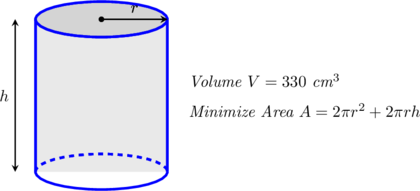
 , the fixed volume constraint is
  . The volume formula for a cylinder is
 ![\[\pi r^2 h = 330 \implies h = \frac{330}{\pi r^2}\]](https://mathematics.lu/wp-content/ql-cache/quicklatex.com-864b65803dca658f942a71481f335fae_l3.png "Rendered by QuickLaTeX.com")
 ). Substituting the height formula into this expression gives:
![\[A(r) = 2\pi r^2 + 2\pi r \left( \frac{330}{\pi r^2} \right) = 2\pi r^2 + \frac{660}{r}\]](https://mathematics.lu/wp-content/ql-cache/quicklatex.com-f986518e8be70279141764fcba477e2a_l3.png "Rendered by QuickLaTeX.com")
 with respect to
 ![\[A'(r) = 4\pi r - \frac{660}{r^2}\]](https://mathematics.lu/wp-content/ql-cache/quicklatex.com-ca610369ff6d176399a161666eeda087_l3.png "Rendered by QuickLaTeX.com")
![\[4\pi r - \frac{660}{r^2} = 0 \implies 4\pi r^3 = 660 \implies r^3 = \frac{165}{\pi}\]](https://mathematics.lu/wp-content/ql-cache/quicklatex.com-197af32ab0c753e1245e13cf61e20067_l3.png "Rendered by QuickLaTeX.com")
![\[r = \sqrt{\frac{165}{\pi}} \approx 3.74\text{ cm}\]](https://mathematics.lu/wp-content/ql-cache/quicklatex.com-91b15927aeca41ed2329035feba78e68_l3.png "Rendered by QuickLaTeX.com")
![\[h = \frac{330}{\pi r^2} = \frac{2 \cdot 165}{\pi r^2} = \frac{2 \cdot \pi r^3}{\pi r^2} = 2r\]](https://mathematics.lu/wp-content/ql-cache/quicklatex.com-712b048406c27db758f5328d15547c8c_l3.png "Rendered by QuickLaTeX.com")
![\[h = 2 \times 3.74 \approx 7.49\text{ cm}\]](https://mathematics.lu/wp-content/ql-cache/quicklatex.com-ac1ff8bfa59413c87f9f92e998846048_l3.png "Rendered by QuickLaTeX.com")
 ). The optimal dimensions are a radius of approximately
  and a height of approximately
  .
.Ending up with the right dimensions might save you a very minimal manufacturing cost per can, but since millions of these are sold daily, that minimal difference will quickly amount to a larger extra revenue.
Exercises
A farmer wants to enclose a rectangular pasture for livestock. One side of the pasture will be bounded by a straight river, which requires no fencing. The other three sides will be enclosed using 240 meters of fencing material.
 , where represents the number of specialized drone units produced and sold (in hundreds). Determine the production level that maximizes the monthly profit.
 euros, where
  . The total number of active subscribers can be modeled by the linear demand function
  . How much should the company charge each customer per month to maximize its total revenue?
A custom window frame is designed in the shape of a rectangle surmounted by a single semicircle at the top. The total perimeter of the glass pane outer frame is constrained to be exactly  . Let the width of the rectangular base be
  (making the radius of the semicircle
  ) and the height of the rectangular portion be
  .
.
 and determine the valid domain constraints for the radius . and height that maximize the total surface area admitting light through the window.