In the previous page we introduced sequences formally and discussed some different types of sequences: defined explicitly, recursively, arithmetic and geometric sequences.
In this page we discuss sequences whose behaviour is monotonic. That is to say, they are always increasing or decreasing.
Basic Inequalities
In previous years, there is not much of a discussion about inequalities when suddenly in S6 parts of the programme require you to understand them on an intuitive level. This section is meant to explain inequalities at a basic level with the hopes of understanding them more intuitively as the exercises/examples progress.
In S5 you discussed quadratic models and you have seen that the graph of a function  is a parabola. It can intersect the
  -axis at most twice. Once you draw the graph, it is easy to see where the parabola is above the -axis (i.e.:
  ) or below the -axis (i.e.:
  ). We draw our conclusions accordingly. A way to simplify this is by drawing a sign diagram of the function.
A sign diagram of a function  aims to represent the function minimally, by marking where the function is positive, negative, or zero. Let us see an example of how we use this to solve a quadratic inequality:
Example: Solve the quadratic inequality:
![\[x^2 + 4x + 3 > 0\]](https://mathematics.lu/wp-content/ql-cache/quicklatex.com-57cc869bc74afbda41a92b115c439ee1_l3.png "Rendered by QuickLaTeX.com")
![\[x^2 + 4x + 3 = 0\implies(x + 3)(x + 1) = 0\]](https://mathematics.lu/wp-content/ql-cache/quicklatex.com-8ae0b698590804f533d360d4600bfd18_l3.png "Rendered by QuickLaTeX.com")
![\[x = -3 \quad \text{and} \quad x = -1\]](https://mathematics.lu/wp-content/ql-cache/quicklatex.com-a020cbcff54d6d6ecc4f9c0a787b87af_l3.png "Rendered by QuickLaTeX.com")
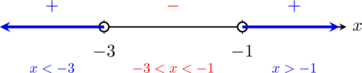
 ), meaning we look for the regions marked with a plus sign (
 ) on our diagram. This occurs to the left of
  and to the right of
  .
.![\[x < -3 \quad \text{or} \quad x > -1\]](https://mathematics.lu/wp-content/ql-cache/quicklatex.com-730625e44d5db625830c7ecb62181f45_l3.png "Rendered by QuickLaTeX.com")
In summary, we have solved this inequality by understanding where the function is zero, and checking the regions before, after, and in between these -intercepts. This is generally a good strategy to solve simple inequalities. You should also include points of discontinuity in your sign diagram, but this is something that might become more intuitive in the next unit. Just think of this last remark the following way: The function  is never zero, but it is very easy to understand its sign diagram. We include 0 in its sign diagram because the function is not defined at 0, so this is a point of discontinuity.
You should consider these as they are points where your function could “disappear” and “reappear” on the other side of the -axis. In short, a function cannot change its sign without going through the -axis or having an asymptote/point of discontinuity somewhere. This remark is only meant for completeness, most cases can be tackled with a relatively straightforward level of analysis.
A few simple rules about inequalities:
- We treat/solve them as we do equations. We can make the same change on both sides to end up with an equivalent expression. E.g.:
 . Here we divided both sides by 2 and both inequalities are equivalent.
 - If, at any point, we multiply or divide by a negative number, we must flip the inequality sign. E.g.:
![\[-2x>8\iff x<-4\]](https://mathematics.lu/wp-content/ql-cache/quicklatex.com-a7d2b19b5033c46834eb95c8824abbfe_l3.png "Rendered by QuickLaTeX.com")
- We cannot divide by something that could potentially be zero. In that case, we should separate into two cases and study them separately (once assuming the expression is 0, once assuming it is not).
Let us now see an example of an inequality involving a rational function (quotient of two polynomials) if only to try and see how inequalities are not very different from equations if we simply use a bit of logic.
Example: Solve the rational inequality:
![\[\frac{x + 2}{x - 3} > 0\]](https://mathematics.lu/wp-content/ql-cache/quicklatex.com-eaa8627b0904085599d686323a7d847f_l3.png "Rendered by QuickLaTeX.com")
![\[x + 2 = 0 \implies x = -2\]](https://mathematics.lu/wp-content/ql-cache/quicklatex.com-e356a4cfdd55192ca878edd80a5afeb0_l3.png "Rendered by QuickLaTeX.com")
![\[x - 3 = 0 \implies x = 3\]](https://mathematics.lu/wp-content/ql-cache/quicklatex.com-9759f1c935e77299464c3362c05b79f4_l3.png "Rendered by QuickLaTeX.com")
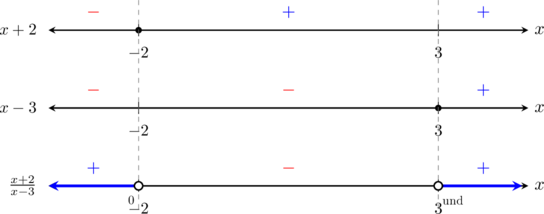
 and to the right of
  because that is where both
  and
and  are simultaneously positive or simultaneously negative.
![\[x < -2 \quad \text{or} \quad x > 3\]](https://mathematics.lu/wp-content/ql-cache/quicklatex.com-7e1dee1325c25439f1690b47074c7534_l3.png "Rendered by QuickLaTeX.com")
We could have also asked for  , in which case we should include the value
  in our solution. The value
  will not be included because the denominator then would be zero, and we cannot divide an expression by 0.
Monotonically Increasing/Decreasing Sequences
We begin with formal definitions:
Definition (Increasing and Decreasing Sequences): A sequence  is classified by how its consecutive terms change as the position index
  grows larger.
1. Increasing Sequence
A sequence is increasing if each term is greater than or equal to the preceding term for all positive integers:
![\[u_{n+1} \ge u_n \quad \text{for all } n \ge 1\]](https://mathematics.lu/wp-content/ql-cache/quicklatex.com-fea50e7cc60cd417d939caccf42fad25_l3.png "Rendered by QuickLaTeX.com")
Note: If the inequality is strict ( ), the sequence is strictly increasing.
2. Decreasing Sequence
A sequence is decreasing if each term is less than or equal to the preceding term for all positive integers:
![\[u_{n+1} \le u_n \quad \text{for all } n \ge 1\]](https://mathematics.lu/wp-content/ql-cache/quicklatex.com-46a566a900fa30130a2ed8a32def7acb_l3.png "Rendered by QuickLaTeX.com")
Note: If the inequality is strict ( ), the sequence is strictly decreasing.
Sequences that are either completely increasing or completely decreasing are referred to as monotonic sequences.
Alternatively, we can compare:
 in which case the sequence is increasing,
 in which case it is decreasing,
 , i.e.: increasing,
 , i.e.: decreasing.
Example: Determine whether the sequence defined explicitly by  is increasing or decreasing for all
  .
.

![\[u_n = \frac{n}{n+1}\]](https://mathematics.lu/wp-content/ql-cache/quicklatex.com-cc6f930bc4af26dd693e72003250b1e3_l3.png "Rendered by QuickLaTeX.com")
 :
:![\[u_{n+1} = \frac{n+1}{(n+1)+1} = \frac{n+1}{n+2}\]](https://mathematics.lu/wp-content/ql-cache/quicklatex.com-9c61db70fa1f8c7e55884480eeae8c3d_l3.png "Rendered by QuickLaTeX.com")
![\[u_{n+1} - u_n = \frac{n+1}{n+2} - \frac{n}{n+1}\]](https://mathematics.lu/wp-content/ql-cache/quicklatex.com-724cd97d028626fbc0696c0e6c550ca5_l3.png "Rendered by QuickLaTeX.com")
![\[u_{n+1} - u_n = \frac{(n+1)(n+1) - n(n+2)}{(n+2)(n+1)}\]](https://mathematics.lu/wp-content/ql-cache/quicklatex.com-0a5ea93d4f10f22fcc4ff57183f944ac_l3.png "Rendered by QuickLaTeX.com")
![\[u_{n+1} - u_n = \frac{(n^2 + 2n + 1) - (n^2 + 2n)}{(n+2)(n+1)}\]](https://mathematics.lu/wp-content/ql-cache/quicklatex.com-52fd190e1acdc7f273e145ca80c7eea0_l3.png "Rendered by QuickLaTeX.com")
![\[u_{n+1} - u_n = \frac{1}{(n+2)(n+1)}\]](https://mathematics.lu/wp-content/ql-cache/quicklatex.com-005b19fc8f55cd540f9dbf9c2f9a535e_l3.png "Rendered by QuickLaTeX.com")
 and
and ![\[\frac{1}{(n+2)(n+1)} > 0 \implies u_{n+1} - u_n > 0 \implies u_{n+1} > u_n\]](https://mathematics.lu/wp-content/ql-cache/quicklatex.com-888404db5c30015695db37a2ede2047c_l3.png "Rendered by QuickLaTeX.com")
Constant Sequences
A sequence  is constant if
  for any
  with
with  being some constant, real number.
This can also be shown as  , but in practice it should be obvious when a sequence is constant.
Graphing Sequences
We have seen that some sequences are defined explicitly. For example  . Here we have
  .
.
What we are doing to find a term is replacing in the formula for  as we do with functions. When we want to find
  we replace
  in its equation. The big difference being that in a sequence , the term can only be a non-negative integer. Either way, just as we replace values of we can represent this sequence graphically.
Example: Generate the first 4 terms of the sequence defined by  for , and plot its terms to observe its long-term behavior.
Substituting index values  into the explicit general formula yields the first 4 terms:
- •

- •

- •

- •
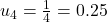
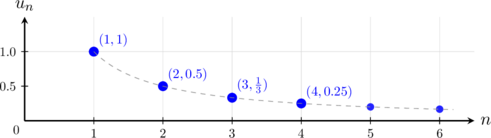
The terms of the sequence are  . As shown on the plotted grid points, each additional discrete step drops closer to the horizontal axis.
Can we conclude from the graph that the sequence ? No! Seeing a few terms is not enough to conclude such behaviour. Instead, it is infinitely better to show it by definition.
![\[\frac{u_{n+1}}{u_n}=\frac{\frac{1}{n+1}}{\frac{1}{n}}=\frac{1}{n+1}\cdot\frac{n}{1}=\frac{n}{n+1}<1\]](https://mathematics.lu/wp-content/ql-cache/quicklatex.com-8048864cdcb3e7d9bb7edf808787d761_l3.png "Rendered by QuickLaTeX.com")
 because we see that the denominator is greater than the numerator. I.e.:
  .
.Exercises
For each of the following sequences defined for , determine whether the sequence is increasing or decreasing.
![\[u_n = \frac{1}{n}\]](https://mathematics.lu/wp-content/ql-cache/quicklatex.com-32e03c1a1f9703ae7369e2f7f9e2e0ab_l3.png "Rendered by QuickLaTeX.com")
![\[u_n = \frac{n}{n + 2}\]](https://mathematics.lu/wp-content/ql-cache/quicklatex.com-1a92f085cf9c1733d7b0f0ff40da9e2a_l3.png "Rendered by QuickLaTeX.com")
![\[u_n = \frac{2n - 1}{n}\]](https://mathematics.lu/wp-content/ql-cache/quicklatex.com-7e931c5a982166c00bab0ebd78ebadef_l3.png "Rendered by QuickLaTeX.com")
![\[u_n = \frac{3}{n + 1}\]](https://mathematics.lu/wp-content/ql-cache/quicklatex.com-5d23fd6b8aea01ddfc4652fe1813ad6a_l3.png "Rendered by QuickLaTeX.com")
![\[u_n = \frac{n^2}{n^2 + 1}\]](https://mathematics.lu/wp-content/ql-cache/quicklatex.com-adc3754887134aaf813b50314e3054c0_l3.png "Rendered by QuickLaTeX.com")
Analyze the mathematical behavior of the sequences below by comparing consecutive terms or studying algebraic trends for all positive integers .
 :
:
![\[u_n = \frac{1}{2n + 3}\]](https://mathematics.lu/wp-content/ql-cache/quicklatex.com-121329d6611b8123674b0d2f9cbdef3d_l3.png "Rendered by QuickLaTeX.com")
approaches infinity ( ):
):
![\[u_n = 5 + \left(\frac{1}{3}\right)^n\]](https://mathematics.lu/wp-content/ql-cache/quicklatex.com-afe71c2552e54c80409b18750333eb87_l3.png "Rendered by QuickLaTeX.com")
Analyze the behavior of the sequence defined explicitly below for . No calculators are allowed.
![\[u_n = (-1)^{2n}\]](https://mathematics.lu/wp-content/ql-cache/quicklatex.com-944c7490abdfaaeb1d179cdceb6800a4_l3.png "Rendered by QuickLaTeX.com")
For each of the following three sequences defined for , calculate the first 4 terms. Then, sketch their discrete coordinate points on an axis system containing only the first quadrant, showing enough terms to illustrate their long-term behavior.
![\[u_n = \frac{n}{n + 1}\]](https://mathematics.lu/wp-content/ql-cache/quicklatex.com-8742cacc12df5bb37e848868050e194c_l3.png "Rendered by QuickLaTeX.com")
![\[u_n = 2 - \frac{1}{n}\]](https://mathematics.lu/wp-content/ql-cache/quicklatex.com-7e2eb6c6fe253be0ca0faadb698c5138_l3.png "Rendered by QuickLaTeX.com")
![\[u_n = 2n\]](https://mathematics.lu/wp-content/ql-cache/quicklatex.com-d5332c55147a42df659db9b47b24fccb_l3.png "Rendered by QuickLaTeX.com")
Consider the sequence defined explicitly for by the quadratic formula:
![\[u_n = (n - 5)^2\]](https://mathematics.lu/wp-content/ql-cache/quicklatex.com-5447ac1a4efe9700b2945be3c32e5934_l3.png "Rendered by QuickLaTeX.com")
Complete the following tasks to analyze how its behavior changes across different index ranges.
 through
  ) of the sequence.
 in the first quadrant of an axis system.) from which the sequence turns and becomes strictly increasing for all subsequent terms. Prove this trend by examining the inequality .
Analyze the behavior of the alternating sequence defined explicitly below for .
![\[u_n = (-1)^n\]](https://mathematics.lu/wp-content/ql-cache/quicklatex.com-d1942d78f6be1132bd129142710f48be_l3.png "Rendered by QuickLaTeX.com")