In this page, we discuss how to solve equations and inequalities involving exponential functions. We begin with some basic cases and quickly evolve to more general situations.
You have already seen some of these cases in S5, when you discussed exponential models. The trick to solving these equations is to move them from an exponential equation into an equation that we can solve more easily.
Basis Equations from S5
There are some cases that can be dealt with rather easily and intuitively:
- Case 1: An exponential equation of the form
 is equivalent to
  .
. - Case 2: An exponential equation of the form
 is equivalent to
  .
.
Let us see examples of this.
Example: Solve the exponential equation  for all real values of
  .
.
 ), we can immediately equate the exponents:
![\[x^2 - 2x - 5 = - x - 3\]](https://mathematics.lu/wp-content/ql-cache/quicklatex.com-2d4414e8d5afd4b4423c56e45820aab0_l3.png "Rendered by QuickLaTeX.com")
![\[x^2 - 2x - 5 + x + 3 = 0\]](https://mathematics.lu/wp-content/ql-cache/quicklatex.com-6c124f9064a53ddc989941f978e39471_l3.png "Rendered by QuickLaTeX.com")
![\[x^2 - x - 2 = 0\]](https://mathematics.lu/wp-content/ql-cache/quicklatex.com-47f87d18cc1f2adf25552a43f4c08d07_l3.png "Rendered by QuickLaTeX.com")
![\[x^2-x-2=0\implies(x-2)(x+1)=0\]](https://mathematics.lu/wp-content/ql-cache/quicklatex.com-9369f6240b4b73124cab737e7c0614a0_l3.png "Rendered by QuickLaTeX.com")
![\[x = 2\text{ or }x=-1\]](https://mathematics.lu/wp-content/ql-cache/quicklatex.com-e5574152b379c48c93f8bdd5086628c2_l3.png "Rendered by QuickLaTeX.com")
![\[x = 2, \quad x = -1\]](https://mathematics.lu/wp-content/ql-cache/quicklatex.com-8ec60ec8d3426d71e4599ec74e0f8b68_l3.png "Rendered by QuickLaTeX.com")
This was our typical easy example. If the bases are the same, the powers must be the same. See how we used that fact to go from an exponential equation to a quadratic one. The next example shows how to deal with the same power but different bases.
Example: Solve the exponential equation  for all real values of .
 and
and  ) but shares the exact same quadratic exponent
  . Since the bases are positive and unequal (
 ), the only way for these two exponential expressions to be equal is if the exponent itself evaluates to zero, because any positive number raised to the power of
  equals
  (
( and
and  ).
). :
:![\[\frac{3^{x^2 - x - 6}}{7^{x^2 - x - 6}} = 1 \implies \left(\frac{3}{7}\right)^{x^2 - x - 6} = \left(\frac{3}{7}\right)^0\]](https://mathematics.lu/wp-content/ql-cache/quicklatex.com-d1510914e0c32acfd802e2ff6071db9a_l3.png "Rendered by QuickLaTeX.com")
![\[x^2 - x - 6 = 0\]](https://mathematics.lu/wp-content/ql-cache/quicklatex.com-4e82e3495a12271a983c67700385125a_l3.png "Rendered by QuickLaTeX.com")
 and add up to
  :
:![\[(x - 3)(x + 2) = 0\]](https://mathematics.lu/wp-content/ql-cache/quicklatex.com-0f3036b59dc5a1d23a5dcee33a97d778_l3.png "Rendered by QuickLaTeX.com")
![\[x = 3 \quad \text{or} \quad x = -2\]](https://mathematics.lu/wp-content/ql-cache/quicklatex.com-657eca0058d976adf4cb975a4e48f4b5_l3.png "Rendered by QuickLaTeX.com")
![\[x = -2, \quad x = 3\]](https://mathematics.lu/wp-content/ql-cache/quicklatex.com-9f63b57b543f96176bf08b9b0eb07653_l3.png "Rendered by QuickLaTeX.com")
 , which verifies our solution.
Our final basic example will deal with a case that is very similar to our first case. This is the case where the bases are different, but easily linked. Using properties of powers, we can turn these equations into the case where the bases are the same.
Example: Solve the exponential equation  for all real values of .
 , can be expressed as a power of the left-side base,
  :
:![\[16 = 4^2\]](https://mathematics.lu/wp-content/ql-cache/quicklatex.com-60485f641897ad1c142be2e9248423b7_l3.png "Rendered by QuickLaTeX.com")
![\[4^{x^2 - x - 2} = (4^2)^{x + 1}\]](https://mathematics.lu/wp-content/ql-cache/quicklatex.com-1956ad4ac8d34ba105875115e03a0a13_l3.png "Rendered by QuickLaTeX.com")
 , to distribute the exponent on the right side:
![\[4^{x^2 - x - 2} = 4^{2(x + 1)}\]](https://mathematics.lu/wp-content/ql-cache/quicklatex.com-c3ebea6aad3335d05cd49d2eede739fa_l3.png "Rendered by QuickLaTeX.com")
![\[4^{x^2 - x - 2} = 4^{2x + 2}\]](https://mathematics.lu/wp-content/ql-cache/quicklatex.com-8ccb8182529b89a1b157fcb21a59a01e_l3.png "Rendered by QuickLaTeX.com")
 )
) ), their exponents must be equal. Equating the quadratic and linear polynomials yields:
![\[x^2 - x - 2 = 2x + 2\]](https://mathematics.lu/wp-content/ql-cache/quicklatex.com-ed370b061e999665ea7b6dcc6acf18d0_l3.png "Rendered by QuickLaTeX.com")
![\[x^2 - x - 2 - 2x - 2 = 0\]](https://mathematics.lu/wp-content/ql-cache/quicklatex.com-83f9a62ba3fe8fd370c011ede0d7609c_l3.png "Rendered by QuickLaTeX.com")
![\[x^2 - 3x - 4 = 0\]](https://mathematics.lu/wp-content/ql-cache/quicklatex.com-4fd65aaab65dd4e7d974b5a3c5577af8_l3.png "Rendered by QuickLaTeX.com")
 and add up to
  :
:![\[(x - 4)(x + 1) = 0\]](https://mathematics.lu/wp-content/ql-cache/quicklatex.com-57f33479f3705a6e0e738aa3e2b511d8_l3.png "Rendered by QuickLaTeX.com")
![\[x = 4 \quad \text{or} \quad x = -1\]](https://mathematics.lu/wp-content/ql-cache/quicklatex.com-96eba2a75a617181ba5318530491cb4f_l3.png "Rendered by QuickLaTeX.com")
![\[x = -1, \quad x = 4\]](https://mathematics.lu/wp-content/ql-cache/quicklatex.com-ca2f3a1fc296210241436efa91973822_l3.png "Rendered by QuickLaTeX.com")
 for
for  , and
, and  for
for  ).
).Exponential Equations Resulting in Logarithms
So far, we have seen different combinations of situations: bases and powers being the same, different, or linked in some form. How do we deal with a situation that does not fall into this scenario?
For example, how do we solve  ? The numbers 3 and 7 are not “easily linked” in some form using properties of powers. Here we use the logarithm. We can choose any number for the base, but some choices are clearly better than others.
Example: Solve the exponential equation  using three different logarithmic bases: base-3 (
 ), base-7 (
 ), and the natural logarithm (
 ).
).
 , the left side simplifies directly:
![\[\log_3\left(3^{x+2}\right) = \log_3\left(7^{x-1}\right)\]](https://mathematics.lu/wp-content/ql-cache/quicklatex.com-2bbd74ad920a75f7531cd18826b21ea8_l3.png "Rendered by QuickLaTeX.com")
![\[x + 2 = (x - 1)\log_3(7)\]](https://mathematics.lu/wp-content/ql-cache/quicklatex.com-a253b8931c61d03abe01e595e76e4871_l3.png "Rendered by QuickLaTeX.com")
![\[x + 2 = x\log_3(7) - \log_3(7)\]](https://mathematics.lu/wp-content/ql-cache/quicklatex.com-61a98ef2560103e62893b98f6db12ecb_l3.png "Rendered by QuickLaTeX.com")
![\[x - x\log_3(7) = -2 - \log_3(7)\]](https://mathematics.lu/wp-content/ql-cache/quicklatex.com-eabeb691aeaa5f846fd9860ef7e6fe7d_l3.png "Rendered by QuickLaTeX.com")
![\[x\big(1 - \log_3(7)\big) = -\big(2 + \log_3(7)\big)\]](https://mathematics.lu/wp-content/ql-cache/quicklatex.com-89b4a7de280269b580d6f60c5728bfa5_l3.png "Rendered by QuickLaTeX.com")
![\[x = \frac{2 + \log_3(7)}{\log_3(7) - 1}\approx4.889...\]](https://mathematics.lu/wp-content/ql-cache/quicklatex.com-f2353a4d7961b05427fad8360fd8080c_l3.png "Rendered by QuickLaTeX.com")
 ):
):![\[\log_7\left(3^{x+2}\right) = \log_7\left(7^{x-1}\right)\]](https://mathematics.lu/wp-content/ql-cache/quicklatex.com-5e43dbd7e768d9656eb4bb9aab83e0c0_l3.png "Rendered by QuickLaTeX.com")
![\[(x + 2)\log_7(3) = x - 1\]](https://mathematics.lu/wp-content/ql-cache/quicklatex.com-3d3c05ffa4ecebf804f3fec2bea6ff6d_l3.png "Rendered by QuickLaTeX.com")
![\[x\log_7(3) + 2\log_7(3) = x - 1\]](https://mathematics.lu/wp-content/ql-cache/quicklatex.com-8032e3d3b51be202a2a397a5d7d8f414_l3.png "Rendered by QuickLaTeX.com")
![\[2\log_7(3) + 1 = x - x\log_7(3)\]](https://mathematics.lu/wp-content/ql-cache/quicklatex.com-3b8195ce6042b1e05eaa78d92d4a1f00_l3.png "Rendered by QuickLaTeX.com")
![\[x\big(1 - \log_7(3)\big) = 2\log_7(3) + 1\]](https://mathematics.lu/wp-content/ql-cache/quicklatex.com-fe55b5ae31899dc77d7ba1aa0644e466_l3.png "Rendered by QuickLaTeX.com")
![\[x = \frac{2\log_7(3) + 1}{1 - \log_7(3)}\approx4.889...\]](https://mathematics.lu/wp-content/ql-cache/quicklatex.com-963f6c12ee13fb012f54d65579f99a7a_l3.png "Rendered by QuickLaTeX.com")
![\[\ln\left(3^{x+2}\right) = \ln\left(7^{x-1}\right)\]](https://mathematics.lu/wp-content/ql-cache/quicklatex.com-5d4c766fbdfe9d941a58ab270311464b_l3.png "Rendered by QuickLaTeX.com")
![\[(x + 2)\ln(3) = (x - 1)\ln(7)\]](https://mathematics.lu/wp-content/ql-cache/quicklatex.com-e58d5d21369fd296ac83b60212918002_l3.png "Rendered by QuickLaTeX.com")
![\[x\ln(3) + 2\ln(3) = x\ln(7) - \ln(7)\]](https://mathematics.lu/wp-content/ql-cache/quicklatex.com-7d46af0e0f6ef14ce1f5ba84803c1abe_l3.png "Rendered by QuickLaTeX.com")
![\[x\ln(3) - x\ln(7) = -2\ln(3) - \ln(7)\]](https://mathematics.lu/wp-content/ql-cache/quicklatex.com-91ecf99bc766a2cf809504328180fe6b_l3.png "Rendered by QuickLaTeX.com")
![\[x\big(\ln(3) - \ln(7)\big) = -\big(2\ln(3) + \ln(7)\big)\]](https://mathematics.lu/wp-content/ql-cache/quicklatex.com-5c55430b371ef83218a0bd272f472f93_l3.png "Rendered by QuickLaTeX.com")
 to clean up signs:
![\[x = \frac{2\ln(3) + \ln(7)}{\ln(7) - \ln(3)} \implies x = \frac{\ln(63)}{\ln\left(\frac{7}{3}\right)}\approx4.889\]](https://mathematics.lu/wp-content/ql-cache/quicklatex.com-a595c2098e98607911bdf3f809d8bb78_l3.png "Rendered by QuickLaTeX.com")
We can also approximate  , and
, and  in the middle of our solutions and then approximate the answer. None of this changes the actual logic. Ideally, you take these elements as they are (fixed numbers) and only approximate your final answer.
Exponential Inequalities
Inequalities are in general slightly more annoying, but there is a general logic that can simplify some of them. If you want to understand where a function  is positive, find out where
  is 0 or undefined, then use a sign diagram and check between each of these possible places. This uses, again, our intuition that a function cannot change signs without having a point of discontinuity or a 0. Of course, an exponential function
  is never negative since we only deal with
  so the inequalities will not be as simple. Instead, we compare two exponential functions.
Comparing two exponential functions in an inequality can be somewhat easier. If the basis is more than 1, then we move the inequality to the powers:
![\[a^{f(x)}>a^{g(x)}\iff f(x)>g(x)\text{ if }a>0\]](https://mathematics.lu/wp-content/ql-cache/quicklatex.com-af1757de6f1f0fdf045d494d201d3c1e_l3.png "Rendered by QuickLaTeX.com")
 , then we swap the inequality sign.
 ![\[a^{f(x)}>a^{g(x)}\iff f(x)<g(x)\]](https://mathematics.lu/wp-content/ql-cache/quicklatex.com-11604257f4d1d4711cee1ce1662c1299_l3.png "Rendered by QuickLaTeX.com")
Example: Solve the exponential inequality 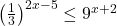 for all real values of . State the final answer using interval notation.
 and
and  , can be easily converted into a base of
 ![\[\frac{1}{3} = 3^{-1} \quad \text{and} \quad 9 = 3^2\]](https://mathematics.lu/wp-content/ql-cache/quicklatex.com-b3aa5ae5e7f0a12255b970eed046e9cf_l3.png "Rendered by QuickLaTeX.com")
![\[\left(3^{-1}\right)^{2x - 5} \le \left(3^2\right)^{x + 2}\]](https://mathematics.lu/wp-content/ql-cache/quicklatex.com-5680f5e1705466afaf22782ea6e8cc2e_l3.png "Rendered by QuickLaTeX.com")
![\[3^{-1(2x - 5)} \le 3^{2(x + 2)}\]](https://mathematics.lu/wp-content/ql-cache/quicklatex.com-85bce83589421f9039c5353bad4ebc2a_l3.png "Rendered by QuickLaTeX.com")
![\[3^{-2x + 5} \le 3^{2x + 4}\]](https://mathematics.lu/wp-content/ql-cache/quicklatex.com-e13bfd4e2501c2a96373d127a644ad97_l3.png "Rendered by QuickLaTeX.com")
 ), the exponential function
  is strictly increasing. This property ensures that the direction of the inequality remains unchanged when we equate the exponents directly:
![\[-2x + 5 \le 2x + 4\]](https://mathematics.lu/wp-content/ql-cache/quicklatex.com-57889b8cd2e440a0db52b7f593c11401_l3.png "Rendered by QuickLaTeX.com")
![\[-2x - 2x \le 4 - 5\]](https://mathematics.lu/wp-content/ql-cache/quicklatex.com-b64c05c5500f39a375c216990307472f_l3.png "Rendered by QuickLaTeX.com")
![\[-4x \le -1\]](https://mathematics.lu/wp-content/ql-cache/quicklatex.com-246f3d2979b5f5011d386dbbc725da38_l3.png "Rendered by QuickLaTeX.com")
![\[x \ge \frac{-1}{-4} \implies x \ge \frac{1}{4}\]](https://mathematics.lu/wp-content/ql-cache/quicklatex.com-b2e33c8eb910c97e5c717ccb6fab2ea4_l3.png "Rendered by QuickLaTeX.com")
![\[\left[\frac{1}{4}, \infty\right)\]](https://mathematics.lu/wp-content/ql-cache/quicklatex.com-fc6bc05dcbe9ac0ebf701e2e28127902_l3.png "Rendered by QuickLaTeX.com")
We can also use a graphic calculator to observe this. Let us see an example with a quadratic function in the power:
Example: Solve the exponential inequality 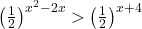 for all real values of . State the final solution using interval notation.
 ). Because the base satisfies
  , the exponential function
  is strictly decreasing. This means larger inputs produce smaller outputs. Therefore, when we drop the bases to compare the exponents, we must reverse the direction of the inequality sign:
![\[x^2 - 2x < x + 4\]](https://mathematics.lu/wp-content/ql-cache/quicklatex.com-c73cb781f3e45c1c8594999902fdfaa2_l3.png "Rendered by QuickLaTeX.com")
![\[x^2 - 2x - x - 4 < 0\]](https://mathematics.lu/wp-content/ql-cache/quicklatex.com-7caf1c9a3deb6810d084da68c3a06d01_l3.png "Rendered by QuickLaTeX.com")
![\[x^2 - 3x - 4 < 0\]](https://mathematics.lu/wp-content/ql-cache/quicklatex.com-411ce603466b830b3c84a5bf388a34f0_l3.png "Rendered by QuickLaTeX.com")
![\[(x - 4)(x + 1) = 0 \implies x = 4 \quad \text{or} \quad x = -1\]](https://mathematics.lu/wp-content/ql-cache/quicklatex.com-8b46956461501b4fd789eb65cbca6f6f_l3.png "Rendered by QuickLaTeX.com")
 ,
,  , and
, and  .
. across the number line boundaries to locate where it evaluates to strictly negative values (
 ):
):
![\[(-1, 4)\]](https://mathematics.lu/wp-content/ql-cache/quicklatex.com-54478ab58b8fdeb324522804a91436d3_l3.png "Rendered by QuickLaTeX.com")
Exercises
For each of the following exponential equations, solve for all real values of . State your answers as exact values, and simplify any fractions or radicals where applicable.







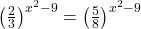
For each of the following exponential equations, the bases cannot be converted into a common integer power. Solve for all real values of using logarithms. State your final answer as a quotient using either natural logarithms () or any other logarithm, then approximate it.




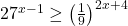
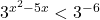
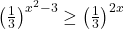
For each of the following exponential inequalities, find all real values of that satisfy the statement. Pay close attention to whether the base is greater than 1 or between 0 and 1, as this affects the inequality direction. State your final solution using interval notation.



![\[5^{\cos(x)} \le 5^{\sin(x)}\]](https://mathematics.lu/wp-content/ql-cache/quicklatex.com-3b385cb1bbd06d5da2f833b28ec2ddd5_l3.png "Rendered by QuickLaTeX.com")
restricted to the bounded interval  .
.