Previous Knowledge Required: Sequences and limits (S6).
A sequence  in an ordered list of items. We use the shorthand notation
  to refer to the
  -th term of the sequence, so that the symbol refers to a collection:
![\[\{u_n\}_{n=1}^\infty=\{u_1,u_2,u_3,...\}\]](https://mathematics.lu/wp-content/ql-cache/quicklatex.com-6d77b4c996884a57015ecaf23f5ae5f1_l3.png "Rendered by QuickLaTeX.com")
Quick Reminder from S6
Sometimes these sequences will be defined explicitly with some formula (possibly depending on ) and sometimes recursively (depending on previous terms of the sequence). We can use any letter  to refer to a specific sequence, and the subscript refers to the term in that place of the sequence. That is:
  refers to the first term of the sequence
  and so on. Some sequences may even start from a 0-th term, so that you may also see the notation
  to indicate the very first term in the sequence is
  .
.
Example: In an explicitly defined sequence, any term can be calculated directly using its position index (), without needing to know the preceding terms. Unlike arithmetic or geometric sequences that rely on constant addition or multiplication, explicit sequences can follow any mathematical function.
Consider the sequence defined explicitly by the non-linear rule:
![\[u_n = n^2 - n + 2 \quad \text{for } n \ge 1\]](https://mathematics.lu/wp-content/ql-cache/quicklatex.com-eac9e26e0376418c92f69758dee108c4_l3.png "Rendered by QuickLaTeX.com")
Using this explicit rule, the first 8 terms are evaluated directly by substituting the position values  through
  for :
for :
| Position () |
Direct Substitution Steps | Term Value () |
|---|---|---|
| 1 |  |
2 |
| 2 |  |
4 |
| 3 |  |
8 |
| 4 |  |
14 |
| 5 |  |
22 |
| 6 |  |
32 |
| 7 |  |
44 |
| 8 |  |
58 |
Therefore, the first 8 terms of this explicit sequence are: 2, 4, 8, 14, 22, 32, 44, 58 and we can replace any to find more and more terms.
We mentioned it already, but sequences can also be defined using one or more previous terms in the sequence. These are referred to as recursive sequences.
Example: The Fibonacci sequence is a classic example of a recursive sequence. Each term is generated by performing operations on the preceding terms. Specifically, each new number in this pattern is formed by calculating the sum of the two numbers immediately before it.
The sequence is formally defined by the mathematical rule:
![\[F_1 = 1\]](https://mathematics.lu/wp-content/ql-cache/quicklatex.com-ad101059b728dba95ecbb1710d8db1fb_l3.png "Rendered by QuickLaTeX.com")
![\[F_2 = 1\]](https://mathematics.lu/wp-content/ql-cache/quicklatex.com-4d65330ed6e8ce9c18893ffa1f1e5840_l3.png "Rendered by QuickLaTeX.com")
![\[F_n = F_{n-1} + F_{n-2} \quad \text{for } n \ge 3\]](https://mathematics.lu/wp-content/ql-cache/quicklatex.com-574abd924992f6f6ca1dd9cebfd20aa1_l3.png "Rendered by QuickLaTeX.com")
Following this recursive blueprint, the first 8 terms are computed as follows:
| Term Symbol | Recursive Calculation Steps | Resulting Value |
|---|---|---|
 |
Given Initial Baseline | 1 |
 |
Given Initial Baseline | 1 |
 |
 |
2 |
 |
 |
3 |
 |
 |
5 |
 |
 |
8 |
 |
 |
13 |
 |
 |
21 |
Therefore, the first 8 terms of the standard Fibonacci sequence are: 1, 1, 2, 3, 5, 8, 13, 21 and it continues forever.
You have also learned to do some basic limit calculation, though you will also expand on this topic in S7 when you begin the analysis unit.
Arithmetic Sequences
Definition (Arithmetic Sequence): An arithmetic sequence is a sequence of numbers where the difference between any consecutive terms is a constant value. This constant value is known as the common difference ( ).
).
The sequence can be defined recursively as:
![\[u_{n} = u_{n-1} + d \quad \text{for } n \ge 2\]](https://mathematics.lu/wp-content/ql-cache/quicklatex.com-93bfb0d60dd55419adf587706d405ada_l3.png "Rendered by QuickLaTeX.com")
Alternatively, it can be expressed explicitly using its initial term  as:
as:
![\[u_n = u_1 + (n - 1)d \quad \text{for } n \ge 1\]](https://mathematics.lu/wp-content/ql-cache/quicklatex.com-a0991aebbaede05fb1c63d4e93c9ce42_l3.png "Rendered by QuickLaTeX.com")
This alternative definition can be concluded very easily by looking at the terms of the sequence. If we add to go from to  and then again to go from to
  then we go from to by adding twice. This is what the 2nd formula is basically saying. To go from to we must add a total of
  times.
Example (Arithmetic Sequence): Consider an arithmetic sequence defined by its first term  and a common difference
  . Find the first 5 terms of the sequence, and compute the value of the
  term (
 ).
).




 ,
, ![\[u_{20} = u_1 + (20 - 1)d\]](https://mathematics.lu/wp-content/ql-cache/quicklatex.com-3da90a6ce970e31a529100a76d18b37f_l3.png "Rendered by QuickLaTeX.com")
![\[u_{20} = 5 + 19(3) = 5 + 57 = 62\]](https://mathematics.lu/wp-content/ql-cache/quicklatex.com-99511409a7230eb62058cd80bc33f193_l3.png "Rendered by QuickLaTeX.com")
We can also be asked to add terms in a sequence, and in the case of arithmetic sequences, we have a rather quick way of doing so.
Claim (Sum of terms in an Arithmetic Sequence): The sum of the first terms of an arithmetic sequence, denoted as  , can be evaluated using the first term and the common difference .
![\[S_n=\sum_{i=1}^n a_i=a_1+a_2+...+a_n = \frac{n\cdot(u_1+u_n)}{2}\]](https://mathematics.lu/wp-content/ql-cache/quicklatex.com-b84552add566a2c2818b4d025f814276_l3.png "Rendered by QuickLaTeX.com")
![\[\sum_{i=1}^n = u_1 + (u_1 + d) + (u_1 + 2d) + \dots + \left[u_1 + (n-2)d\right] + \left[u_1 + (n-1)d\right]\]](https://mathematics.lu/wp-content/ql-cache/quicklatex.com-e3b3d356dfa82078dd6fc68a3998f52f_l3.png "Rendered by QuickLaTeX.com")
 term:
term:![\[\sum_{i=1}^n = \left[u_1 + (n-1)d\right] + \left[u_1 + (n-2)d\right] + \dots + (u_1 + 2d) + (u_1 + d) + u_1\]](https://mathematics.lu/wp-content/ql-cache/quicklatex.com-529ca6c1d989c8d5b51edab4a575c397_l3.png "Rendered by QuickLaTeX.com")
 :
:![\[2\sum_{i=1}^n = \underbrace{\left[2u_1 + (n-1)d\right] + \left[2u_1 + (n-1)d\right] + \dots + \left[2u_1 + (n-1)d\right]}_{n \text{ times}}\]](https://mathematics.lu/wp-content/ql-cache/quicklatex.com-cb12e34c94213e57c97cc59a414d150a_l3.png "Rendered by QuickLaTeX.com")
![\[2\sum_{i=1}^n = n\left[2u_1 + (n-1)d\right] \implies S_n = \frac{n}{2}\Big[2u_1 + (n-1)d\Big]=\frac{n(u_1+u_n)}{2}\]](https://mathematics.lu/wp-content/ql-cache/quicklatex.com-5704497fff4c45d0ab42f17af9393ecd_l3.png "Rendered by QuickLaTeX.com")
Example (Finite Arithmetic Sum): An infrastructure project expands its solar grid capacity incrementally each month. In the first month, they install  solar panels. By the final month of the phase, month
  , their operational expansion rate reaches exactly
  panels installed that month. Calculate the total number of solar panels installed over this -month period.
 ) =
) = ![\[S_n = \frac{n}{2}(u_1 + u_n)\]](https://mathematics.lu/wp-content/ql-cache/quicklatex.com-c8615215b32c0651209e5d3e627d8aff_l3.png "Rendered by QuickLaTeX.com")
![\[S_{24} = \frac{24}{2}(14 + 106)\]](https://mathematics.lu/wp-content/ql-cache/quicklatex.com-bf0fd90a411500b87ea2a42671ba12a0_l3.png "Rendered by QuickLaTeX.com")
![\[S_{24} = 12 \times 120 = 1440\]](https://mathematics.lu/wp-content/ql-cache/quicklatex.com-c8ac9a1767d9175cda289383ad58a4e8_l3.png "Rendered by QuickLaTeX.com")
You could also be asked to find terms or the rule that defines an arithmetic sequences and use some of these formulas to understand the connection.
Example: For a given arithmetic sequence, the third term is  (
( ) and the fifth term is
  (
( ). Find the first term (), the common difference (), and state the general explicit rule for this sequence.
 . Substitute the parameters for both given terms:
![\[\begin{cases} u_3 = u_1 + (3 - 1)d \implies u_1 + 2d = 13 \quad \text{(Eq. 1)} \\ u_5 = u_1 + (5 - 1)d \implies u_1 + 4d = 21 \quad \text{(Eq. 2)} \end{cases}\]](https://mathematics.lu/wp-content/ql-cache/quicklatex.com-3ca78034607c3052070c144f0d4dbc81_l3.png "Rendered by QuickLaTeX.com")
![\[(u_1 + 4d) - (u_1 + 2d) = 21 - 13\]](https://mathematics.lu/wp-content/ql-cache/quicklatex.com-3171a17afa5d4047f76c602b6c2a714a_l3.png "Rendered by QuickLaTeX.com")
![\[2d = 8 \implies d = 4\]](https://mathematics.lu/wp-content/ql-cache/quicklatex.com-dce0412fecb096eaf083a76da0425eca_l3.png "Rendered by QuickLaTeX.com")
![\[u_1 + 2(4) = 13\]](https://mathematics.lu/wp-content/ql-cache/quicklatex.com-a8fdaf0df4688e9428a08635fe3d7e1e_l3.png "Rendered by QuickLaTeX.com")
![\[u_1 + 8 = 13 \implies u_1 = 5\]](https://mathematics.lu/wp-content/ql-cache/quicklatex.com-a0cad3855d6639b84a926b0625fea1ea_l3.png "Rendered by QuickLaTeX.com")
![\[u_n = 5 + (n - 1)4\]](https://mathematics.lu/wp-content/ql-cache/quicklatex.com-b2943974097d57367ef968f9d849d9ff_l3.png "Rendered by QuickLaTeX.com")
![\[u_n = 5 + 4n - 4 \implies u_n = 4n + 1 \quad \text{for } n \ge 1\]](https://mathematics.lu/wp-content/ql-cache/quicklatex.com-b90ff0dcc3a8e64f821740e8e93cc266_l3.png "Rendered by QuickLaTeX.com")
 .
.Geometric Sequences
Definition (Geometric Sequence): A geometric sequence is a sequence of numbers where each term after the first is found by multiplying the previous term by a fixed, non-zero constant value. This constant value is known as the common ratio ( or
or  depending on the source).
The sequence can be defined recursively as:
![\[u_{n} = r \cdot u_{n-1} \quad \text{for } n \ge 2\]](https://mathematics.lu/wp-content/ql-cache/quicklatex.com-b3bfd73880cf901b1a79d8ae56863da3_l3.png "Rendered by QuickLaTeX.com")
Alternatively, it can be expressed explicitly using its initial term as:
![\[u_n = u_1 \cdot r^{n-1} \quad \text{for } n \ge 1\]](https://mathematics.lu/wp-content/ql-cache/quicklatex.com-57be6783640c51b4b1fdde8763afe09a_l3.png "Rendered by QuickLaTeX.com")
Example (Geometric Sequence): Consider a geometric sequence defined by its first term  and a common ratio
  . Find the first 5 terms of the sequence, and compute the value of the
  term (
 ).
).
 :
:



 ,
, ![\[u_{10} = u_1 \cdot r^{10-1}\]](https://mathematics.lu/wp-content/ql-cache/quicklatex.com-364c11c538cba53f664938f412f13d6c_l3.png "Rendered by QuickLaTeX.com")
![\[u_{10} = 6 \cdot 2^9 = 6 \cdot 512 = 3072\]](https://mathematics.lu/wp-content/ql-cache/quicklatex.com-74c1fb6c973e93612f756f69155a7ee6_l3.png "Rendered by QuickLaTeX.com")
Claim (Sum of terms in a Geometric Sequence): The sum of the first terms of a geometric sequence with common ratio  is given by
  . If
. If  , the infinite sum
  converges to a fixed limit.
![\[S_n =\sum_{i=1}^n= u_1 \frac{1 - r^n}{1 - r} \quad \text{and} \quad S_\infty = \sum_{i=1}^\infty u_i=\frac{u_1}{1 - r} \,\, \text{for } |r| < 1\]](https://mathematics.lu/wp-content/ql-cache/quicklatex.com-7fa536ca8b3d5c738749150a5ac75b6c_l3.png "Rendered by QuickLaTeX.com")
![\[S_n = u_1 + u_1r + u_1r^2 + \dots + u_1r^{n-2} + u_1r^{n-1}\]](https://mathematics.lu/wp-content/ql-cache/quicklatex.com-33d982c1a476d1c9eb61c0012f297f2f_l3.png "Rendered by QuickLaTeX.com")
![\[rS_n = u_1r + u_1r^2 + u_1r^3 + \dots + u_1r^{n-1} + u_1r^n\]](https://mathematics.lu/wp-content/ql-cache/quicklatex.com-d748a68b8791a1c2e1f95ad93675894d_l3.png "Rendered by QuickLaTeX.com")
![\[S_n - rS_n = u_1 - u_1r^n\]](https://mathematics.lu/wp-content/ql-cache/quicklatex.com-69aecccb7f70348c8b5550fcd389bb71_l3.png "Rendered by QuickLaTeX.com")
![\[S_n(1 - r) = u_1(1 - r^n) \implies S_n = u_1 \frac{1 - r^n}{1 - r}\]](https://mathematics.lu/wp-content/ql-cache/quicklatex.com-a5ca7f43c4c27ef4e1255a72d30cd545_l3.png "Rendered by QuickLaTeX.com")
![\[S_\infty = \lim_{n \to \infty} S_n = \lim_{n \to \infty} \left( u_1 \frac{1 - r^n}{1 - r} \right)\]](https://mathematics.lu/wp-content/ql-cache/quicklatex.com-efa0fd56026ad6bde62e78ba4cb57917_l3.png "Rendered by QuickLaTeX.com")
 ):
):![\[S_\infty = u_1 \frac{1 - 0}{1 - r} = \frac{u_1}{1 - r}\]](https://mathematics.lu/wp-content/ql-cache/quicklatex.com-b66db2b879a57c11c3595a31e6f170ee_l3.png "Rendered by QuickLaTeX.com")
Another way of showing this claim is by using the identity:
![\[(1+x+x^2+...+x^{n-1})(x-1)=x^n-1\implies 1+x+x^2+...+x^{n-1}=\frac{x^n-1}{x-1}\]](https://mathematics.lu/wp-content/ql-cache/quicklatex.com-9c4b61474eb91c0c12f7796c96bcfed2_l3.png "Rendered by QuickLaTeX.com")
The left-hand side is a geometric sequence, starting from
and always being multiplied by  (or if you will). The difference between this and the formula above is a factor of that would otherwise be multiplying every term (when the sequence does not start with 1).
This yields an explanation to a very interesting phenomenon: we can have an infinite sum, where every term is positive, but the sum is finite. The next example will show this in detail.
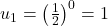
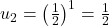
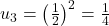
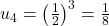
Example (Finite and Infinite Geometric Sequence Sums): Consider the geometric sequence defined explicitly by the rule  for
for  . The first few terms of this sequence are generated as follows:
For this sequence, evaluate the following metrics:
- Find the sum of the first terms of this sequence:
 .
. - Determine the exact limit of the sum of all terms () as the number of terms approaches infinity.

 )
) ,
,  , and
, and  into the finite geometric sum formula:
![\[S_n = u_1 \frac{1 - r^n}{1 - r}\]](https://mathematics.lu/wp-content/ql-cache/quicklatex.com-e1e68c76cfc2981f0a29dadea03a3553_l3.png "Rendered by QuickLaTeX.com")
![\[S_8 = 1 \cdot \frac{1 - \left(\frac{1}{2}\right)^8}{1 - \frac{1}{2}} = \frac{1 - \frac{1}{256}}{\frac{1}{2}}\]](https://mathematics.lu/wp-content/ql-cache/quicklatex.com-e56aa2ac7d1b873bc1e8131092b2a8d6_l3.png "Rendered by QuickLaTeX.com")
![\[S_8 = \frac{\frac{255}{256}}{\frac{1}{2}} = \frac{255}{256} \times 2 = \frac{255}{128} \quad (\text{or } 1.9921875)\]](https://mathematics.lu/wp-content/ql-cache/quicklatex.com-520e3ca148eeb27d0a6860050376447e_l3.png "Rendered by QuickLaTeX.com")
 (
( ), the infinite sum converges to a fixed structural limit. Apply the infinite sum formula:
![\[S_\infty = \frac{u_1}{1 - r}\]](https://mathematics.lu/wp-content/ql-cache/quicklatex.com-3441bd972c0071d8eedce6fef8efbc3a_l3.png "Rendered by QuickLaTeX.com")
![\[S_\infty = \frac{1}{1 - \frac{1}{2}} = \frac{1}{\frac{1}{2}} = 2\]](https://mathematics.lu/wp-content/ql-cache/quicklatex.com-0c9fbe299b3ab8f91ec870ad155b730f_l3.png "Rendered by QuickLaTeX.com")
 , and if the terms are added indefinitely, the total sum converges to exactly 2.
Another way of thinking about this example is the following: Imagine you have a glass of water you want to fill up. At first you fill half of it with water. Then you fill half of what is left (i.e.: thus far you have 3/4 of the glass filled). If you continue like this, you will end up with the glass full, but not overflowing. This is because you are always filling up half of what is left, so at any finite point you will always have a bit left from which only half is filled.
Example: A finite geometric sequence has  terms and a common ratio
  . Given that the sum of all terms with an odd index (
 ) is equal to
  , determine the first term () of the sequence.
 because we step forward by two positions at a time (
 ). Since
  .
.![\[\text{Odd Sum} = u_1 + u_3 + u_5 + u_7 + u_9\]](https://mathematics.lu/wp-content/ql-cache/quicklatex.com-5b1b545d34bb681621b37eb04200dd22_l3.png "Rendered by QuickLaTeX.com")
![\[1364 = u_1 + u_1(4) + u_1(4)^2 + u_1(4)^3 + u_1(4)^4\]](https://mathematics.lu/wp-content/ql-cache/quicklatex.com-0a1e8241122c8d7871164137fde82cca_l3.png "Rendered by QuickLaTeX.com")
![\[1364 = u_1(1 + 4 + 16 + 64 + 256)\]](https://mathematics.lu/wp-content/ql-cache/quicklatex.com-b3714e78235209515d0078bf9d3e150c_l3.png "Rendered by QuickLaTeX.com")
![\[1 + 4 + 16 + 64 + 256 = 341\]](https://mathematics.lu/wp-content/ql-cache/quicklatex.com-f5c7facad243381d0ed2053406c7c5bc_l3.png "Rendered by QuickLaTeX.com")
![\[1364 = 341u_1\]](https://mathematics.lu/wp-content/ql-cache/quicklatex.com-cdd24e527c9baeb6c82cb45f384d5c35_l3.png "Rendered by QuickLaTeX.com")
![\[u_1 = \frac{1364}{341} = 4\]](https://mathematics.lu/wp-content/ql-cache/quicklatex.com-b3e733d22288f2685cb107bd55595644_l3.png "Rendered by QuickLaTeX.com")
 .
.Combining Sequences
Sequences do not necessarily depend exclusively on , but rather could be defined using other sequences. Here is an example of such a sequence.
Example: Let  be defined by
![\[\begin{cases}u_0 = 1,\\u_{n+1} = 3u_n + 2 \quad (n \ge 0)\end{cases}\]](https://mathematics.lu/wp-content/ql-cache/quicklatex.com-5bc4424dfec4945722ea69cf94bdc7e4_l3.png "Rendered by QuickLaTeX.com")
Define a second sequence  by
by
![\[v_n = u_n + 1.\]](https://mathematics.lu/wp-content/ql-cache/quicklatex.com-122962746bec77735efa15f090bafcb8_l3.png "Rendered by QuickLaTeX.com")
- Show that is a geometric sequence.
- Determine its common ratio and first term.
- Find an explicit formula for
 .
. - Deduce an explicit formula for .
 and verify that
  evaluates to a constant ratio independent of
 ![\[v_{n+1} = u_{n+1} + 1\]](https://mathematics.lu/wp-content/ql-cache/quicklatex.com-14f3efd999c4c200fdf53318ab27bf15_l3.png "Rendered by QuickLaTeX.com")
 into the expression:
![\[v_{n+1} = (3u_n + 2) + 1 = 3u_n + 3\]](https://mathematics.lu/wp-content/ql-cache/quicklatex.com-75996bb7b57e74b5a267b92bb7f809df_l3.png "Rendered by QuickLaTeX.com")
![\[v_{n+1} = 3(u_n + 1)\]](https://mathematics.lu/wp-content/ql-cache/quicklatex.com-38e005e965732b444551e3d569e4e801_l3.png "Rendered by QuickLaTeX.com")
 , we substitute it back to obtain the recurrence relationship:
![\[v_{n+1} = 3v_n \implies \frac{v_{n+1}}{v_n} = 3\]](https://mathematics.lu/wp-content/ql-cache/quicklatex.com-c6dc268f994f21223afaf074d3b32b32_l3.png "Rendered by QuickLaTeX.com")
 .
. . Evaluate
  :
:
![\[v_0 = u_0 + 1 = 1 + 1 = 2\]](https://mathematics.lu/wp-content/ql-cache/quicklatex.com-7bd86b4807b16066379670910606d97b_l3.png "Rendered by QuickLaTeX.com")
 . Substitute our specific parameters:
![\[v_n = 2 \cdot 3^n \quad \text{for } n \ge 0\]](https://mathematics.lu/wp-content/ql-cache/quicklatex.com-27691aedc8d28a9c9edcb7bea022b67c_l3.png "Rendered by QuickLaTeX.com")
![\[u_n = v_n - 1\]](https://mathematics.lu/wp-content/ql-cache/quicklatex.com-d9b16d6330881ab6e516e91a0c0bc9bf_l3.png "Rendered by QuickLaTeX.com")
![\[u_n = 2 \cdot 3^n - 1 \quad \text{for } n \ge 0\]](https://mathematics.lu/wp-content/ql-cache/quicklatex.com-6bf8717badf3d53b15e3767533789349_l3.png "Rendered by QuickLaTeX.com")
Exercises
Consider an arithmetic sequence defined by its first term  and a common difference
  . Solve the following sub-problems:
- 1. Write down the first
 terms of this sequence.
 - 2. State the explicit rule for the general term of the sequence.
- 3. Find the value of the
 term (
 ).
). - 4. Calculate the sum of the first
 terms of this sequence (
 ).
).
Consider a geometric sequence defined by its first term  and a common ratio . Solve the following sub-problems:
- 1. Write down the first terms of this sequence.
- 2. State the explicit rule for the general term of the sequence.
- 3. Find the value of the
 term (
 ).
). - 4. Calculate the sum of the first terms of this sequence (
 ).
).
Consider a sequence defined explicitly by the rule  for . Solve the following sub-problems:
- 1. Write down the first
 terms of this sequence to observe the initial pattern.
 - 2. Write an algebraic expression for the next consecutive term,
 , in terms of .
 - 3. Prove that the sequence is arithmetic by expanding and simplifying the difference expression
 .
. - 4. State the first term () and the common difference () of this sequence based on your proof.
Consider a sequence defined explicitly by the rule  for . Solve the following sub-problems:
- 1. Write down the first terms of this sequence to observe the initial pattern.
- 2. Write an algebraic expression for the next consecutive term, , in terms of .
- 3. Prove that the sequence is geometric by simplifying the quotient expression
 using index laws.
 - 4. State the first term () and the common ratio () of this sequence based on your proof.
Consider a geometric sequence defined explicitly by the rule 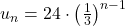 for . Solve the following sub-problems:
- 1. Write down the first terms of this sequence to observe the initial scaling.
- 2. Identify the first term () and the common ratio ().
- 3. State why this geometric sequence is guaranteed to converge as the number of terms approaches infinity.
- 4. Use the infinite sum formula to calculate the sum of all terms.
Let be defined by the recurrence relation:
![\[\begin{cases}u_0 = 3, \\u_{n+1} = 2u_n + 5 \quad (n \ge 0)\end{cases}\]](https://mathematics.lu/wp-content/ql-cache/quicklatex.com-c52a8f64adade39849c9f4032df3d96f_l3.png "Rendered by QuickLaTeX.com")
Define an auxiliary sequence by the translation rule:
![\[v_n = u_n + 5.\]](https://mathematics.lu/wp-content/ql-cache/quicklatex.com-7715d0cb420ef5a883d4e821253bad6c_l3.png "Rendered by QuickLaTeX.com")
- 1. Show algebraically that forms a geometric sequence.
- 2. Determine the common ratio () and the first term (
 ) of this sequence framework.
 - 3. Find an explicit formula for in terms of .
- 4. Deduce an explicit formula for the original sequence in terms of .
Let be defined by the recurrence relation:
![\[\begin{cases}u_0 = 4, \\ u_{n+1} = 4u_n - 9 \quad (n \ge 0)\end{cases}\]](https://mathematics.lu/wp-content/ql-cache/quicklatex.com-ad8ca9f993764de5b561578ce264c8b5_l3.png "Rendered by QuickLaTeX.com")
Define an auxiliary sequence by the translation rule:
![\[v_n = u_n - 3.\]](https://mathematics.lu/wp-content/ql-cache/quicklatex.com-01faa09605a99101a6c1b83a73d93b52_l3.png "Rendered by QuickLaTeX.com")
- 1. Show algebraically that forms a geometric sequence.
- 2. Determine the common ratio () and the first term () of this sequence framework.
- 3. Find an explicit formula for in terms of .
- 4. Deduce an explicit formula for the original sequence in terms of .
Let be defined by the recurrence relation:
![\[\begin{cases}u_0 = 1,\\ u_{n+1} = 5u_n - 8 \quad (n \ge 0)\end{cases}\]](https://mathematics.lu/wp-content/ql-cache/quicklatex.com-2b61cbbc11730e4cc8538e959f815e5f_l3.png "Rendered by QuickLaTeX.com")
Define an auxiliary sequence by the translation rule:
![\[v_n = u_n - 2.\]](https://mathematics.lu/wp-content/ql-cache/quicklatex.com-2d6fcfa3296abce04735392e70c1b6f8_l3.png "Rendered by QuickLaTeX.com")
- 1. Show algebraically that forms a geometric sequence.
- 2. Determine the common ratio () and the first term () of this sequence framework.
- 3. Find an explicit formula for in terms of .
- 4. Deduce an explicit formula for the original sequence in terms of .